What Does Architectural Rendering Actually Cost Right Now?

🔢 Quick Numbers
- 44% of architects now use AI to generate concept images (Chaos & Architizer, State of Architectural Visualization Report 2024-2025)
- AI rendering reduces visualization costs by 90-99% compared to traditional studio outsourcing (AI Architectures, 2026)
- Standard architectural still images cost $500-$3,000 per image from traditional providers; AI platforms charge $10-$50/month for hundreds of renders (multiple industry sources, 2026)
Pricing by Rendering Type

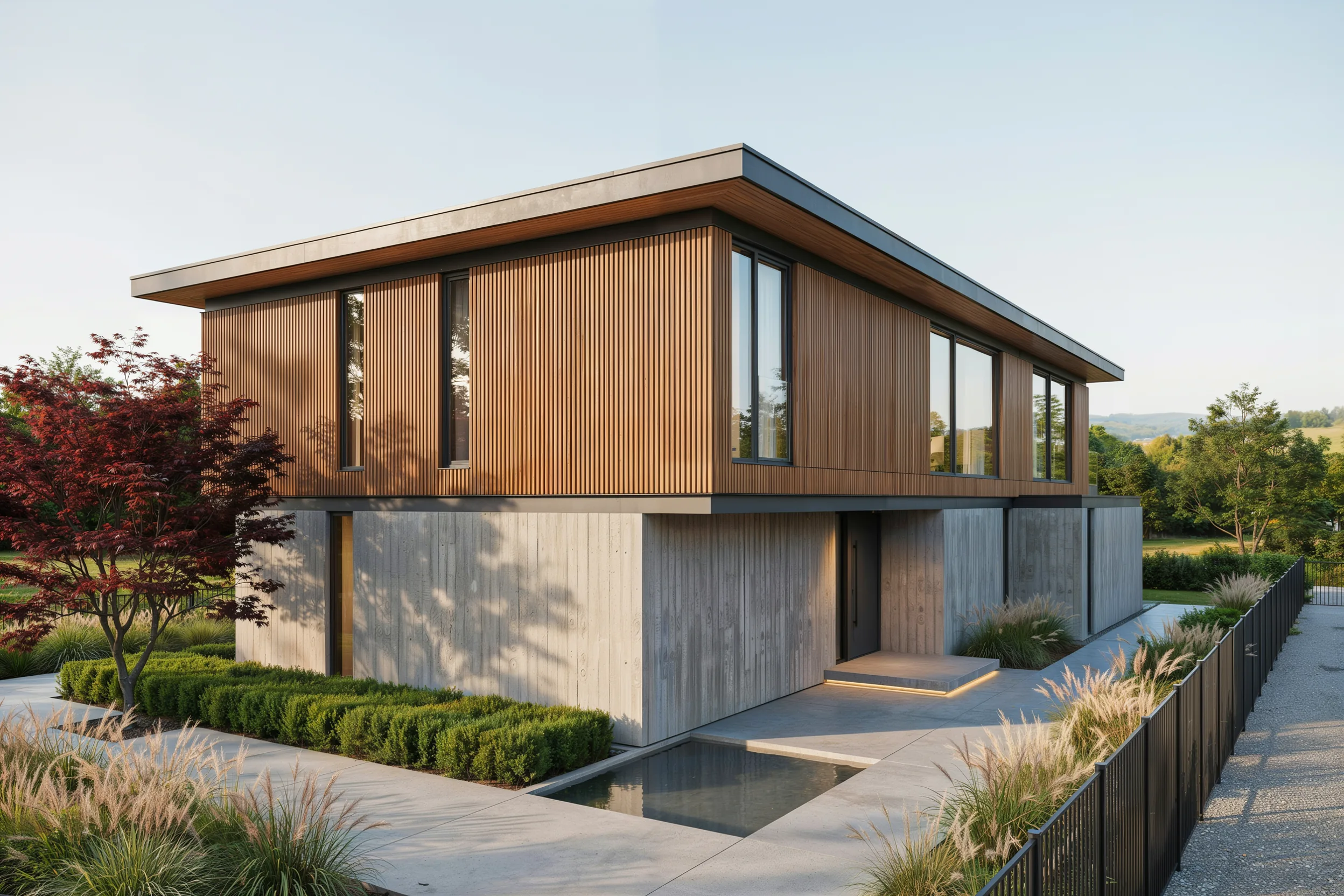
Exterior Rendering Costs
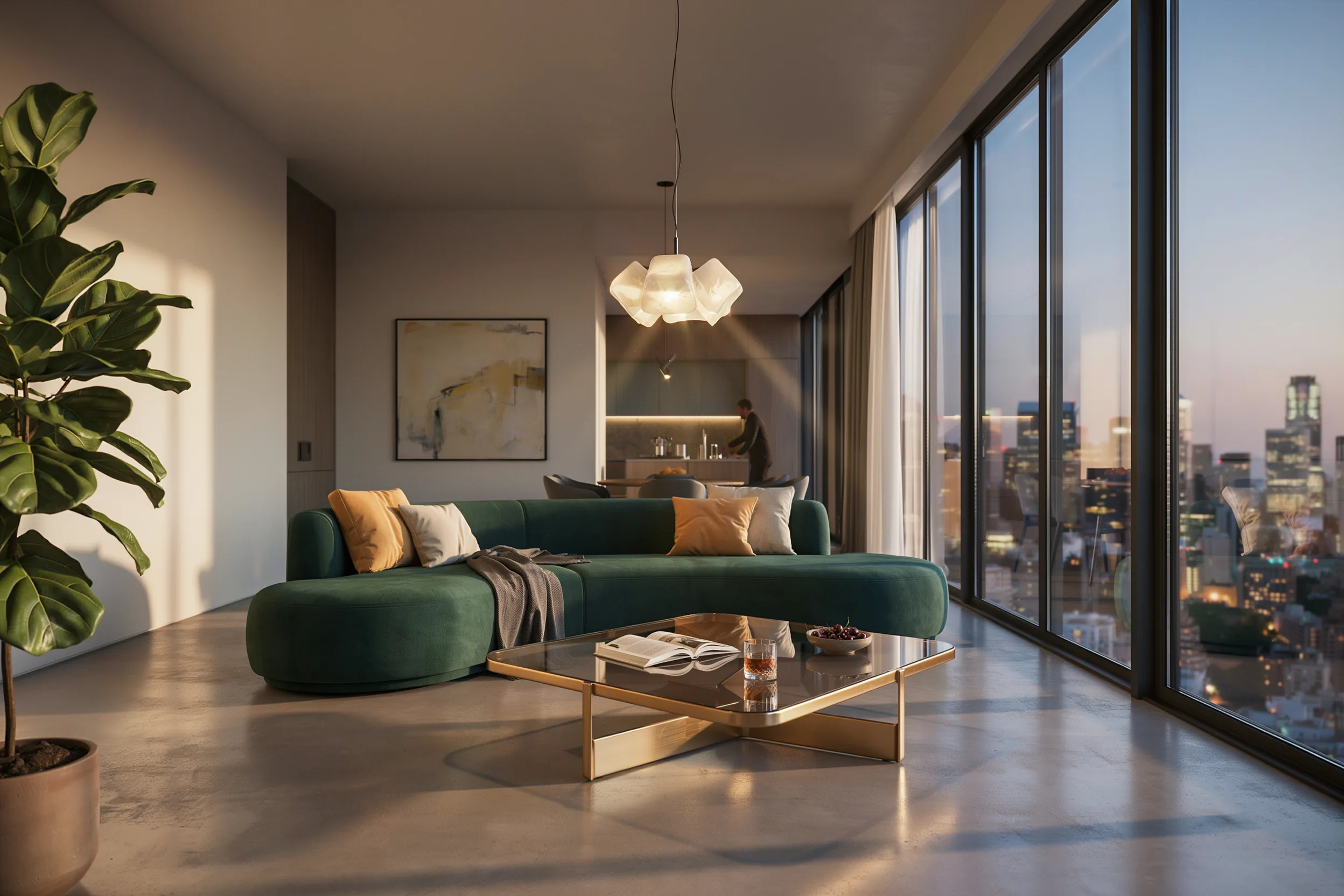
Interior Rendering Costs

3D Animation and Walkthrough Costs
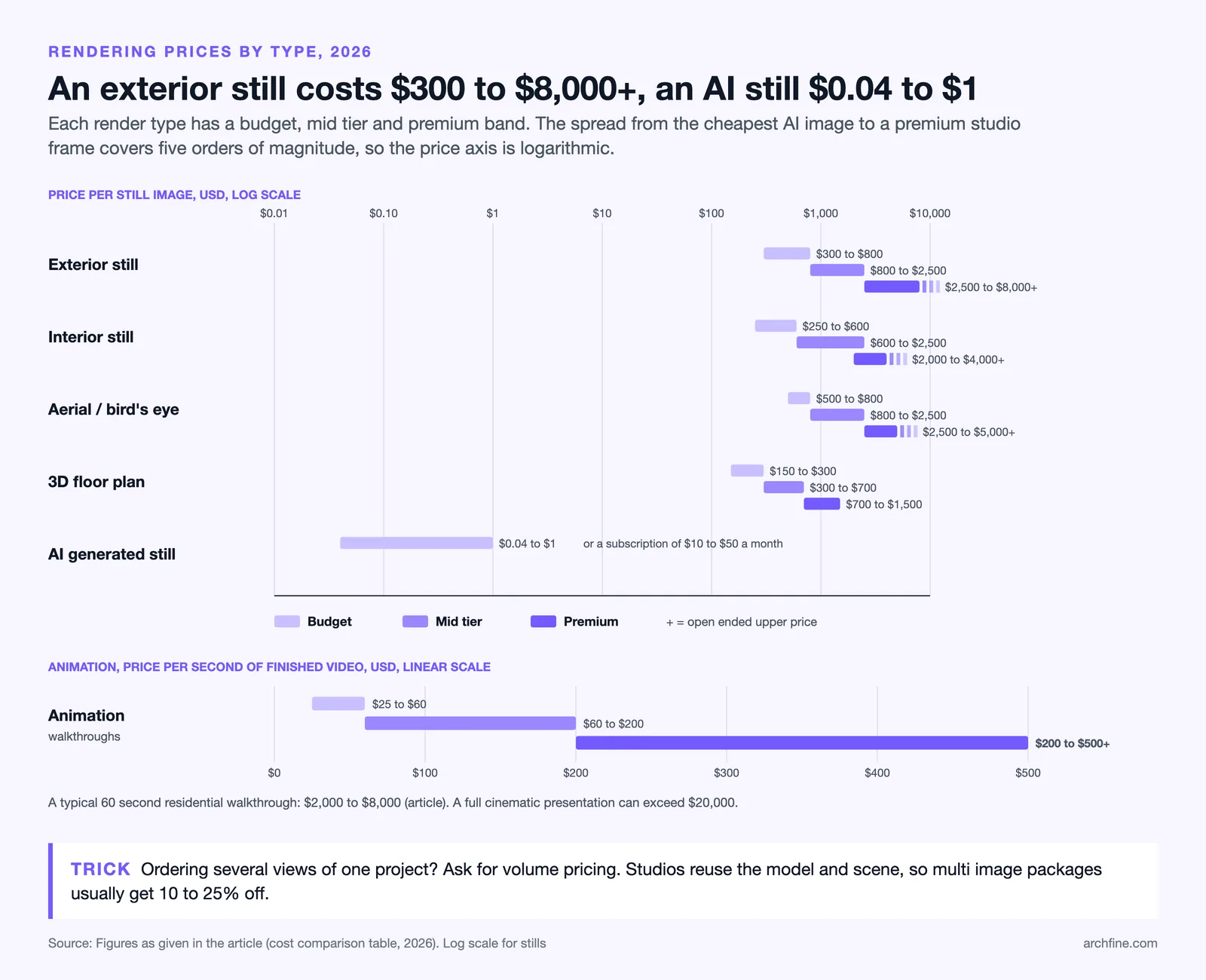
Cost Comparison Table by Render Type
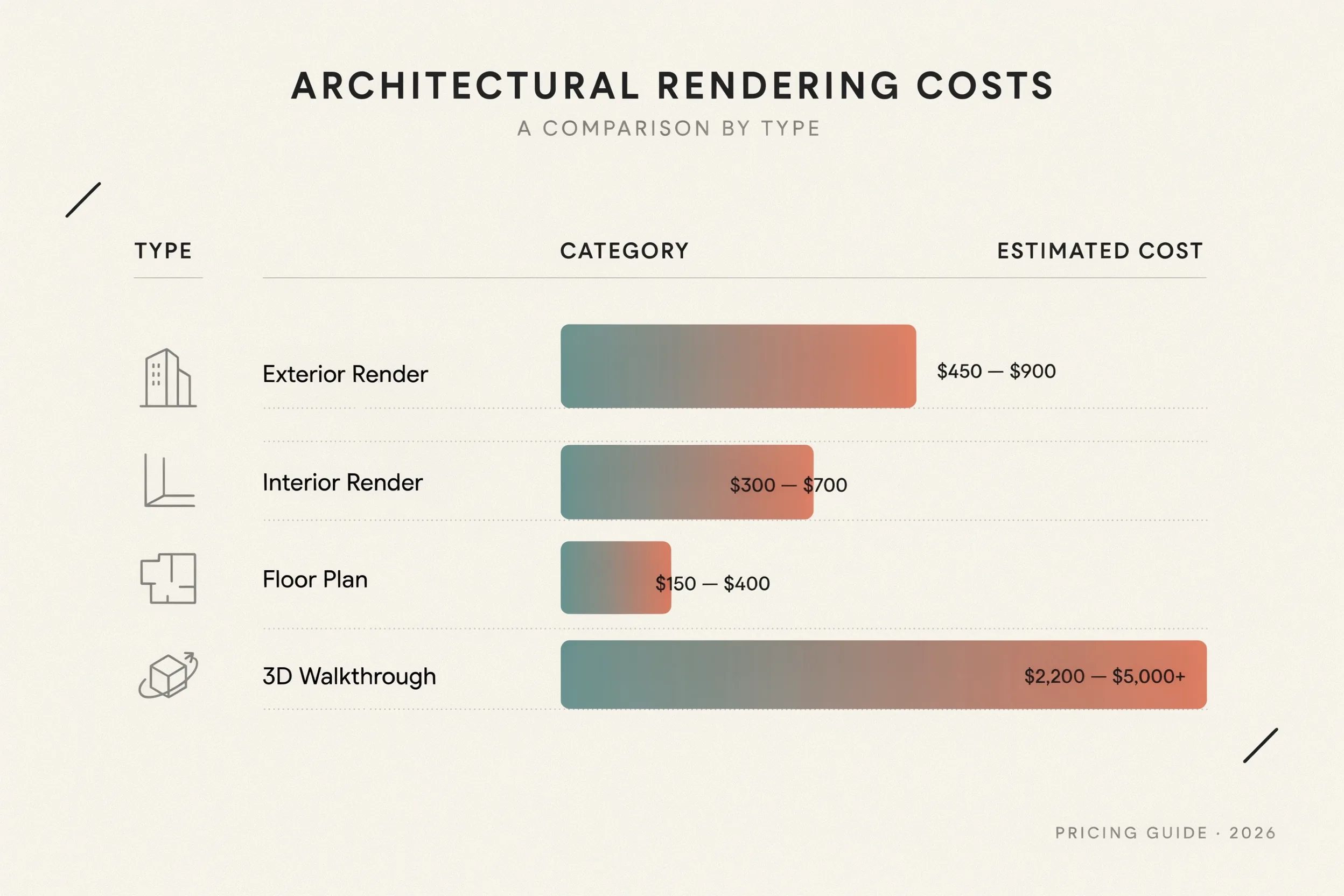
| Render Type | Budget Range | Mid-Tier Range | Premium Range |
|---|---|---|---|
| Exterior Still | $300 – $800 | $800 – $2,500 | $2,500 – $8,000+ |
| Interior Still | $250 – $600 | $600 – $2,500 | $2,000 – $4,000+ |
| Aerial / Bird’s Eye | $500 – $800 | $800 – $2,500 | $2,500 – $5,000+ |
| 3D Floor Plan | $150 – $300 | $300 – $700 | $700 – $1,500 |
| Animation (per second) | $25 – $60 | $60 – $200 | $200 – $500+ |
| AI-Generated Still | $0.04 – $1 | Included in subscription | $10 – $50/month |
💡 Pro Tip
If you are ordering multiple renders for the same project, always ask about volume pricing. Most studios offer 10-25% discounts on multi-image packages because they reuse the 3D model, materials, and scene setup across different camera angles. Ordering six views individually almost always costs more than bundling them upfront.
Architectural Rendering Cost by Provider Type


Freelance 3D Artists: $300 – $1,200 per Image
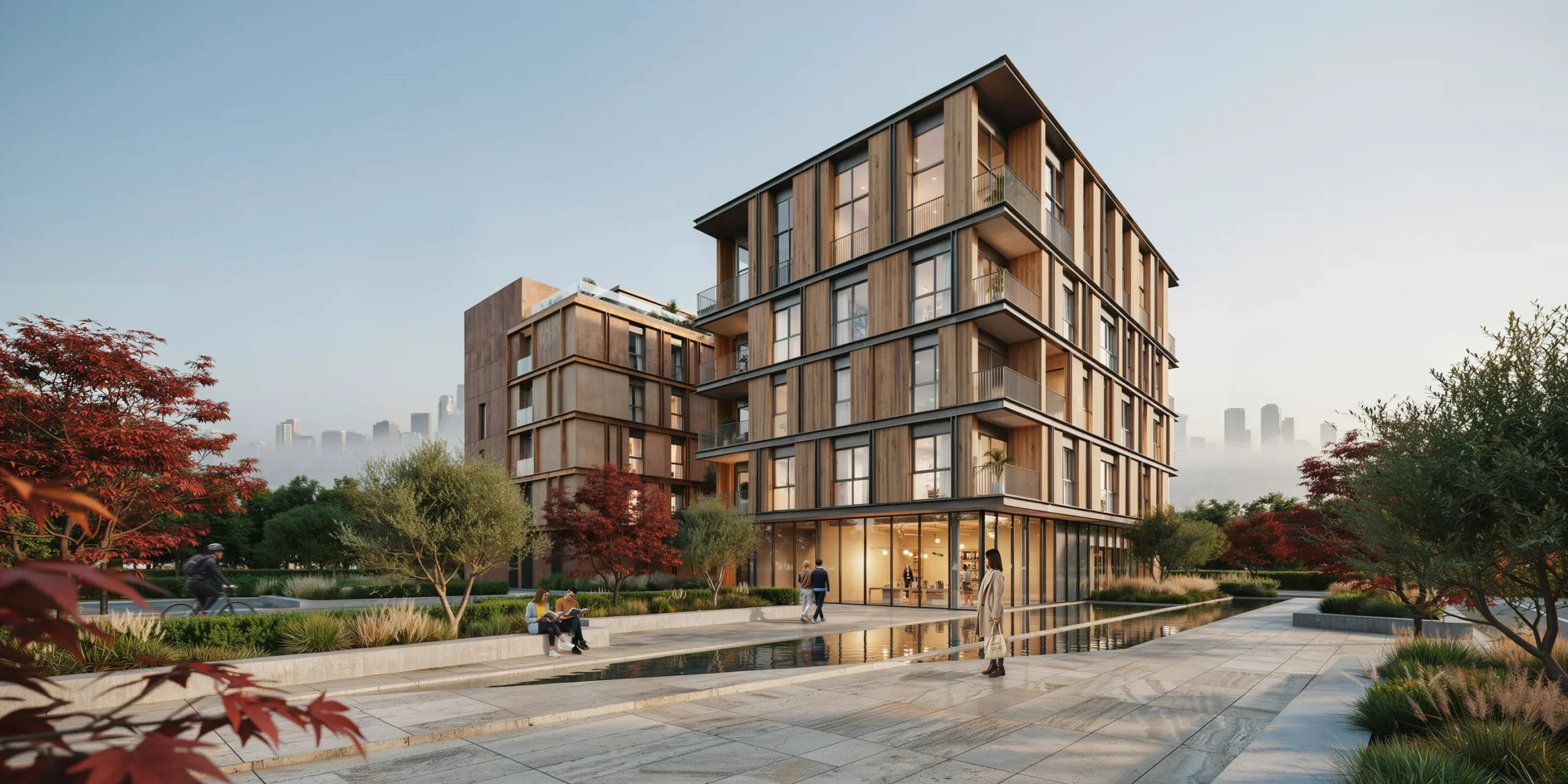
Mid-Tier Rendering Studios: $800 – $2,500 per Image
Mid-tier studios typically employ dedicated teams with established production pipelines. They offer more predictable quality, structured revision rounds, and professional project management. Turnaround times usually fall between 5 and 10 business days for standard still images. These studios represent the sweet spot for most commercial and residential projects that need reliable, presentation-ready visuals without the premium pricing of boutique firms.High-End Visualization Studios: $2,000 – $8,000+ per Image
Premium studios deliver art-directed, portfolio-grade images with careful attention to lighting, atmosphere, and storytelling. These firms often work on landmark projects, competition entries, and luxury real estate marketing. Turnaround times run 1 to 3 weeks, and the process typically involves close collaboration between the studio’s creative team and the architect. You are paying for a level of visual artistry and brand consistency that mid-tier options rarely match.In-House Rendering Teams: $150 – $500 per Image (Amortized)
Building an in-house visualization capability looks attractive on a per-image basis, but the upfront investment is significant. Hardware costs start at $10,000 or more for a capable workstation. Annual software licenses for tools like V-Ray, 3ds Max, or Cinema 4D run $2,000 to $5,000. And then there is the salary: a skilled architectural visualizer in the US commands $60,000 to $90,000 per year, according to salary data tracked by the American Institute of Architects (AIA) and industry benchmarking reports. For firms producing 50 or more renders per month, the amortized per-image cost can drop below $200. For everyone else, the fixed overhead rarely justifies the investment.⚠️ Common Mistake to Avoid
Many firms compare per-image prices without factoring in revision costs, communication overhead, and turnaround delays. A $500 render that requires three paid revision rounds and takes two weeks to finalize can end up costing more in real terms than a $1,200 render delivered correctly the first time. Always compare total project cost, not just the initial quote.
AI Rendering Platforms: $10 – $50 per Month
What Factors Drive Architectural Rendering Prices Up?
Understanding the cost drivers helps you avoid surprise invoices and gives you levers to optimize your budget.Project Scale and Scene Complexity
A single-family home exterior is a fundamentally different production task than an aerial view of a 500-unit residential development. The number of objects in the scene, the complexity of building geometry (smooth organic forms cost more than rectangular boxes), and the density of the surrounding environment all affect how long a scene takes to model, light, and render. Simple geometry equals lower cost. Complex organic forms, detailed facades, and dense landscaping push prices higher.Level of Realism and Detail
A conceptual render with simplified materials and basic lighting costs a fraction of a fully photorealistic image with physically accurate material properties, global illumination, and high-resolution textures. The jump from “good enough for internal review” to “indistinguishable from a photograph” often doubles the production time and cost. Be honest about what level of quality each deliverable actually requires, and you can save significantly.Turnaround Time
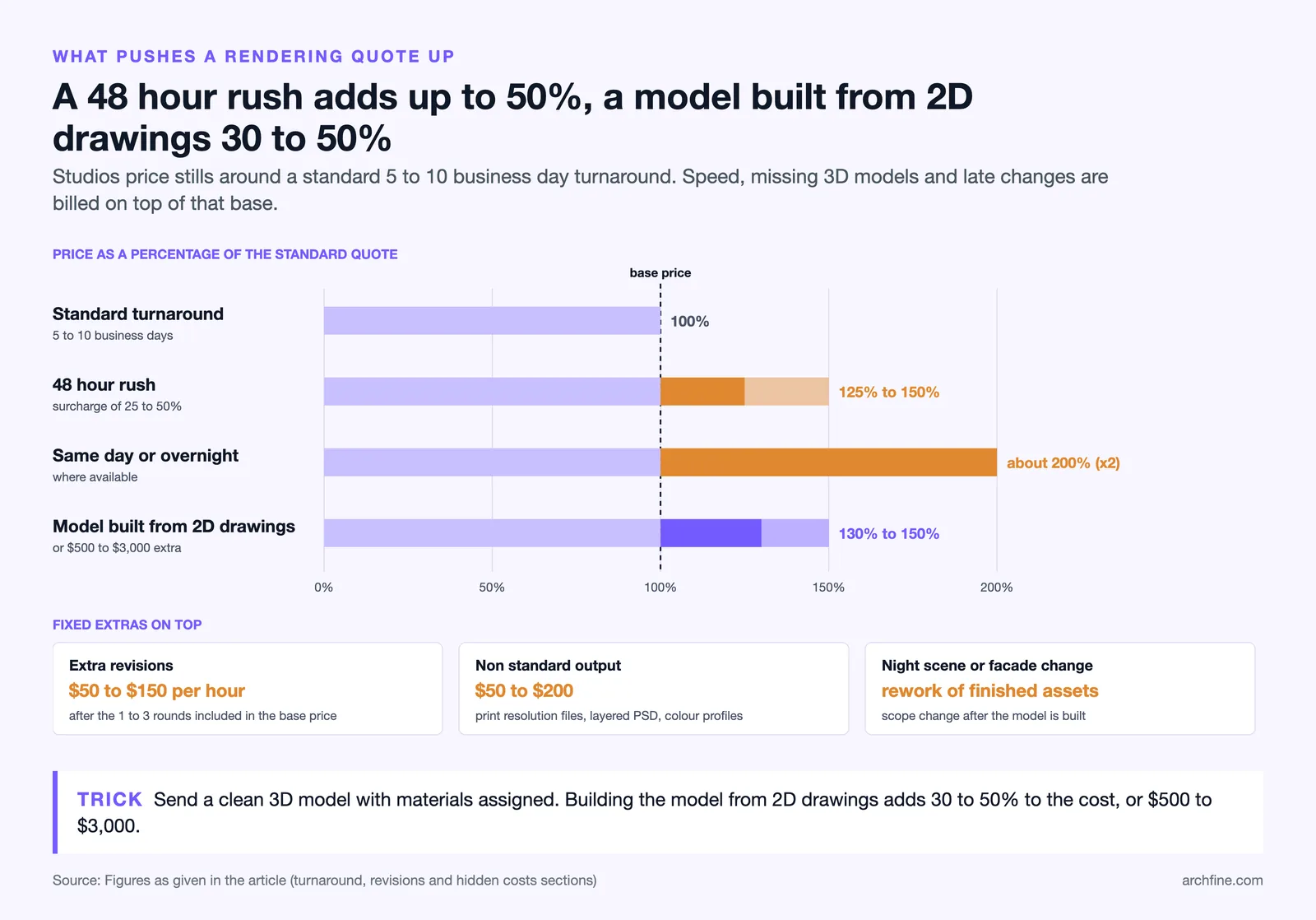
Rush fees are standard across the industry. Most studios build their base pricing around a standard turnaround of 5 to 10 business days for still images. Asking for delivery within 48 hours typically adds a 25-50% surcharge. Same-day or overnight delivery, where available, can double the base price. Planning your visualization needs early in the project timeline is one of the simplest ways to keep architectural rendering cost under control.💡 Pro Tip
Providing a clean, detailed 3D model is the single most effective way to reduce your visualization costs. When the rendering studio has to build the 3D model from 2D drawings, it can add 30-50% to the total cost. Exporting a well-organized SketchUp, Revit, or Rhino model with correct materials assigned saves the studio hours of prep work, and those savings get passed to you.
Revisions and Scope Changes
Most studios include 1 to 3 rounds of revisions in their base price. Anything beyond that is billed at an hourly rate, typically $50 to $150 per hour. Scope changes mid-project, like switching from a daytime to a nighttime scene or changing the building’s facade material after the model is built, are even more expensive because they require reworking completed assets. A detailed, well-organized brief at the start of the project minimizes revision rounds and keeps costs predictable.Geographic Location of the Provider
Studio location significantly affects pricing. A 2026 pricing comparison from industry sources puts offshore rates (Eastern Europe, South Asia, Southeast Asia) at $200 to $800 per exterior still, compared to $800 to $4,000 for US and Western European firms. The quality gap between top-tier offshore studios and domestic providers has narrowed considerably, though communication efficiency and timezone alignment remain practical considerations for project management.How to Reduce Your Architectural Rendering Cost
Budget-conscious firms are not necessarily choosing cheaper providers. They are being smarter about when, how, and what they render. Start by matching the rendering method to the project phase. There is no reason to commission a $2,500 photorealistic exterior for an early concept review. AI rendering tools can produce dozens of concept variations in minutes at negligible cost, allowing you to test materials, massing, and styles before committing budget to high-end visualization. Platforms like ArchFine let you upload sketches, CAD drawings, or 3D screenshots and receive photorealistic renders in seconds, which makes them ideal for the schematic design phase. Bundle your rendering needs into packages rather than ordering images individually. Studios reuse the 3D model and scene setup across multiple camera angles, and multi-image projects typically receive a 10-25% discount per image compared to single-image orders. A developer marketing a 50-unit residential project, for example, will get far better per-image rates on a 10-view package than on 10 separate orders. Provide the best possible input files. Clean 3D models with properly assigned materials, reference images for mood and style direction, and a clear written brief all reduce the studio’s prep time. Every hour saved on model cleanup, material research, and communication overhead translates directly into lower costs for you.🏗️ Real-World Example
Small Architecture Firm, Annual Comparison: A firm handling 20 projects per year, each needing approximately 5 rendered images, produces 100 total renders annually. Outsourcing those at an average of $1,500 per image totals $150,000. Switching to an AI-first workflow for concept and development phases (roughly 80% of renders) and reserving traditional renders for final marketing deliverables (20%) brings the total to approximately $30,000, a reduction of about 80% while maintaining premium quality where it matters most.
AI Rendering vs Traditional Studio: When to Use Each
The question is no longer “AI or traditional” but “AI when and traditional when.” The majority of forward-thinking architectural firms have adopted a hybrid approach, and the cost savings are significant. AI rendering excels during RIBA Stages 0-2 (or AIA Schematic Design), where you need to explore options quickly and cheaply. Testing how a building looks in different architectural styles, generating quick visuals for feasibility studies, producing multiple material options for a client meeting, or creating social media content on a tight schedule are all ideal use cases. The speed advantage is also striking: a traditional high-quality render takes 4-8 hours of production time, while an AI render takes 30-60 seconds. Traditional rendering still wins for final marketing materials, luxury real estate campaigns, competition entries where every pixel is scrutinized, and construction documentation visuals. The ability to manually control every material property, lighting angle, and camera setting gives traditional renderers a precision edge that AI tools have not fully matched. Industry coverage on platforms like ArchDaily confirms that traditional studios remain the standard for final deliverables on landmark projects. For a deeper look at how these two approaches compare visually, see our guide on photorealistic vs stylized renders and what each approach achieves at different project stages.⚖️ Pros & Cons at a Glance
✔️ AI Rendering Pros: Near-instant output, extremely low cost per image, unlimited iteration, no hardware investment
✖️ AI Rendering Cons: Less pixel-level control, occasional geometry inconsistencies, not yet ideal for construction-level detail
Hidden Costs to Watch For
The quoted price per image rarely tells the full story. Several cost categories frequently catch firms off guard. Revision fees beyond the included rounds can accumulate fast, especially when client feedback arrives in waves rather than consolidated batches. Some studios charge per-revision-round while others bill hourly for changes, and the difference can be significant. Clarify the revision policy in writing before work begins. Model preparation charges apply when you provide 2D drawings instead of a 3D model. The studio must build the digital model from scratch, which can add $500 to $3,000 depending on building complexity. If you have an in-house team working in Revit, SketchUp, or Rhino, exporting a clean model file eliminates this cost entirely. Licensing and usage rights deserve attention. Most studios grant commercial usage rights by default, but some restrict usage to specific media (print vs digital) or charge extra for extended licensing. AI platforms like ArchFine include full commercial rights on all paid plans, which simplifies the legal picture considerably. Post-production and final delivery formats can also add costs. If you need print-resolution files (300 DPI at large dimensions), layered PSD files for your marketing team, or specific color profiles, confirm these are included in the base quote. Some studios charge $50 to $200 extra for non-standard output formats.Is Architectural Rendering Worth the Investment?
The relevant question is not “how much does a render cost?” but “what is the cost of not having one?” Consider a real estate developer selling 50 apartments at $300,000 each. A complete rendering package for the entire project might cost $7,000 to $15,000, which is less than 0.1% of the gross development value. If those renders help secure even one additional pre-sale before construction, they have paid for themselves several times over. For architects, the return on visualization investment shows up in higher client approval rates, fewer design revisions during construction, and faster planning approvals. According to industry data, integrating rendering early in the design process can reduce overall project costs by up to 30% through earlier detection of design issues and faster stakeholder alignment. Understanding what makes a great architectural render helps you direct your budget toward visuals that actually drive results rather than just looking impressive.🎓 Expert Insight
According to the Chaos and Architizer State of Architectural Visualization Report 2024-2025, still images remain the most valued visualization format among architects and their clients, with 85% of architects regularly facing client requests for revisions on their renderings. This confirms that budgeting for revisions, not just initial production, is critical to realistic cost planning.
✅ Key Takeaways
- Architectural rendering cost in 2026 spans from under $1 per AI-generated image to $8,000+ for premium studio work, depending on method, complexity, and turnaround time.
- AI rendering platforms have made concept-phase visualization nearly free, with subscriptions starting at $10-$50 per month for hundreds of renders.
- The hybrid workflow (AI for concept phases, traditional for final deliverables) reduces total annual visualization spending by 40-60% for most firms.
- Providing clean 3D models, bundling multi-image orders, and planning timelines early are the three most practical ways to reduce costs with any provider.
- Always compare total project cost including revisions, model prep, and licensing rather than just the quoted per-image rate.