Photorealistic vs stylized renders represent two fundamentally different approaches to architectural visualization, and each one triggers a different response from clients. Photorealistic renders excel at building trust and closing deals on final designs, while stylized renders spark creative conversations and speed up early-stage approvals. The right choice depends on your project phase, client type, and presentation goals.
Every architect and designer faces this decision at some point: should you invest hours into a pixel-perfect photorealistic image, or present a stylized concept render that communicates the mood and intent without pretending to be a photograph? The answer is rarely straightforward. Residential clients shopping for their dream home react very differently to visuals than a commercial developer evaluating ROI on a mixed-use project. Understanding these differences is not optional anymore. With rendering technology evolving rapidly, architects who pick the wrong style at the wrong time risk losing projects to competitors who know how to match the visual to the moment.
This guide breaks down both rendering approaches, compares their strengths, and gives you a practical framework for choosing the right one at every stage of a project.
What Are Photorealistic Renders in Architecture?
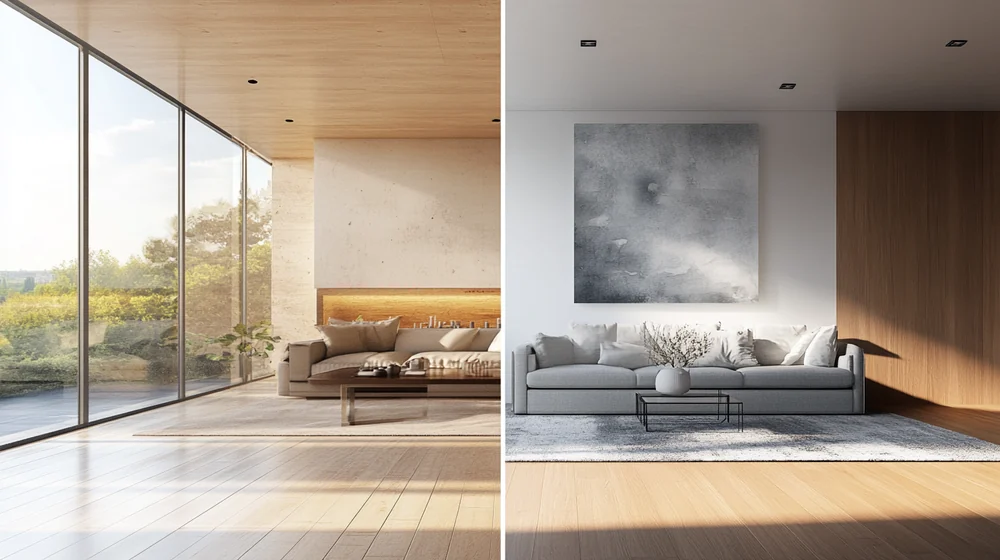
Photorealistic architectural renders aim to produce images that are virtually indistinguishable from real photographs. They simulate accurate lighting, material properties, reflections, shadows, and environmental context so convincingly that viewers perceive the unbuilt space as if it already exists. This level of realism is achieved through physically based rendering (PBR) materials, global illumination algorithms, and high-resolution texture mapping.
The technology behind photorealistic rendering has matured significantly. Tools like V-Ray, Corona Renderer, Lumion, and Enscape allow architects to produce images that capture everything from the grain of a walnut floor to the way afternoon sunlight filters through curtain fabric. AI-powered platforms, including tools like ArchFine, are making this process even faster by generating high-quality photorealistic outputs from sketches and basic 3D models in seconds rather than hours.
The core strength of photorealistic rendering lies in emotional certainty. When a client sees a photorealistic image of their future living room bathed in warm evening light, they stop imagining and start believing. That shift from imagination to belief is where purchase decisions happen.

💡 Pro Tip
When presenting photorealistic renders to residential clients, always include at least one “lived-in” detail: a slightly open book on a coffee table, a jacket draped over a chair, or steam rising from a cup. These small imperfections prevent the sterile “CG look” and make the space feel real and attainable. Experienced visualization artists call this “dressing the scene,” and it consistently increases positive client reactions.
What Are Stylized Renders in Architecture?
Stylized renders deliberately step away from photorealism. They use artistic techniques like watercolor washes, sketch overlays, clay renders, collage compositions, diagrammatic styles, or abstract material palettes to communicate a design concept without committing to exact material or lighting choices. The goal is to show the intent and spatial quality of a design rather than its final appearance.
This category covers a wide range of visual styles. A white clay render strips away color and texture to focus purely on form and volume. A watercolor-style visualization suggests atmosphere and mood without locking in specific finishes. A collage render combines photography, hand-drawn elements, and digital overlays to tell a story about how a space will feel rather than how it will look. These non-photorealistic approaches are widely discussed in architectural media outlets like ArchDaily as essential tools for conceptual communication. Each style serves a different communicative purpose, but they all share one trait: they invite discussion rather than demanding approval.
Stylized rendering has seen a resurgence in recent years, partly as a reaction to the ubiquity of photorealism. As rendering techniques continue to evolve, many architects find that presenting an overly polished image too early in the process actually slows things down. Clients fixate on material choices or furniture selections instead of evaluating spatial layout and massing, which are the decisions that actually matter at the conceptual stage.
How Does Each Rendering Style Affect Client Decision-Making?
The psychology behind client reactions to different rendering styles is more nuanced than most architects realize. Photorealistic renders trigger what cognitive psychologists call “processing fluency,” meaning the brain interprets them as real environments and responds with emotional reactions similar to visiting an actual space. This makes photorealistic images incredibly powerful for closing deals, but it also means any element the client dislikes will provoke an equally strong negative reaction.
Stylized renders, on the other hand, activate a different cognitive mode. Because they clearly read as representations rather than reality, clients approach them with a more analytical and collaborative mindset. They ask questions like “what if we opened up this wall?” or “could this area work as a reading nook?” rather than “I don’t like that sofa” or “the countertop looks too dark.” This distinction matters enormously in early design phases where flexibility is essential.
A 2025 survey by Chaos and Architizer involving over 1,000 architects found that still images remain the dominant visualization format, but real-time rendering is rapidly gaining ground as a top need. The same report noted that 44% of architects now use AI to generate concept images and early design ideas, suggesting a growing appetite for fast, stylized visuals during the ideation phase before committing to full photorealistic production.
🎓 Expert Insight
“Photorealistic renders show what a space will look like, but diagrams and abstract representations explain why it works. The most effective presentations layer these different modes of representation, using each for what it does best.” — illustrarch.com, How to Present Architecture Proposals
This layered approach is gaining traction among firms that consistently win competitive bids. Rather than choosing one rendering style, they strategically deploy both to guide clients through the decision-making process.
Photorealistic vs Stylized Renders: Key Differences at a Glance

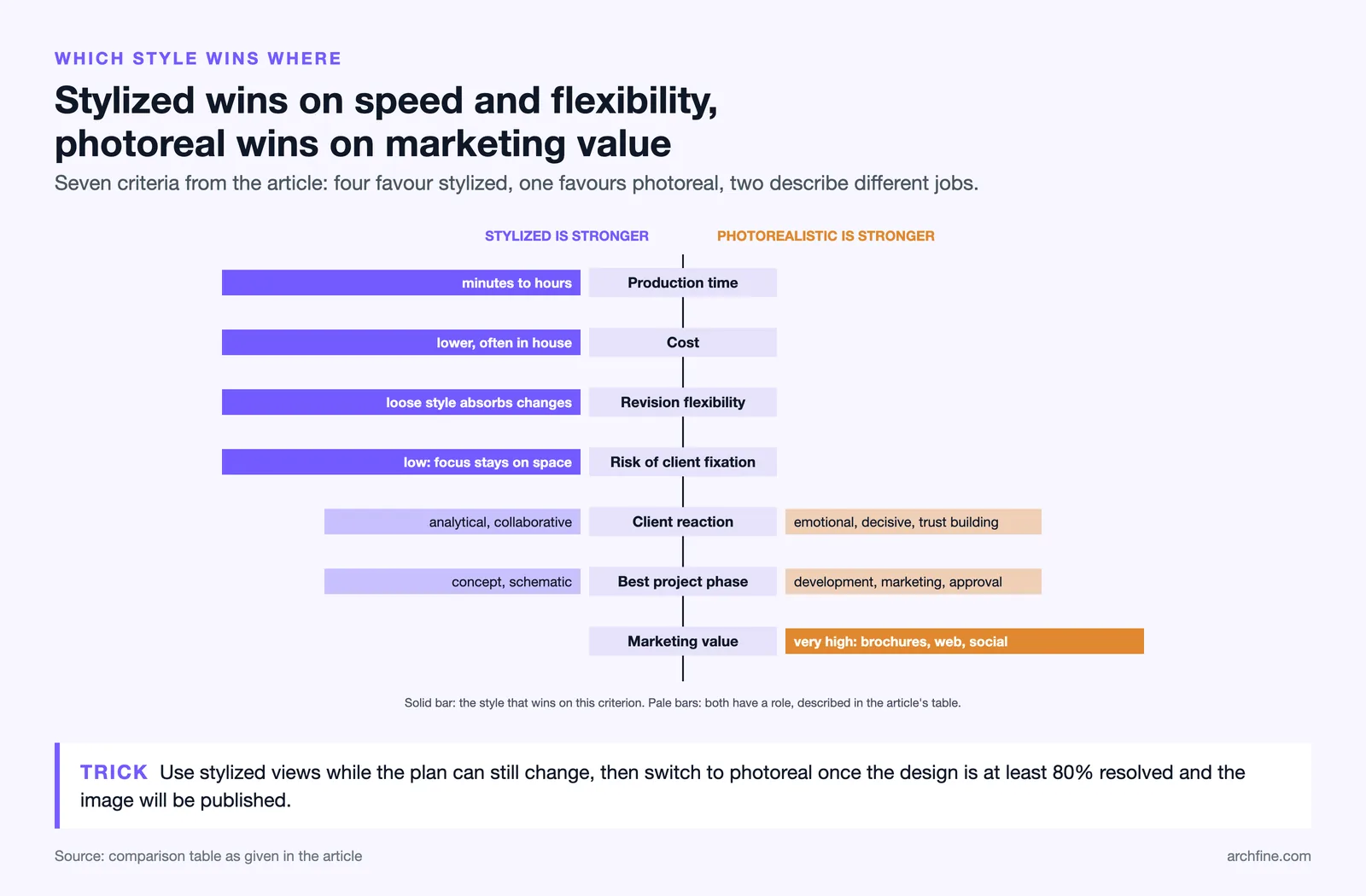
The following table summarizes the core differences between photorealistic and stylized rendering approaches across the factors that matter most in client-facing work:
| Factor | Photorealistic Renders | Stylized Renders |
|---|---|---|
| Production Time | Hours to days per image (traditional); minutes with AI tools | Minutes to hours; faster iteration cycles |
| Client Reaction | Emotional, decisive, trust-building | Analytical, collaborative, discussion-sparking |
| Best Project Phase | Design development, marketing, final approvals | Concept design, schematic phase, early presentations |
| Cost | Higher (traditional); decreasing rapidly with AI | Lower; often producible in-house |
| Revision Flexibility | Lower; changes require significant rework | Higher; loose style accommodates quick changes |
| Risk of Client Fixation | High; clients may focus on furniture or color details | Low; abstract style keeps focus on spatial design |
| Marketing Value | Very high; ideal for brochures, websites, social media | Moderate; works for portfolio and competition boards |
When Photorealistic Renders Win Clients Faster
Photorealistic renders are the clear winner in situations where the client needs to see the finished result before committing money. This happens most often in real estate development, where investors and buyers make decisions based on how a property will look and feel. A developer selling off-plan apartments will almost always convert more buyers with photorealistic exterior and interior renders than with conceptual sketches, no matter how beautiful those sketches might be.
The same applies to design-build projects where the client is both the end user and the decision-maker. Homeowners renovating their kitchen want to see exactly what the new space will look like with their chosen cabinets, countertops, and lighting fixtures. A stylized render simply does not answer the questions they are asking. They want confirmation, not exploration.
Photorealistic rendering also dominates in competitive bid situations where multiple firms are presenting to the same client. When a client compares competing bid proposals side by side, the firm with photorealistic visuals often appears more prepared, more capable, and more trustworthy. Fair or not, a polished photorealistic image communicates professionalism in a way that a sketch-style render cannot match in formal settings.
🔢 Quick Numbers
- The global 3D rendering market was valued at $4.85 billion in 2025 and is projected to reach $19.82 billion by 2033 at a 19.6% CAGR (Grand View Research, 2025)
- 3D real-time rendering tools reduced design errors by 25 to 30%, improving client satisfaction in 85% of projects (Market Growth Reports, 2025)
- 44% of architects use AI to generate concept images and early design ideas (Chaos and Architizer State of Archviz Report, 2025)
When Stylized Renders Win Clients Faster
Stylized renders outperform photorealistic ones in several specific and often overlooked scenarios. The most obvious is the early conceptual phase, where the design is still fluid. Presenting a photorealistic image of a concept that might change dramatically in the next iteration is not just wasteful; it is strategically dangerous. Clients see a finished-looking image and assume the design is locked. When you later propose significant changes, they feel like you are taking something away from them rather than improving the project.
Competition entries and public design reviews are another area where stylized renders frequently outperform. Architecture competition juries, composed of experienced professionals, often respond more positively to renders that demonstrate design thinking rather than rendering skill. A thoughtful collage or diagrammatic visualization that reveals the logic behind a design can be far more compelling than a generic photorealistic exterior shot that could belong to any project.
Stylized renders also work better when you are presenting to technically sophisticated clients like corporate real estate teams or institutional decision-makers who understand that design is a process. These clients value transparency and collaboration. A sketch-style render signals that you are still listening and that their input matters, while a polished photorealistic image can unintentionally signal that you have already made all the decisions without them.
⚠️ Common Mistake to Avoid
One of the most common mistakes architects make is presenting photorealistic renders during the schematic design phase. Clients often interpret highly polished visuals as a finished design, making them resistant to changes later. If you need to explore multiple design directions, use stylized or diagrammatic renders first. Save photorealism for when the design is at least 80% resolved and you need final approval or marketing assets.
The Hybrid Approach: Using Both Styles Strategically
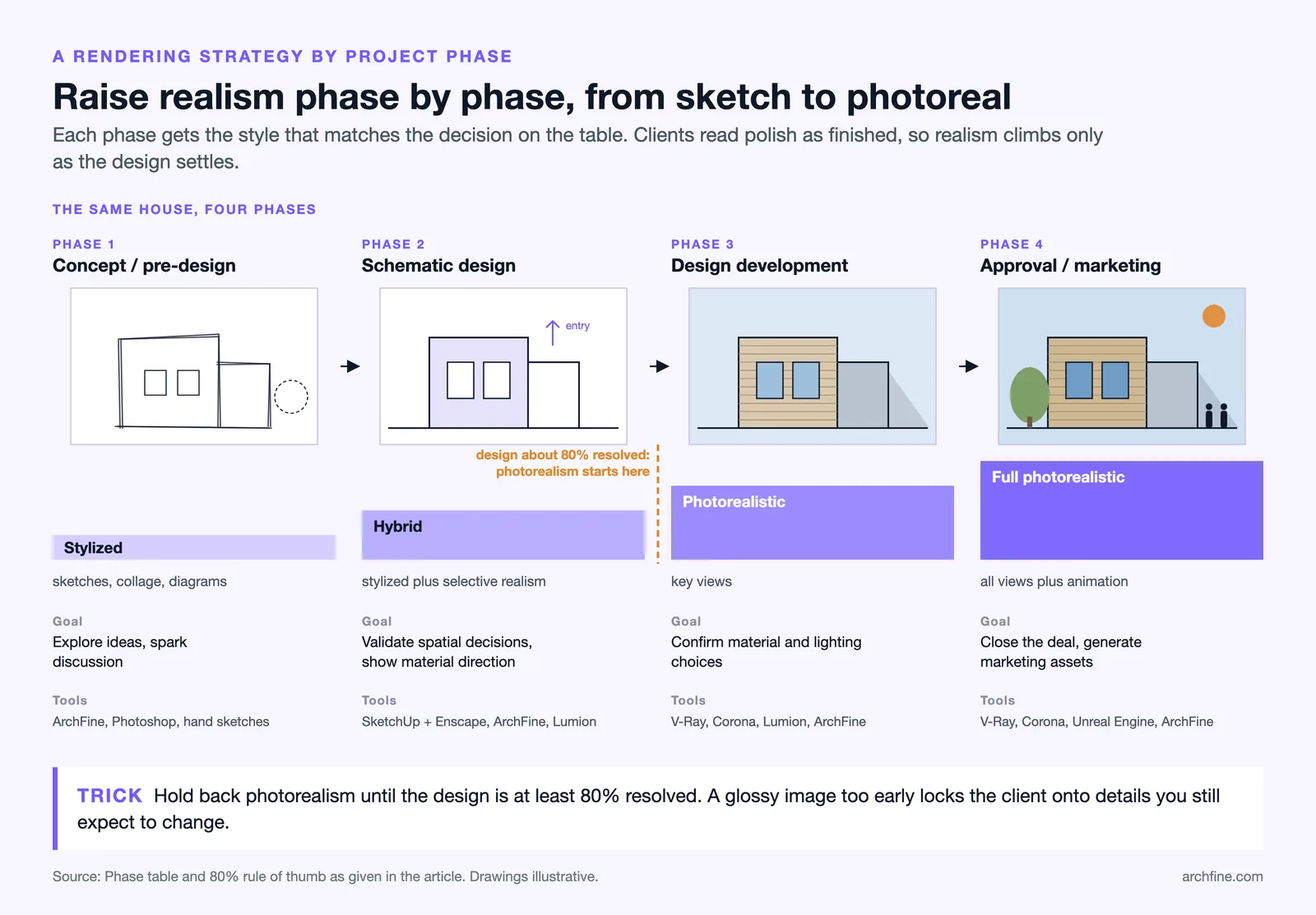
The most successful architectural firms do not choose between photorealistic and stylized renders. They use both, deploying each style at the optimal moment in the project lifecycle. This hybrid approach is becoming the industry standard because it aligns the visualization method with the decision being made at each stage.
During concept development, quick stylized sketches and mood boards establish the design direction without over-committing. AI-powered tools like ArchFine make this even faster by transforming rough sketches into polished concept visualizations in seconds. As the design matures into schematic and design development phases, a mix of stylized diagrams and selective photorealistic views helps clients understand both the spatial logic and the material character of the project. Finally, during approvals and marketing, full photorealistic renders and animations close the deal.
This staged approach also manages client expectations effectively. When you start with sketches and gradually increase the realism of your visuals as the design solidifies, clients naturally understand that design is a process. They see the progression from abstract to concrete and feel like active participants in the journey rather than passive reviewers of a finished product.
A Practical Rendering Strategy by Project Phase
| Project Phase | Recommended Style | Goal | Suggested Tools |
|---|---|---|---|
| Concept / Pre-Design | Stylized (sketches, collage, diagrams) | Explore ideas, spark discussion | ArchFine, Photoshop, hand sketches |
| Schematic Design | Hybrid (stylized + selective photorealism) | Validate spatial decisions, show material direction | SketchUp + Enscape, ArchFine, Lumion |
| Design Development | Photorealistic (key views) | Confirm material and lighting choices | V-Ray, Corona, Lumion, ArchFine |
| Client Approval / Marketing | Full photorealistic (all views + animation) | Close the deal, generate marketing assets | V-Ray, Corona, Unreal Engine, ArchFine |
💡 Pro Tip
Build a “rendering escalation plan” into your project fee proposals. Define which rendering styles you will produce at each phase and tie them to specific deliverables. This sets clear expectations with clients, prevents scope creep on visualization work, and positions your rendering output as a strategic service rather than an afterthought.
How AI Is Changing the Photorealistic vs Stylized Debate
AI rendering tools are fundamentally reshaping the economics and speed of architectural visualization. The traditional argument against photorealistic renders in early design phases was always about time and cost. Producing a single photorealistic image could take a skilled artist an entire day using conventional rendering engines. That made photorealism impractical for concept exploration, where you might need to visualize five or ten options in a single afternoon.
That constraint is disappearing. AI-powered platforms can now generate photorealistic or stylized visualizations from sketches, floor plans, or basic 3D models in under a minute. This means architects can produce photorealistic concept options almost as fast as they could previously produce rough sketches. The question is no longer “can we afford photorealism at this stage?” but rather “does photorealism serve the right purpose at this stage?”
Even with AI speed, the strategic considerations remain. A photorealistic concept render still risks anchoring the client to specific details too early. But AI also enables something new: rapid stylistic iteration. You can show the same space as a watercolor visualization, a sketch-style render, and a photorealistic image in the same meeting, letting the client see the design through multiple lenses. This multi-style presentation approach was practically impossible before AI, and firms that adopt it are reporting stronger client engagement and faster approvals.
📌 Did You Know?
According to the 2025 State of Archviz Report by Chaos and Architizer, 11% of architectural firms have already integrated AI into their visualization workflow, and excitement around AI experimentation increased by 20% compared to the previous year. The most common AI use case? Generating concept images and early design ideas, which is exactly where stylized renders traditionally dominated.
Matching Render Style to Client Type
Different client profiles respond to different visual languages, and understanding these patterns gives you a significant competitive advantage. Here is how the major client categories typically react:
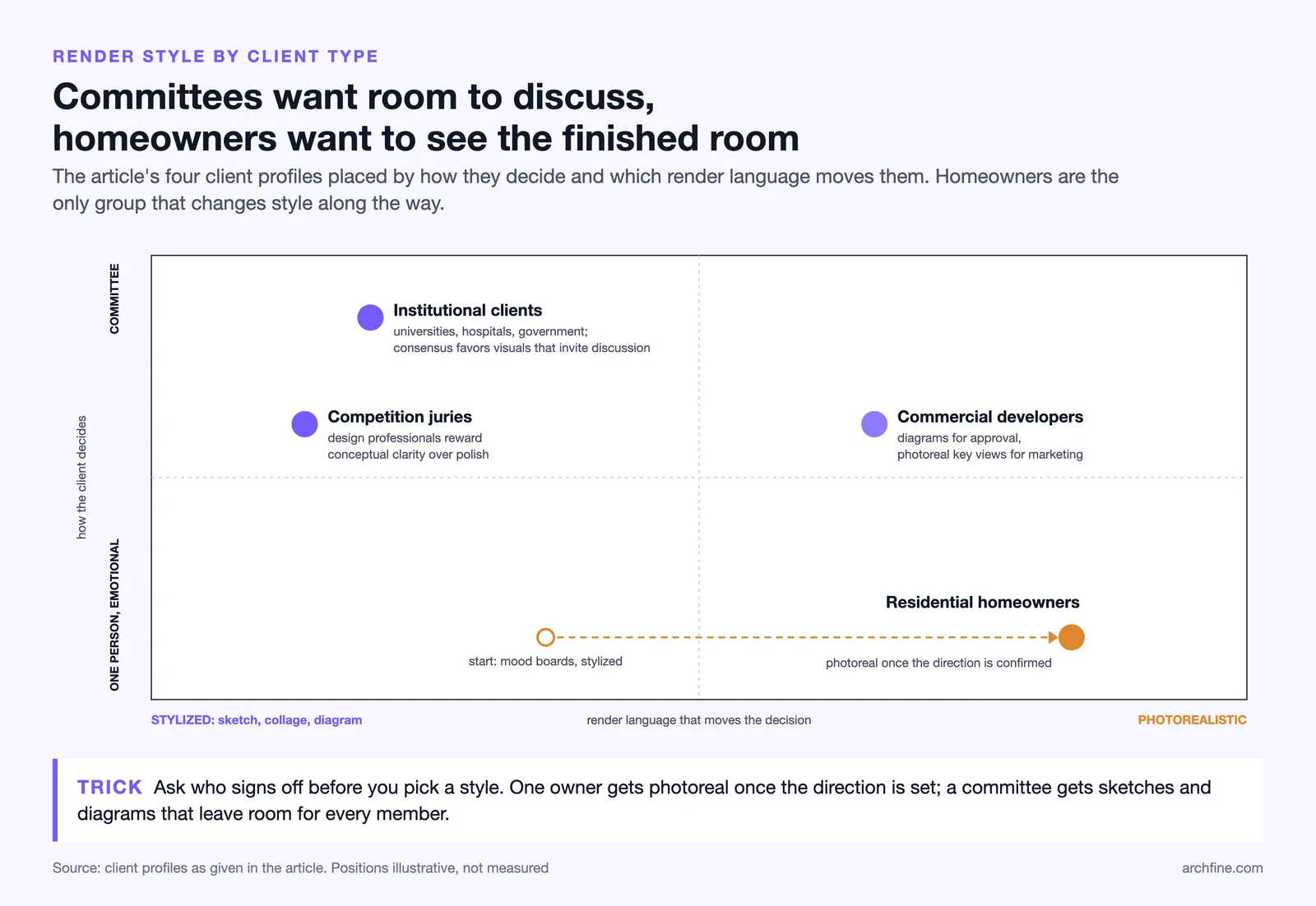
Residential homeowners are emotionally driven. They are building or renovating their personal space, and they need to feel excited and confident about the result. Photorealistic renders that show warm lighting, natural materials, and lifestyle elements almost always accelerate their decision-making. However, if you present photorealism too early and they dislike something specific, the recovery process can be painful. Start with mood boards and stylized concepts, then move to photorealism once the design direction is confirmed.
Commercial developers focus on return on investment and marketability. They want to see how the building will look in brochures, on websites, and in investor presentations. Photorealistic renders are essential for their marketing pipeline, but during the design approval process, they often prefer clean, efficient presentations that highlight floor area ratios, circulation, and spatial efficiency. Industry publications like Dezeen regularly showcase how leading firms balance data-rich diagrams with photorealistic hero images in their commercial project presentations. Hybrid approaches work best here: effective architectural presentations for this audience combine data-rich diagrams with selected photorealistic key views.
Architecture competition juries, especially those composed of design professionals, tend to value conceptual clarity over rendering polish. According to the American Institute of Architects (AIA), effective visual communication remains central to the architectural profession, and the way you present your work can significantly influence how a jury or client perceives your project. A jury that has reviewed hundreds of entries in a single day will respond more strongly to a presentation that communicates design intent clearly than one that simply looks beautiful. Stylized renders that reveal the thought process behind the design often score higher in these contexts.

Institutional clients like universities, hospitals, and government bodies operate through committee decision-making. Committees need consensus, and consensus-building favors visuals that invite discussion. Stylized and hybrid renders that leave room for interpretation tend to move through committee approval processes faster than photorealistic images that trigger detailed debates about surface colors and fixture selections.
The Role of Real-Time Rendering in Client Presentations
Real-time rendering engines like Unreal Engine, Twinmotion, and Enscape have introduced a third option that sits between traditional photorealism and stylized approaches. These tools produce high-quality visuals that update instantly as changes are made, enabling architects to modify designs during client meetings in real time. Advances in GPU technology, particularly NVIDIA RTX ray tracing, have made this level of interactivity possible without sacrificing visual quality.
The impact on client presentations is significant. Instead of showing static images and asking clients to imagine alternatives, architects can now change wall colors, swap materials, adjust furniture layouts, and shift the time of day in a scene while the client watches. This interactivity builds trust because the client sees that their input is being heard and implemented immediately.
Real-time rendering also blurs the line between photorealistic and stylized. Most real-time engines now support multiple visual styles within the same model. You can show a white clay model to discuss massing, switch to a diagram view to explain circulation, and then render the same scene in full photorealistic mode to close the presentation. This flexibility makes real-time rendering particularly valuable for firms that serve diverse client types and need to adapt their presentation style on the fly.
🏗️ Real-World Example
Zaha Hadid Architects: The firm has long been known for blending multiple rendering styles in its competition presentations. For the Bee’ah Headquarters in Sharjah (completed 2022), the team used stylized conceptual diagrams to explain the building’s dune-inspired form during early design phases, then transitioned to photorealistic renders and VR walkthroughs for final client approvals. This layered approach helped communicate both the poetic design intent and the practical buildability of the complex form.
Practical Tips for Choosing the Right Render Style
Rather than defaulting to one rendering style for all situations, consider these practical guidelines before starting any visualization work:
Ask yourself what decision the client needs to make at this meeting. If they need to choose between two fundamentally different design concepts, stylized renders that focus on spatial quality will serve you better than photorealistic details. If they need to approve a specific material palette or confirm that the design meets their expectations before construction begins, photorealistic renders are the right tool.

Consider the client’s visual literacy. Clients who work in design-adjacent fields (real estate, interior design, construction) can read abstract representations easily. Clients from non-visual backgrounds (finance, law, technology) may struggle with anything that does not look like a photograph. Match your visual language to your audience’s ability to decode it.
Factor in the revision cycle. If you know the design will change significantly after this presentation, investing in full photorealistic production is a poor use of resources. Stylized renders can be produced, revised, and reproduced at a fraction of the cost and time, making them the efficient choice for iterative design phases.
Think about the afterlife of the image. If the render will be used only in a single internal meeting, efficiency matters more than polish. If it will appear on the client’s website, in marketing brochures, or on social media, photorealistic quality is non-negotiable. Plan your rendering investment based on how far each image will travel.
Rendering style recommendations should be adapted to your specific project context. Client preferences, project budgets, and local market expectations vary, and no single approach works universally.
Final Thoughts
The debate between photorealistic vs stylized renders is not about which one is better. It is about which one is right for the specific moment in your project. Photorealistic renders close deals, build trust, and generate powerful marketing assets. Stylized renders open conversations, accelerate design exploration, and prevent premature commitment to details that might change.
The architects winning the most projects in 2026 are the ones who treat rendering style as a strategic tool rather than a personal preference. They match the visual language to the client, the project phase, and the decision being made. With AI tools like ArchFine making both photorealistic and stylized outputs faster and more accessible than ever, there is no longer any excuse for presenting the wrong visual at the wrong time.
✅ Key Takeaways
- Photorealistic renders build emotional certainty and are ideal for final approvals, marketing materials, and real estate sales where clients need to see the finished result.
- Stylized renders spark collaborative discussion and work best during early design phases, competition entries, and presentations to design-literate audiences.
- The most effective architectural firms use a hybrid approach, deploying the right rendering style at each project phase rather than defaulting to one method.
- AI rendering tools are collapsing the time and cost barriers between both styles, enabling multi-style presentations that were previously impractical.
- Always match your rendering style to the decision being made, the client’s visual literacy, and the intended afterlife of the image.
The full set of options, from diagrammatic through clay to nocturnal, is covered in our guide to architectural rendering styles.