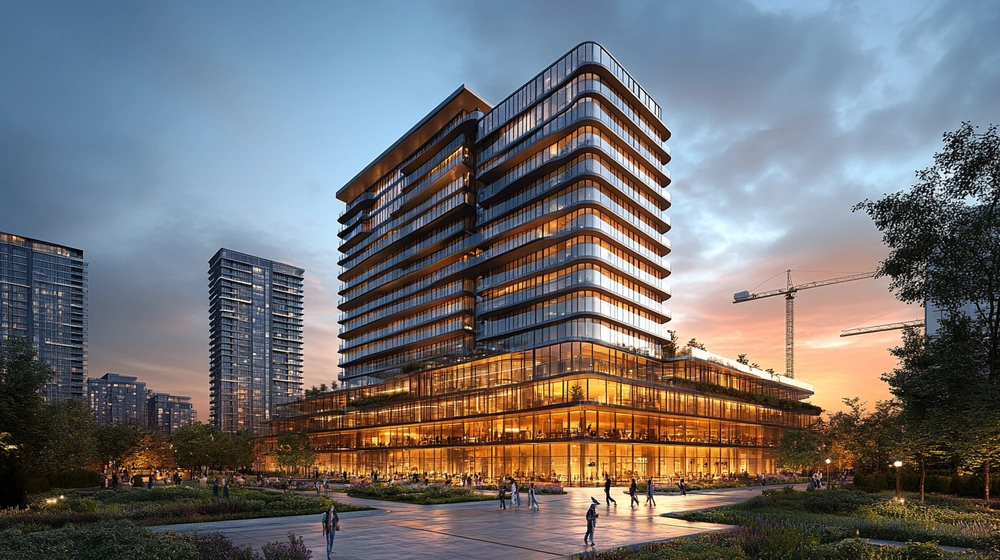

AI renders for real estate allow developers to create photorealistic images of unbuilt properties in minutes, replacing weeks of traditional 3D visualization work and helping sales teams secure buyer commitments months before construction wraps up. This shift from conventional rendering studios to AI-powered platforms is changing the financial math behind pre-construction marketing across residential, commercial, and mixed-use developments.
Selling a building that does not yet exist has always been the core challenge of real estate development. Buyers struggle to picture a finished apartment from a floor plan or a construction-site photo. Developers, on the other hand, need early revenue to fund construction and prove demand to lenders. For decades, the solution was traditional 3D rendering, a process that produced stunning visuals but came with steep costs and long turnaround times. AI rendering tools have compressed that entire workflow into something a marketing team can run in-house, on demand, at a fraction of the budget. A McKinsey Global Institute analysis estimates that generative AI could create $110 billion to $180 billion or more in value for the real estate industry, with design visualization and marketing among the highest-impact use cases.
Why Pre-Construction Sales Depend on Visual Marketing
The psychology behind pre-construction buying is straightforward: people commit to properties they can see themselves living in. An empty lot or a steel frame does not trigger that emotional response. According to the National Association of Realtors (NAR) 2025 Profile of Home Staging, 83% of buyers’ agents reported that staging a home made it easier for buyers to visualize the property as their future home. For pre-construction projects where physical staging is impossible, rendered visuals fill that gap entirely.
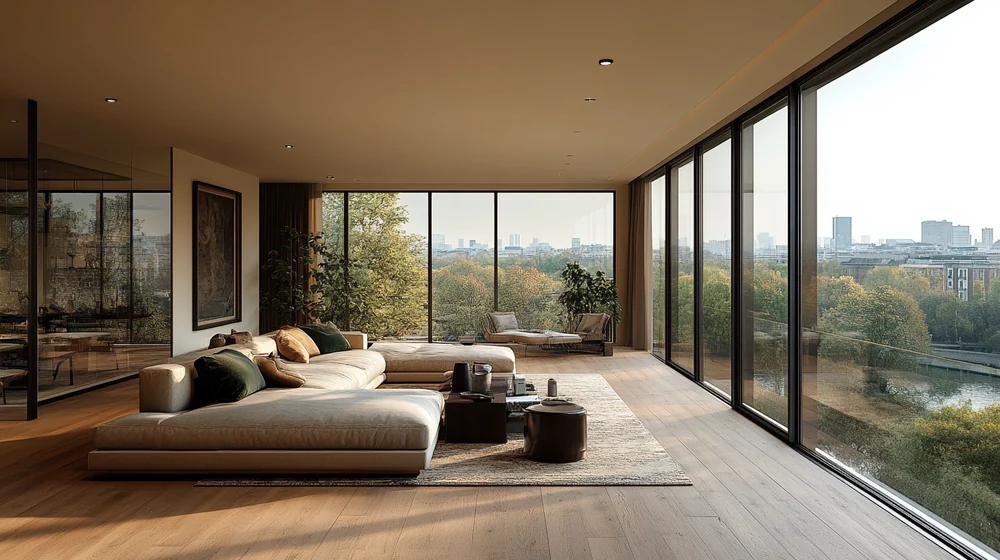
Developers who launch marketing campaigns with high-quality renders can start collecting deposits months or even years before completion. This early cash flow reduces financing risk, demonstrates market demand to banks, and often determines whether a project moves forward at all. The quality and speed of those visuals directly affect how fast units move off the plan. According to the Real Estate Staging Association (RESA), staged homes sell up to three times faster than non-staged homes, and over 85% of staged properties sell at or above the asking price.
💡 Pro Tip
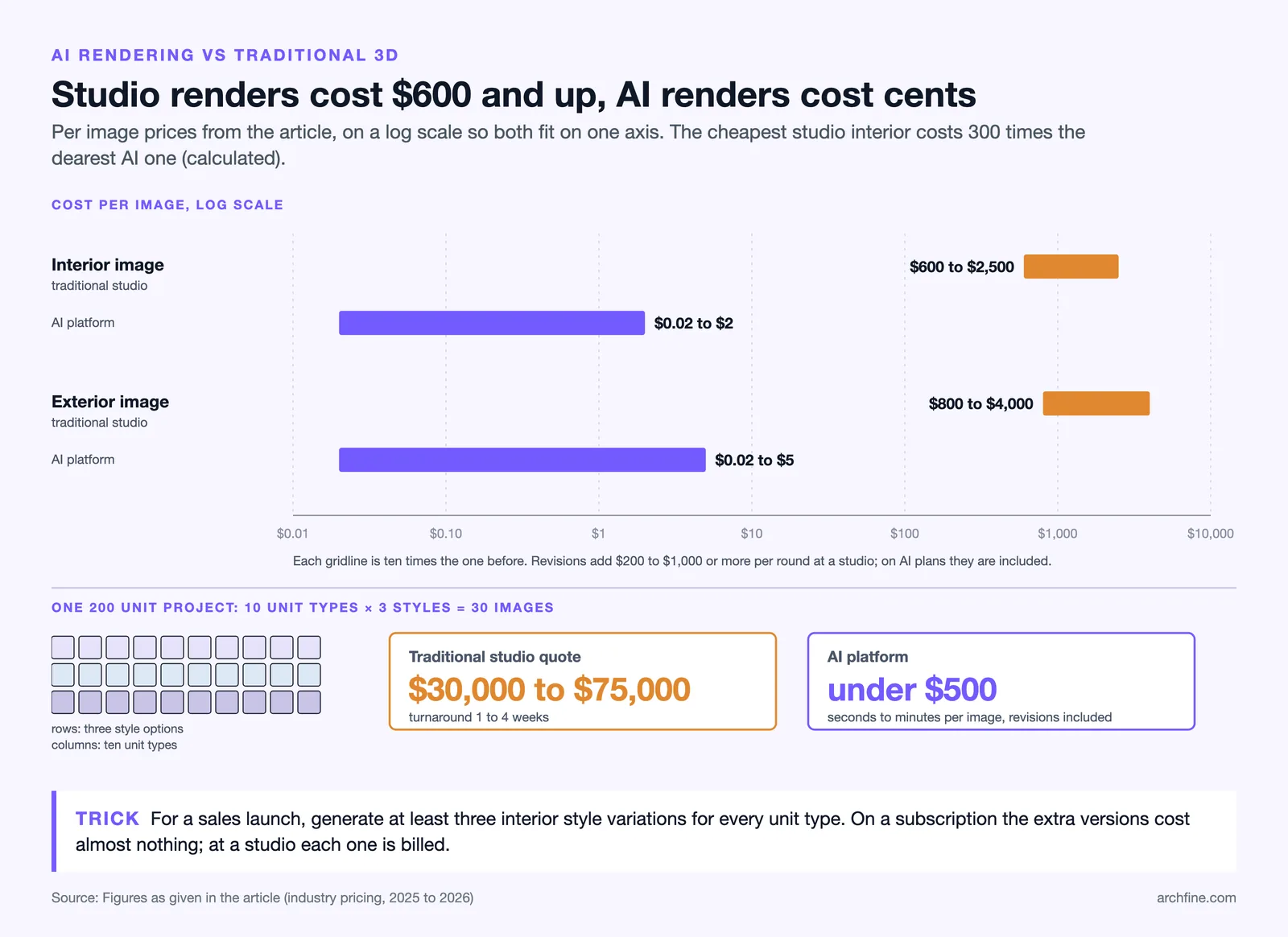
When preparing pre-construction renders for a sales launch, generate at least three interior style variations per unit type. Buyers in different demographics respond to different aesthetics. A young professional may connect with a minimalist Scandinavian layout, while a family buyer gravitates toward warm, traditional finishes. AI tools make this multi-style approach cost-effective for the first time.
How AI Rendering Works for Real Estate Development
AI architectural rendering uses machine learning models trained on millions of architectural images to generate photorealistic visuals from basic inputs. A developer can upload a floor plan, a 2D sketch, or even a simple text description, and the AI produces a fully furnished, lit, and textured image within seconds or minutes. The technology understands spatial relationships, material properties, and lighting physics well enough to create images that are nearly indistinguishable from traditional 3D renders.
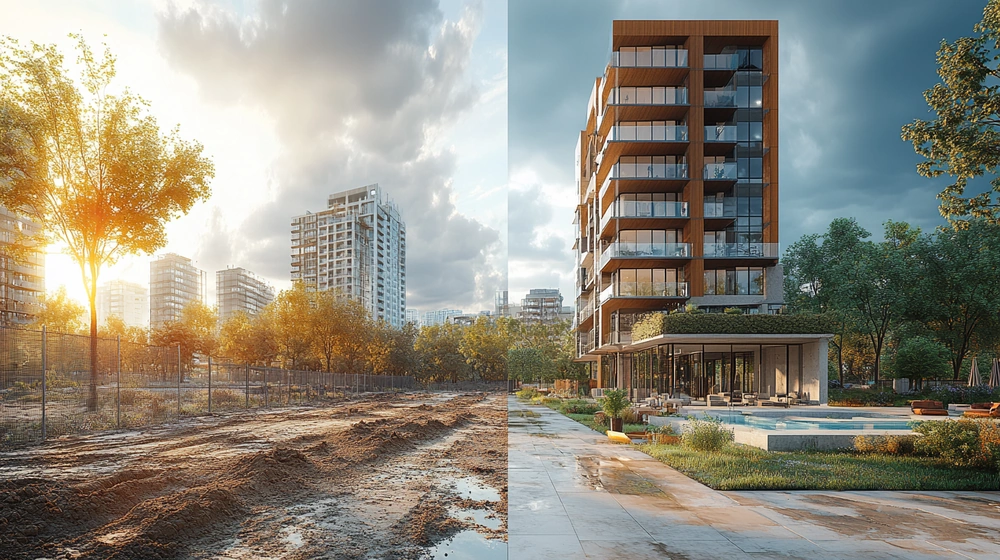
The workflow typically follows a simple sequence. First, the user uploads source material such as a CAD floor plan, an elevation drawing, or a 3D model screenshot. Next, they select style preferences including design theme, color palette, time of day, and camera angle. The AI then processes the input and generates one or more rendered views. Finally, the user reviews, refines with additional prompts, and downloads the final images for marketing use.
What makes this different from traditional rendering is not just speed. The iterative cost is essentially zero. If a client wants to see oak floors instead of marble, or a different kitchen layout, the AI generates a new version in seconds. Traditional studios typically charge for each revision cycle, and the turnaround could take days.
What Can AI Renders Show Buyers?
Modern AI rendering platforms produce several types of visuals that real estate teams use throughout the sales cycle. Photorealistic interior renders show fully furnished rooms with accurate lighting, materials, and proportions. Exterior renders display building facades with landscaping, environmental context, and realistic sky conditions. Aerial views place the development within its neighborhood, showing proximity to parks, transit, and amenities. Some platforms also generate 360-degree panoramic views that can be embedded in virtual tours, similar to the immersive experiences pioneered by platforms like Matterport. The concept of architectural rendering itself has been around for centuries, but AI has fundamentally changed who can produce these visuals and how quickly they can be created.
The range of outputs means a single AI tool can replace what previously required a rendering studio, a photographer, and a virtual tour production team. For a multi-unit residential development, this consolidation saves tens of thousands of dollars.
Cost Comparison: AI Rendering vs. Traditional 3D Visualization
The financial argument for AI rendering is hard to ignore. Traditional architectural visualization is an expensive, time-intensive process. According to multiple industry pricing surveys for 2025 and 2026, high-quality 3D still images from professional studios cost between $600 and $4,000 per image for standard work ($600 to $2,500 for interiors, $800 to $4,000 for exteriors), and premium photorealistic renders from top-tier firms can exceed $8,000 per image. Exterior renders run higher than interiors due to additional site modeling, landscaping, and environmental context.
AI rendering platforms, by contrast, operate on subscription models where individual renders cost as little as a few cents each. Monthly plans typically range from $8 to $50 and include dozens or hundreds of renders.

Traditional vs. AI Rendering Costs
The table below summarizes how traditional studio pricing compares with AI-powered rendering for typical real estate development needs:
| Factor | Traditional 3D Studio | AI Rendering Platform |
|---|---|---|
| Cost per interior image | $600 to $2,500 | $0.02 to $2 |
| Cost per exterior image | $800 to $4,000 | $0.02 to $5 |
| Turnaround time | 1 to 4 weeks | Seconds to minutes |
| Revision cost | $200 to $1,000+ per round | Included in subscription |
| Style variations | Charged per variation | Unlimited at no extra cost |
| Technical skill required | Professional 3D artist | No 3D experience needed |
For a 200-unit residential project that needs renders for 10 different unit types across 3 style options, a traditional studio might quote $30,000 to $75,000. The same scope on an AI platform could cost under $500, including unlimited revisions and re-renders.
🔢 Quick Numbers
- AI-enhanced virtual staging can increase property inquiries by up to 200% compared to unstaged listings (Precedence Research, 2024)
- The global AI in real estate market was valued at $2.9 billion in 2023 and is projected to reach $41.5 billion by 2033 (The Business Research Company, 2024)
- Staged homes sell up to 3 times faster than non-staged homes (Real Estate Staging Association, 2024)
- Traditional high-quality 3D still images cost $600 to $4,000 per image, while AI renders start at $0.02 per image (Industry pricing data, 2025)
Where AI Renders Fit in the Pre-Construction Sales Funnel
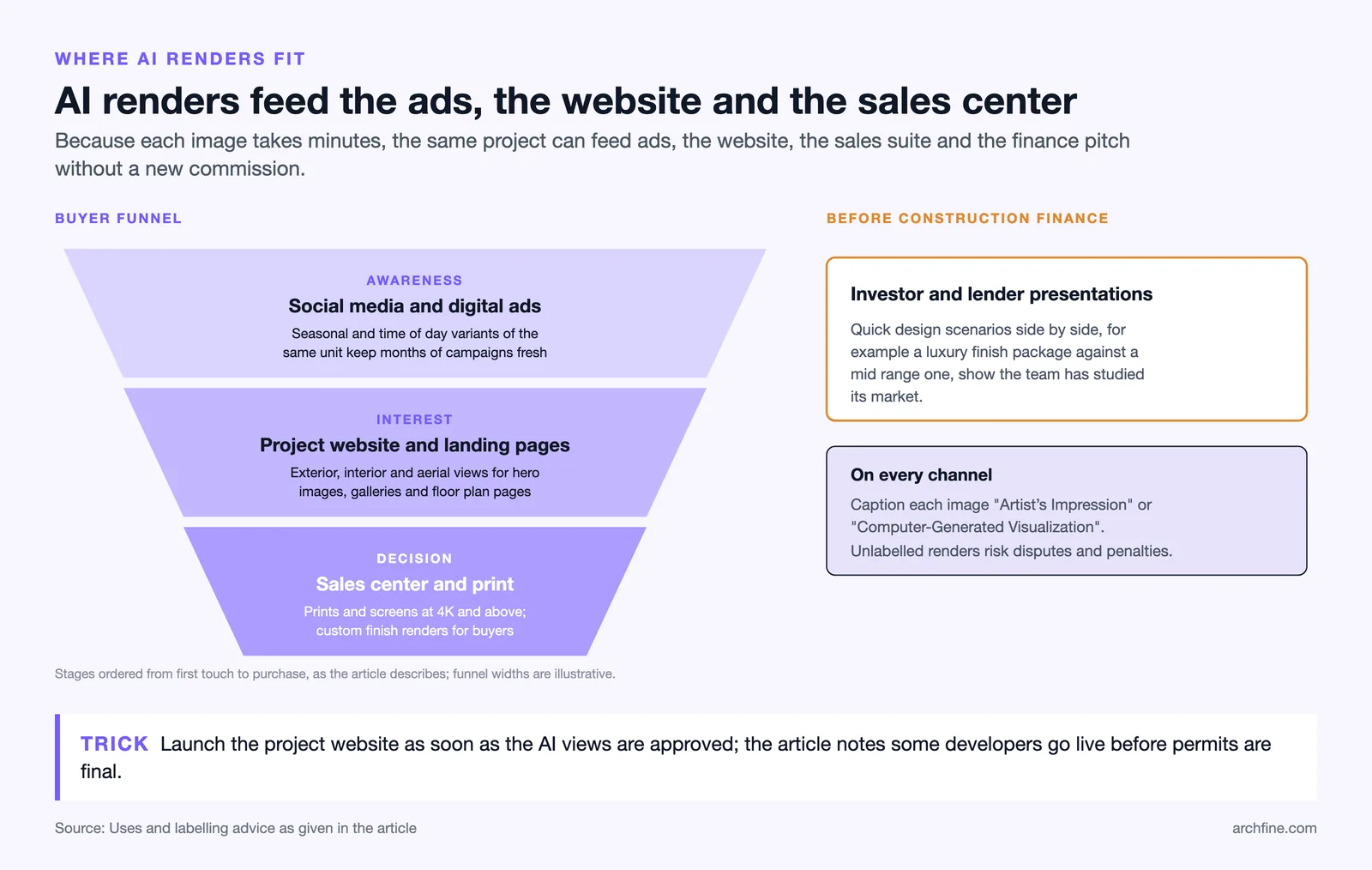
AI renders are not a one-time marketing asset. Smart development teams integrate them across every stage of the sales process, from initial awareness campaigns through to final purchase decisions.
Project Website and Landing Pages
The project website is usually the first touchpoint for potential buyers. AI-generated exterior renders, interior views, and aerial perspectives populate hero images, gallery sections, and interactive floor plan pages. Because AI tools produce images quickly, developers can launch marketing websites earlier in the project timeline, sometimes even before permits are finalized.
Sales Center and Presentation Materials
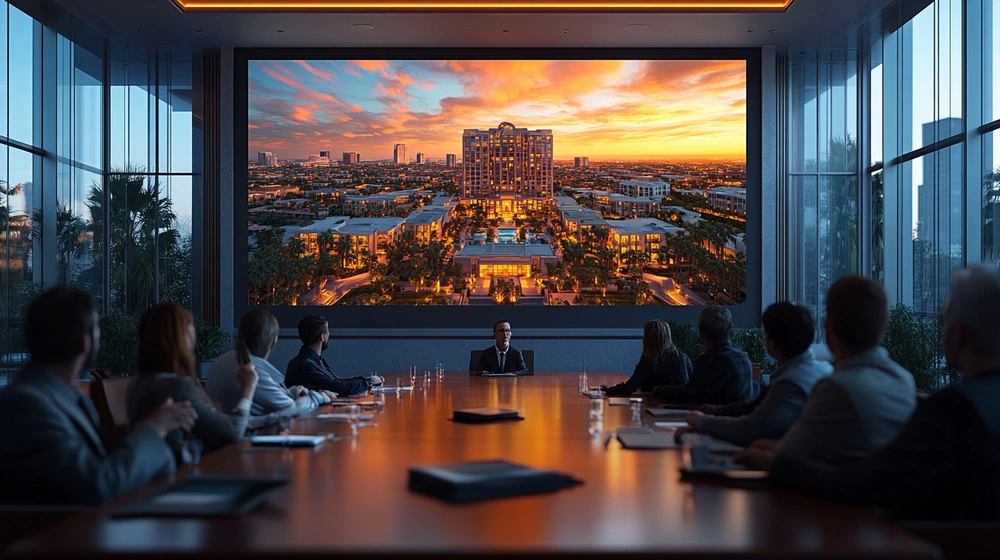
Physical sales centers use large-format prints and digital screens to display renders. AI platforms make it easy to produce images at high resolution (4K and above), suitable for wall-mounted displays and brochure printing. Sales teams can also generate custom renders during buyer consultations, showing specific finish options or furniture layouts that match a buyer’s stated preferences.
Social Media and Digital Advertising
Instagram, Facebook, and Google Display ads rely on visual content to stop the scroll. AI renders provide a steady stream of fresh visuals without the ongoing cost of commissioning new images. Leading architecture publications like ArchDaily and Dezeen regularly feature development projects that use high-quality renders as part of their pre-launch campaigns, reinforcing how central visual marketing has become to the industry. A marketing team can produce seasonal variations (the same unit shown in morning light versus evening, or in summer versus winter landscaping) to keep campaigns fresh over months of pre-sales activity.
⚠️ Common Mistake to Avoid
Many developers use AI renders without clearly labeling them as visualizations. This creates legal and ethical risks, especially in jurisdictions with strict advertising disclosure laws. Always watermark or caption AI-generated images with language like “Artist’s Impression” or “Computer-Generated Visualization.” Misleading buyers with renders that show features not included in the final product can lead to contract disputes and regulatory penalties.
Investor and Lender Presentations

Before construction begins, developers pitch projects to investors and banks. High-quality renders demonstrate that the project has been thoroughly planned and that the market positioning is clear. Industry leaders like JLL and CBRE have noted that development teams with strong visual marketing materials consistently outperform competitors in pre-sales velocity. The ability to show multiple design scenarios quickly (a luxury finish package versus a mid-range option, for example) gives investors confidence that the team has studied its target market.
How Developers Are Using AI Renders in Practice
The real-world applications of AI rendering in real estate go beyond simple image generation. Development teams are building entire pre-sales ecosystems around these tools.
Some developers integrate AI renders into interactive configurators on their websites, letting buyers select finishes, color schemes, and furniture styles in real time. The AI generates a new render for each combination, turning a static sales page into a personalized shopping experience. This approach mirrors what car manufacturers have done with online configurators for years, but applied to residential real estate.
Others use AI to produce marketing collateral at scale. A regional developer with 15 active projects, for example, might need hundreds of unique images across different unit types, angles, and styles. Producing that volume through a traditional studio would cost six figures and take months. AI tools deliver the same output in days at a tiny fraction of the cost.
🏗️ Real-World Example
Zillow Group’s Acquisition of Virtual Staging AI (October 2024): Zillow, one of the largest real estate technology companies in the US, acquired Virtual Staging AI Inc. to integrate AI-powered staging and visualization directly into its platform. This acquisition signals that AI rendering has moved from experimental to essential in mainstream real estate marketing. The deal positions Zillow to offer instant virtual staging to its millions of agent and seller users.
What to Look for in an AI Rendering Platform
Not every AI rendering tool is built for real estate development workflows. When evaluating platforms, development teams should focus on several key capabilities that directly affect output quality and operational efficiency.
Input flexibility matters. The best platforms accept multiple input types including floor plans in PDF or image format, CAD files, simple sketches, and even text-based descriptions. This means the marketing team does not have to wait for final architectural drawings before starting visual production.
Output quality needs to match or approach traditional rendering standards. Look for platforms that produce images with accurate material representation, natural lighting, correct spatial proportions, and high enough resolution for both digital and print use. Some tools still produce results that look obviously AI-generated, with warped geometry or unrealistic reflections, and these can hurt rather than help a sales effort.

Style control is critical for brand consistency. A luxury tower and an affordable housing project require very different visual treatments. The platform should allow detailed style direction through reference images, design templates, or granular prompt controls.
Scalability and batch processing become important for larger portfolios. If a developer manages multiple projects simultaneously, the tool should handle high-volume output without degrading quality or requiring manual intervention for each image.
💡 Pro Tip
Before committing to a platform, run a side-by-side test. Upload the same floor plan to two or three AI rendering tools and compare the output quality, style accuracy, and material realism. Pay special attention to how each tool handles kitchen and bathroom renders, as these are the rooms where buyers scrutinize finishes most closely and where poor AI output is most visible.
How Does AI Rendering Affect Sales Timelines?
Speed is the most immediate benefit. Traditional rendering workflows introduce weeks of delay into the marketing launch schedule. A developer waiting on renders from an external studio cannot publish listing pages, print brochures, or run ad campaigns until those images arrive. Every week of delay is a week of lost buyer attention and potential deposits.
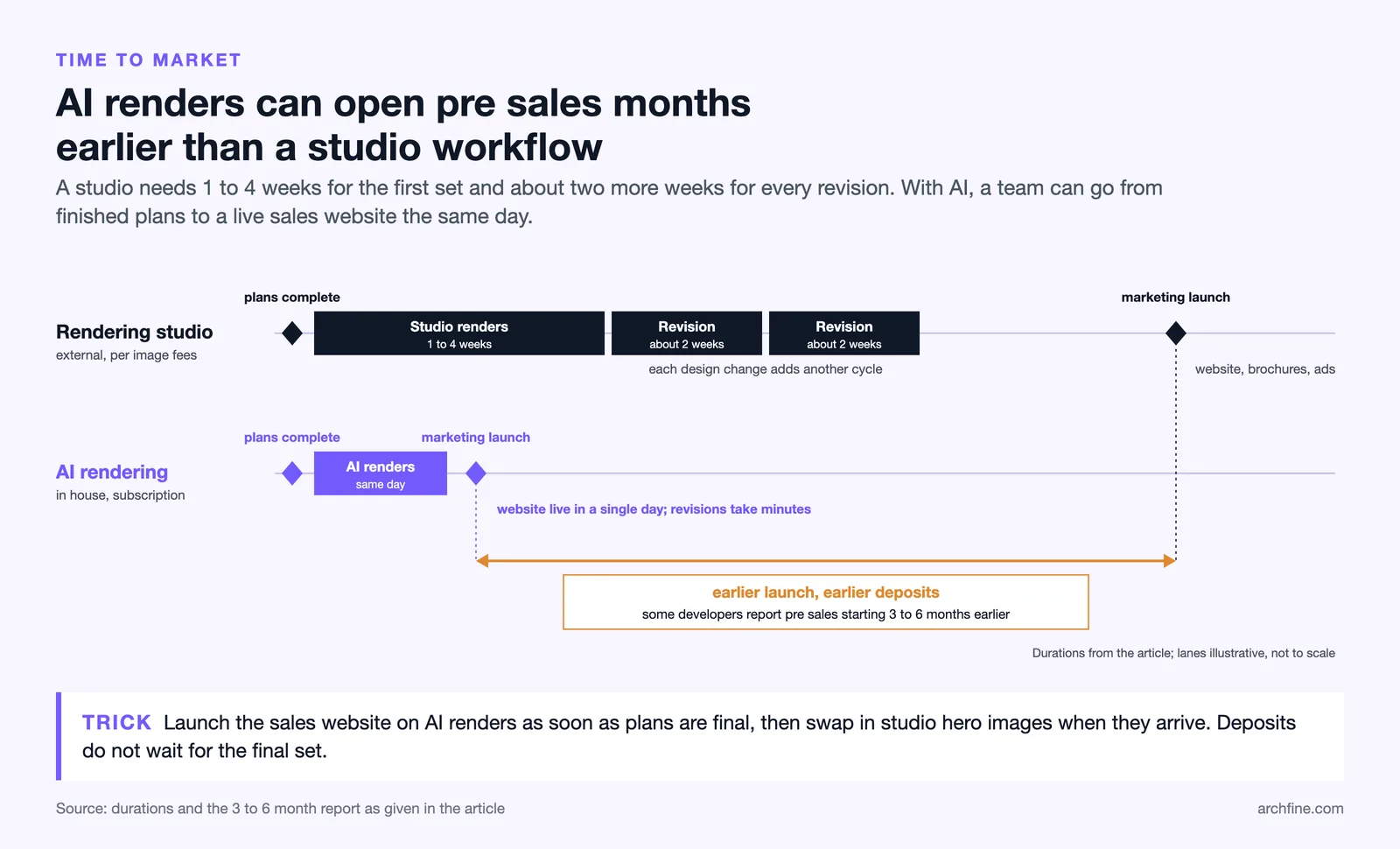
AI rendering compresses the visual production timeline from weeks to hours. A development team can go from completed floor plans to a fully visual marketing website in a single day. This speed advantage compounds when the design changes, as revisions that would have added another two-week cycle with a studio can be completed in minutes with an AI tool.
According to NAIOP (National Association of Industrial and Office Properties), Michael Villegas of IA Interior Architects estimates that AI shortens the design time frame by approximately 30%, and designers can now generate hundreds of potential design solutions in minutes rather than the weeks that the same process required five years ago.
For pre-construction sales specifically, faster renders mean earlier marketing launches, earlier deposits, and stronger cash flow positions during the construction phase. Some developers report starting pre-sales three to six months earlier than they could with traditional rendering workflows.
Ethical and Legal Considerations
AI renders are powerful marketing tools, but they carry responsibilities. The line between aspirational visualization and misleading advertising can be thin, and developers need clear policies around how AI-generated images are used.
Transparency is the baseline requirement. In most markets, advertising regulations require that rendered images be clearly identified as visualizations rather than photographs of existing conditions. The Urban Land Institute (ULI) and professional bodies like the American Institute of Architects (AIA) have highlighted the importance of ethical visual communication in development marketing. Some jurisdictions have specific rules about what must and must not appear in pre-construction marketing materials. Failing to comply can result in penalties, project delays, or lawsuits from buyers who feel misled.

Accuracy matters too. AI tools are capable of generating beautiful images that include features not actually planned for the project, such as premium countertops, high-end appliances, or expansive views that will be partially obstructed. Sales teams must verify that every render accurately reflects the specification of the unit being sold. Establishing a review process where both the marketing and design teams approve renders before publication reduces this risk.
Data privacy is an emerging concern as well. Some AI platforms store uploaded floor plans and project data on external servers. For developers working on confidential projects, choosing platforms with strong data protection policies and on-premise or private cloud options is worth considering.
Note: Advertising disclosure requirements for pre-construction real estate vary by jurisdiction. Developers should consult local regulations and legal counsel to ensure compliance with all applicable marketing laws.
The Future of AI Rendering in Real Estate Development
The technology is advancing fast. Current AI rendering tools already produce impressive stills, but the next generation of platforms is moving toward real-time 3D environments, video walkthroughs, and interactive virtual reality experiences, all generated by AI.
Video rendering is one area where AI will make a significant impact. Traditional architectural animation costs $2,500 to $20,000 per minute of finished video, often produced using professional tools like Autodesk 3ds Max or V-Ray. AI-powered video generation tools are beginning to produce architectural walkthroughs at a fraction of that cost, though quality has not yet matched the best traditional studios for long-form content.
Integration with sales platforms is another trend. Instead of generating renders as standalone files, AI tools are being embedded directly into CRM systems, project websites, and virtual tour platforms. A buyer browsing a project website could customize a unit’s finishes and see a fresh AI render generated in real time, without any human intervention on the developer’s side.
The acquisition of Virtual Staging AI by Zillow Group in October 2024 is a clear signal that major industry players view AI rendering not as an experiment but as core infrastructure for real estate transactions going forward.
📌 Did You Know?
In October 2024, Zillow Group acquired Virtual Staging AI Inc., making it one of the first major real estate platforms to bring AI-powered visualization in-house. According to Market.us, the broader AI in real estate market is expected to grow from $2.9 billion in 2023 to $41.5 billion by 2033, a compound annual growth rate of 30.5%. Architectural visualization and virtual staging are among the fastest-growing segments within this market.
Getting Started with AI Renders for Your Development Project
Adopting AI rendering does not require a complete overhaul of your marketing workflow. Most development teams start with a focused pilot project before scaling across their portfolio.
Begin by selecting one upcoming project and generating AI renders for a single unit type. Compare the output quality and turnaround time against your current rendering vendor. Show the results to your sales team and gather feedback on how the visuals perform in buyer conversations. If the quality meets your standards and the speed advantage is clear, expand to additional unit types and projects.
Consider the learning curve as well. While AI rendering platforms are designed to be accessible, producing consistently high-quality output requires some experimentation with prompts, reference images, and style settings. Designating one or two team members to specialize in AI rendering prompts and quality control pays off quickly in output consistency.
For developers looking for a platform built specifically for architectural visualization, ArchFine offers AI-powered rendering capabilities designed for architecture and real estate workflows. The platform handles floor plan uploads, style customization, and high-resolution output for both digital and print marketing materials.
⚖️ Pros & Cons at a Glance
✔️ Pros: Dramatically lower cost per render, instant turnaround, unlimited revisions, no 3D expertise needed, easy style variations
✖️ Cons: Quality ceiling below top-tier traditional studios for ultra-premium projects, occasional geometric inaccuracies, less control over precise camera angles, emerging technology with ongoing quality improvements
Key Takeaways
✅ Key Takeaways
- AI renders allow real estate developers to launch pre-construction marketing campaigns months earlier than traditional rendering workflows permit.
- Cost savings are substantial: AI rendering platforms deliver images for under $5 each, compared to $600 to $4,000 per image from traditional studios.
- The technology supports the entire sales funnel, from project websites and social media ads to investor presentations and in-person sales center displays.
- 83% of buyers’ agents say staging helps buyers visualize a property as their future home, making rendered visuals critical for pre-construction sales where physical staging is impossible.
- Transparency is essential. Label all AI renders as visualizations and verify accuracy against actual project specifications to avoid legal and ethical issues.
- Start with a pilot project, compare output against your current rendering vendor, and scale based on results.
FAQ
How accurate are AI renders compared to traditional 3D renderings?
AI renders have reached a quality level that works well for most marketing and pre-sales applications. They accurately represent spatial layouts, materials, and lighting for standard residential and commercial interiors. For ultra-premium projects where every shadow and reflection must be pixel-perfect, traditional studios still hold an edge. However, for the vast majority of development marketing needs, AI renders deliver professional-quality results that buyers respond to positively.
Can buyers customize finishes using AI renders during the sales process?
Yes. Many AI rendering platforms support real-time customization, allowing buyers to swap materials, colors, and furniture layouts and see a new render generated within seconds. Some developers embed this capability directly into their project websites or sales center displays, turning the render into an interactive design tool rather than a static marketing image.
Do AI renders replace the need for traditional architectural visualization entirely?
Not entirely. AI rendering excels at volume, speed, and iterative design exploration. Traditional rendering studios remain valuable for hero images in high-profile marketing campaigns, complex architectural animations, and projects where absolute photorealistic precision is required. Most development teams are moving toward a hybrid approach, using AI for the bulk of their visual production and commissioning traditional renders only for flagship marketing assets.
What inputs do AI rendering platforms require?
Most platforms accept floor plans (PDF, PNG, or JPG), CAD file screenshots, rough sketches, 3D model views, or text descriptions. The more detailed the input, the more accurate the output. A dimensioned floor plan with room labels will produce better results than a rough hand sketch, though both are viable starting points.
How should developers label AI-generated renders in marketing materials?
Best practice is to include a clear disclaimer such as “Computer-Generated Visualization,” “Artist’s Impression,” or “AI-Rendered Image” on or near every AI-generated image used in marketing. This protects the developer legally and sets appropriate buyer expectations. Some jurisdictions mandate specific disclosure language for pre-construction advertising, so consulting local regulations is recommended.