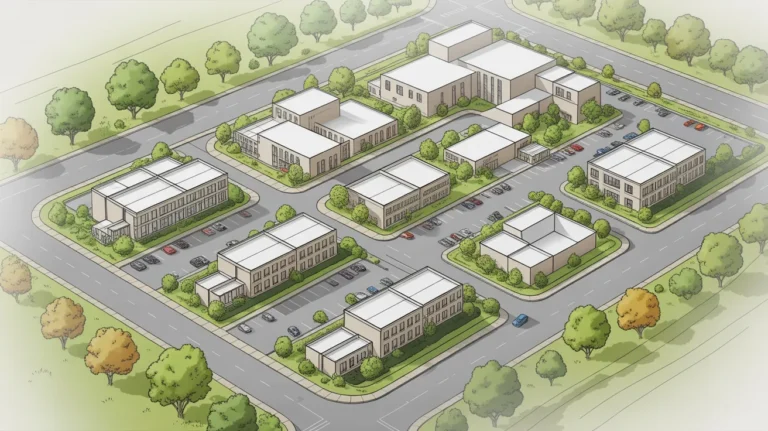
AI real estate visualization uses machine learning to generate photorealistic property renders from photos, floor plans, or empty room images. Real estate developers, agents, and marketing teams use these tools to produce listing visuals, pre-sale renders, and virtual staging at a fraction of the time and cost of traditional visualization workflows.
The first image a buyer sees of a property determines whether they click through or scroll past. For years, producing that image required expensive photography sessions, 3D rendering studios, or elaborate physical staging setups. AI real estate visualization has collapsed that workflow to a matter of minutes. Today, a developer marketing an off-plan building, an agent preparing a vacant listing, and a property manager refreshing a tired rental can all generate photorealistic renders from a single uploaded photo — without hiring a studio.
This guide covers how AI property visualization works, where it delivers the most value in real estate workflows, and what to look for when choosing a rendering tool for your listings.
What Is AI Real Estate Visualization?
AI real estate visualization refers to the use of machine learning models — primarily diffusion-based image synthesis and neural rendering techniques — to generate photorealistic images of properties. The input can be a photograph of an existing room, a raw floor plan, a rough sketch, or an empty space. The output is a polished, high-resolution visual suitable for MLS listings, marketing brochures, developer portals, and social media campaigns.
Unlike traditional 3D rendering, which requires a skilled artist to model a space from scratch over hours or days, AI rendering interprets the geometry and lighting of an uploaded image and applies style, furniture, landscaping, or architectural finish on top. The process compresses what once took a rendering studio several working days into a workflow measured in seconds.
The practical output categories include:
- Virtual staging — furnishing an empty room digitally
- Pre-sale and off-plan visualization — showing a property before it is built
- Exterior renders — improving curb appeal or showing proposed landscaping
- Style remodeling — showing what a space would look like after renovation

Why the Real Estate Industry Adopted AI Rendering Fast
The adoption curve for AI property visualization has been unusually steep, even by real estate technology standards. The reasons are structural rather than speculative.
Faster Listing Preparation
The time between signing a listing agreement and going live on the MLS compresses constantly as buyer competition intensifies. Traditional staging requires furniture sourcing, scheduling, movers, and setup — a process that can take one to three days and still depends on the property being physically accessible. AI staging eliminates every logistical step. An agent can upload room photos on a Monday morning and have market-ready listing visuals by that afternoon.
Speed compounds across a portfolio. An agency managing dozens of active listings simultaneously cannot send every property through a traditional staging pipeline without significant overhead. AI listing visualization scales without proportional cost increases, which makes it attractive not just for individual agents but for brokerages and property management firms handling volume.
Pre-Sale Visualization for Off-Plan Properties
Developers selling units in projects that have not yet broken ground face a fundamental marketing problem: the product does not exist yet. Buyers are asked to commit significant capital based on floor plans and renderings alone. The quality of those renderings directly influences sales velocity and, in some markets, the price premium developers can achieve.
Pre-sale property visualization with AI allows development teams to generate multiple interior and exterior render variants — different finish levels, furniture packages, lighting conditions — at a cost and speed that traditional rendering studios cannot match. A buyer can see the same apartment with a contemporary fit-out, a Scandinavian scheme, and a minimalist palette within the same consultation, rather than waiting weeks for a rendering studio to produce each variant.
Virtual Staging for Empty Spaces
A vacant property is harder to sell than a furnished one. The data is consistent across market cycles: according to the National Association of Realtors, staged homes sell significantly faster and command prices closer to asking value than their unstaged counterparts. The barrier has always been cost — physical staging for a multi-bedroom property can run from $1,500 to $4,000 for the first month, with additional monthly fees if the property does not sell quickly.
AI staging visualization eliminates that cost structure. The same outcome — a fully furnished, photorealistic presentation of each room — can be achieved for a fraction of the price per image, with results delivered in seconds rather than days. For agents covering the staging cost themselves on competitive listings, the economics have fundamentally shifted.

How AI Real Estate Rendering Works
The mechanics of AI property visualization vary between platforms, but most professional tools follow a similar three-stage process.
Uploading a Property Photo or Floor Plan
The process starts with an upload. Depending on the platform and the visualization goal, that input might be a JPEG photograph of an existing room, a scanned floor plan, an architectural drawing, or a raw render from a CAD file. Modern AI rendering tools trained on large datasets of interior and exterior photography can interpret perspective, spatial depth, and lighting conditions from a single photograph with high accuracy.
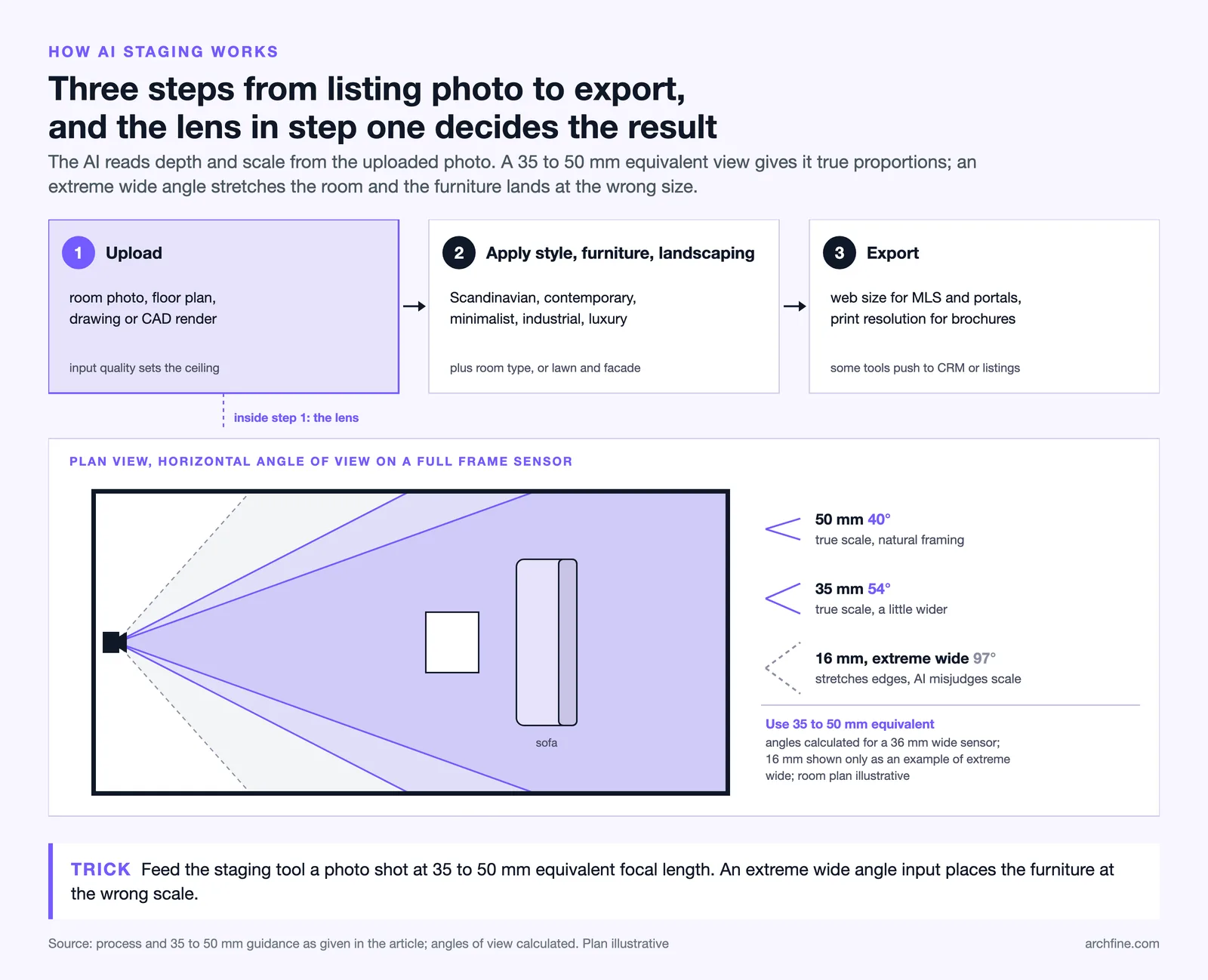
Input quality matters. A well-exposed photograph shot at standard focal lengths — roughly equivalent to a 35–50mm lens — gives the AI the most accurate spatial data to work with. Wide-angle shots at extreme focal lengths compress and distort perspective in ways that cause the model to misplace furniture or misread scale.
Applying Style, Furniture, and Landscaping
Once the image is uploaded, the user selects the type of output they need. For virtual staging, this typically involves choosing an interior style — Scandinavian, contemporary, minimalist, industrial, luxury — and the specific room type. The AI synthesizes furniture, textiles, lighting fixtures, and decorative objects that are spatially consistent with the room’s geometry and the chosen style.
For exterior renders, the same logic applies at the landscape level: the AI can replace dead lawns, add mature plantings, modify facade finishes, or simulate different times of day and lighting conditions. The range of stylistic output available in a single session is something no traditional photography or staging workflow can replicate.
Exporting for Web, Print, or Marketing
Final renders are exported in resolutions suitable for their destination. MLS platforms, listing portals, and property websites typically require images optimized for web delivery. Developer marketing brochures and print campaigns require print-resolution files. Most platforms support multiple export formats, and some include direct integration with CRM tools, listing software, or marketing platforms.

How ArchFine Handles Real Estate Visualization
ArchFine is an AI rendering platform built specifically for architectural and property visualization workflows. The tool accepts room photos, exterior images, and architectural inputs, then generates photorealistic renders in approximately 30 seconds.
For real estate use cases, ArchFine’s workflow is designed around the practical constraints of agents and developers:
- No software installation or 3D modeling experience required
- Upload a photo, add a prompt describing the desired output, and receive a rendered result
- Multiple style variants can be generated from the same source image
- Output resolution is suitable for both digital listing platforms and printed marketing materials
The platform is particularly well suited to real estate marketing rendering at scale — brokerages and development teams can process multiple listings simultaneously without the per-unit cost of a traditional rendering studio. For individual agents, ArchFine’s entry-level access provides the same output quality without requiring a studio-level budget.

What Makes a Real Estate AI Render Effective?
Not all AI property renders perform equally in real estate marketing contexts. The visual quality of a render directly affects buyer engagement metrics — time spent on a listing, inquiry rate, and in-person showing requests. Several factors separate renders that convert from renders that simply exist.
Spatial accuracy is the most fundamental. A render where furniture is misscaled relative to the room, or where the lighting direction is inconsistent with the window placement, reads as artificial immediately to buyers who spend significant time browsing listings. The best AI platforms maintain geometric consistency between the input photo and the staged output.
Style coherence matters almost as much. A living room staged with a contemporary sofa, a farmhouse dining table, and industrial pendant lights communicates indecision rather than a lifestyle. Effective staging renders commit to a coherent aesthetic direction that appeals to the target buyer demographic for that property type and price point.
Lighting realism is often the factor that distinguishes a professional-grade render from a generic AI output. Natural light behavior — the way afternoon sun falls across a hardwood floor, the warmth of recessed lighting against a textured wall — is what makes a staged image feel lived-in rather than rendered. AI models trained on large datasets of professional real estate photography tend to handle this better than general-purpose image generation tools.
Finally, for markets where disclosure is required — and in many jurisdictions it is — AI-staged images must be labeled clearly as virtual representations. Effective disclosure is built into the workflow rather than treated as an afterthought.

AI Staging vs. Traditional Staging: A Cost Comparison
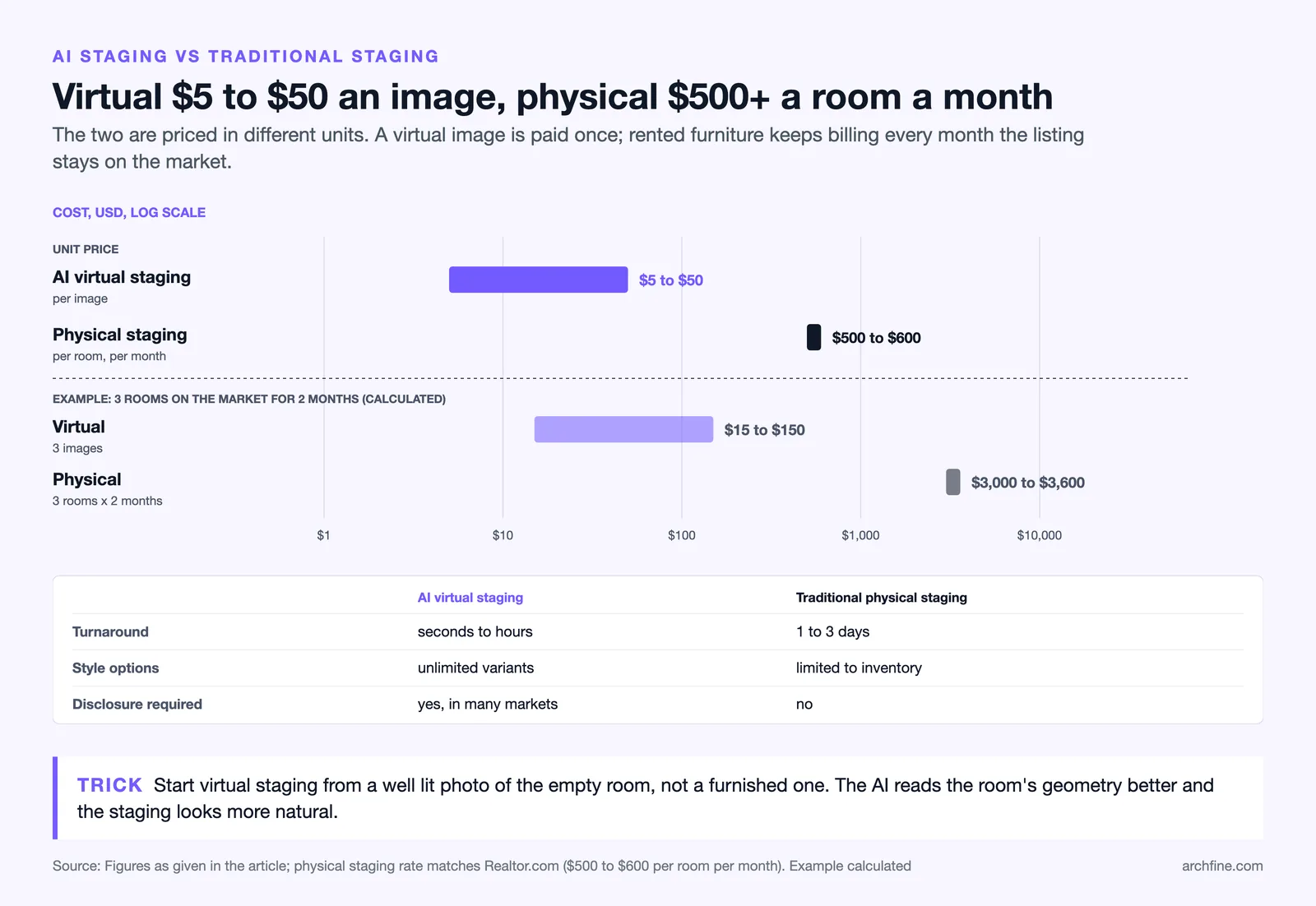
The economic case for AI real estate visualization over traditional physical staging is straightforward, though the choice is not always binary. The table below compares the two approaches across the factors that matter most to real estate professionals.
| Factor | AI Virtual Staging | Traditional Physical Staging |
|---|---|---|
| Cost per room / image | $5 to $50 per image | $500 to $600 per room per month (as of October 2026) |
| Turnaround time | Seconds to hours | 1–3 days |
| Physical furniture | No | Yes |
| Multiple style options | Yes — unlimited variants | Limited to inventory available |
| Disclosure required | Yes (in many markets) | No |
| Best for | Fast listings, off-market, volume workflows | High-end and luxury properties |
AI staging costs have continued to compress as platforms scale. NAR research indicates that staging costs have historically equated to roughly 1% of a home’s list price when done traditionally — a figure that AI tools reduce by 90 to 97% per listing while maintaining listing-quality visual output.
The case for traditional physical staging remains valid in specific contexts: luxury properties where in-person showings are the primary sales mechanism, markets where buyers are known to tour physically before making offers, and situations where the property’s unique architectural features benefit from custom furniture placement that AI cannot yet replicate with full accuracy. Outside those contexts, the cost-benefit calculation increasingly favors AI.
It is worth noting that the two approaches are not mutually exclusive. Some agencies use AI staging for digital listings and early-stage marketing, then bring in physical staging selectively for properties that advance to in-person showing shortlists. This hybrid approach captures the cost efficiency of AI property render tools for the majority of the buyer journey while retaining physical staging where the conversion value is highest.