Choosing a 3D rendering company comes down to four things: whether their existing work resembles what you need, whether they understand construction drawings, how revisions are handled, and what the total cost actually includes. Price per image is the number everyone compares and the least useful of the four.
The market runs from freelancers charging a few hundred per image to established studios charging several thousand, and the difference is rarely visible in a portfolio. Choosing a 3D rendering company on price alone therefore tells you very little about what you will receive.
Here is how to evaluate one, what to supply, and where budgets go wrong.
What Rendering Actually Costs
Prices vary by region, complexity and studio, and the shape is consistent. An exterior view costs more than an interior of similar quality because context, landscaping and entourage all have to be built.
The first image on a project costs disproportionately more than subsequent ones, since scene setup, materials and lighting are shared across every view afterwards. A studio quoting six images is quoting mostly for preparation.
Animation costs an order of magnitude more than stills, because a thirty second sequence is hundreds of frames, each requiring the render time of a still, as our guide to render farms explains.
The full breakdown of what drives these figures sits in our guide to architectural rendering cost.
💡 Pro Tip
Ask for the price of a seventh image before agreeing six. Studios that price additional views from the same scene at a fraction of the first are pricing honestly, and one that charges the same for every image is either padding or setting up each view from scratch, which is worth knowing either way.
Judging a 3D Rendering Company Portfolio
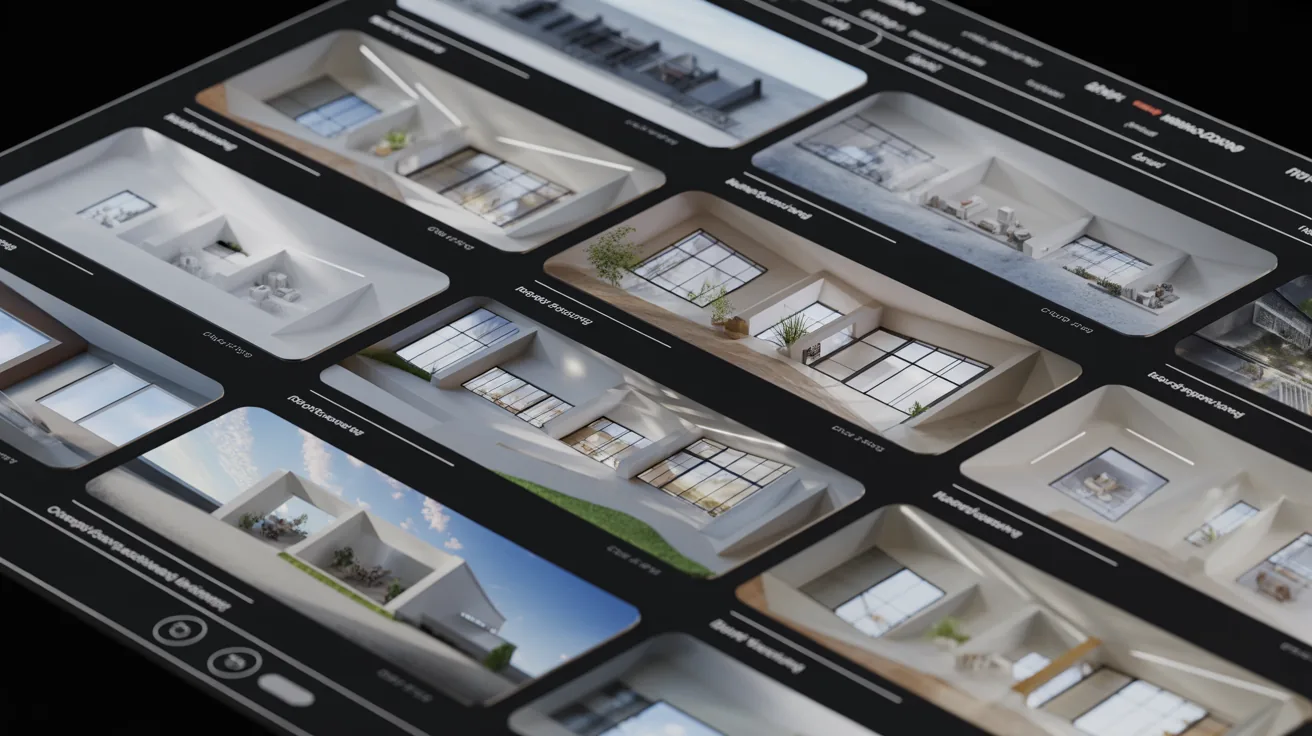
Published project imagery on ArchDaily and Dezeen is a useful calibration for what good looks like across different building types.
Look for work resembling your project rather than work you admire. A studio brilliant at glossy residential interiors may be poor at an industrial shed in flat northern light.
Check whether their images look like buildings or like renders. Perfect skies, immaculate landscaping and impossibly clean surfaces are a house style, and a scheme that needs to look credible rather than aspirational needs a different studio.
Look at the worst image on their site, not the best. Every studio leads with its strongest work, and the range tells you what you get on an ordinary project with an ordinary budget.
Ask what they were given. An image produced from a fully detailed model is a different achievement from one produced from a massing sketch, and studios will tell you if asked.
Questions Worth Asking
| Question | What a good answer looks like |
|---|---|
| How many revision rounds are included? | Two, defined, with a rate for further ones |
| What do you need from us? | A specific list of model, drawings and references |
| What resolution is delivered? | Stated in pixels at a stated print size |
| Who owns the images? | Clear licence terms, in writing |
| What happens if the design changes? | A defined rate rather than goodwill |
| What is the turnaround? | Realistic, usually one to three weeks |
What to Supply
The quality of a render depends heavily on what the studio receives, and briefs are usually thinner than they should be.
The model in a format they can use, cleaned of anything the camera will not see. Exchange formats are covered in our guide to architecture file formats.
The drawings, so the studio can check what the model does not carry and so discrepancies get caught before rendering rather than after.
Camera positions, agreed in advance. This is the single largest source of wasted money in commissioned visualisation.
Material references as photographs of the actual specified products rather than as descriptions.
Context information, including any neighbouring consented schemes that will exist by completion.
The audience, because an image for a planning committee and an image for a sales brochure are different jobs, as our guide to development marketing covers.
⚠️ Common Mistake to Avoid
Do not commission images before the design is settled enough to survive them. Every design change after modelling starts is a revision that either costs money or uses a round you needed later. The cheapest visualisation project is one that begins after the massing is fixed.
Freelancer, Studio or In House
Freelancers cost less and vary more. A good one is excellent value and the risk is capacity, since one person with two clients and a deadline has a problem you inherit.
Studios using engines from vendors such as Chaos cost more and absorb that risk. They also bring art direction, which is what separates a technically correct image from a persuasive one.
In house makes sense above a certain volume. A practice producing images weekly is paying a studio more than a salary, and the calculation shifts, particularly now that AI tools cover the exploratory end, as our roundup of AI design tools covers.
The hybrid position most practices reach is AI for internal and early work, a freelancer or studio for anything a client keeps.
Where Projects Go Wrong
Unclear scope is the first. Six images sounds definite until someone asks whether that includes the aerial and the two interiors.
Late design changes are the second and the most expensive, because they arrive after modelling.
Vague feedback is the third. Make it warmer costs a revision round and achieves nothing, while specific instructions about a material, a light direction or an element resolve in one pass.
No named decision maker is the fourth. A studio receiving contradictory feedback from three people will produce something that satisfies none of them, and agreeing who signs off before starting prevents it.
Your Next Step: Write down the camera positions and the audience for each image before contacting anyone. That single page changes both the quotes you receive and the images you get back.
Working With a Studio Well
The projects that go smoothly share a pattern: one point of contact, agreed viewpoints, a complete brief and feedback given in one consolidated round.
Consolidate comments before sending them. Six separate emails over three days produce confusion and consume a revision round, and one document with numbered points does not.
Be specific about what is wrong rather than about how it feels. The sky is too dramatic and the brick reads too orange are actionable, and it needs more life is not.
Say what you like as well. Studios adjust toward feedback, and telling them only what is wrong risks losing what was working.