
A Matterport alternative is usually sought for one of two reasons: the subscription cost at portfolio scale, or the need for output the platform does not provide, and since 2025 a third: platform risk. CoStar completed its acquisition of Matterport in February 2025, and in October that year Zillow pulled Matterport tours from its listings, citing changed content usage terms. Tours that were an asset on one portal stopped appearing on another. Several options now produce comparable virtual tours, and a few produce floor plans and measurements alongside them.
The category has changed since phone based capture became accurate enough for marketing use, which removed the hardware barrier that kept it professional. That change is why a Matterport alternative is now a realistic option rather than a downgrade.
Here is what the alternatives actually offer, what you give up, and how to choose based on what the tour is for.
What a Virtual Tour Platform Does
Listing platforms such as Houzz and the major portals all expect a tour to be embeddable, which shapes what the platforms provide.
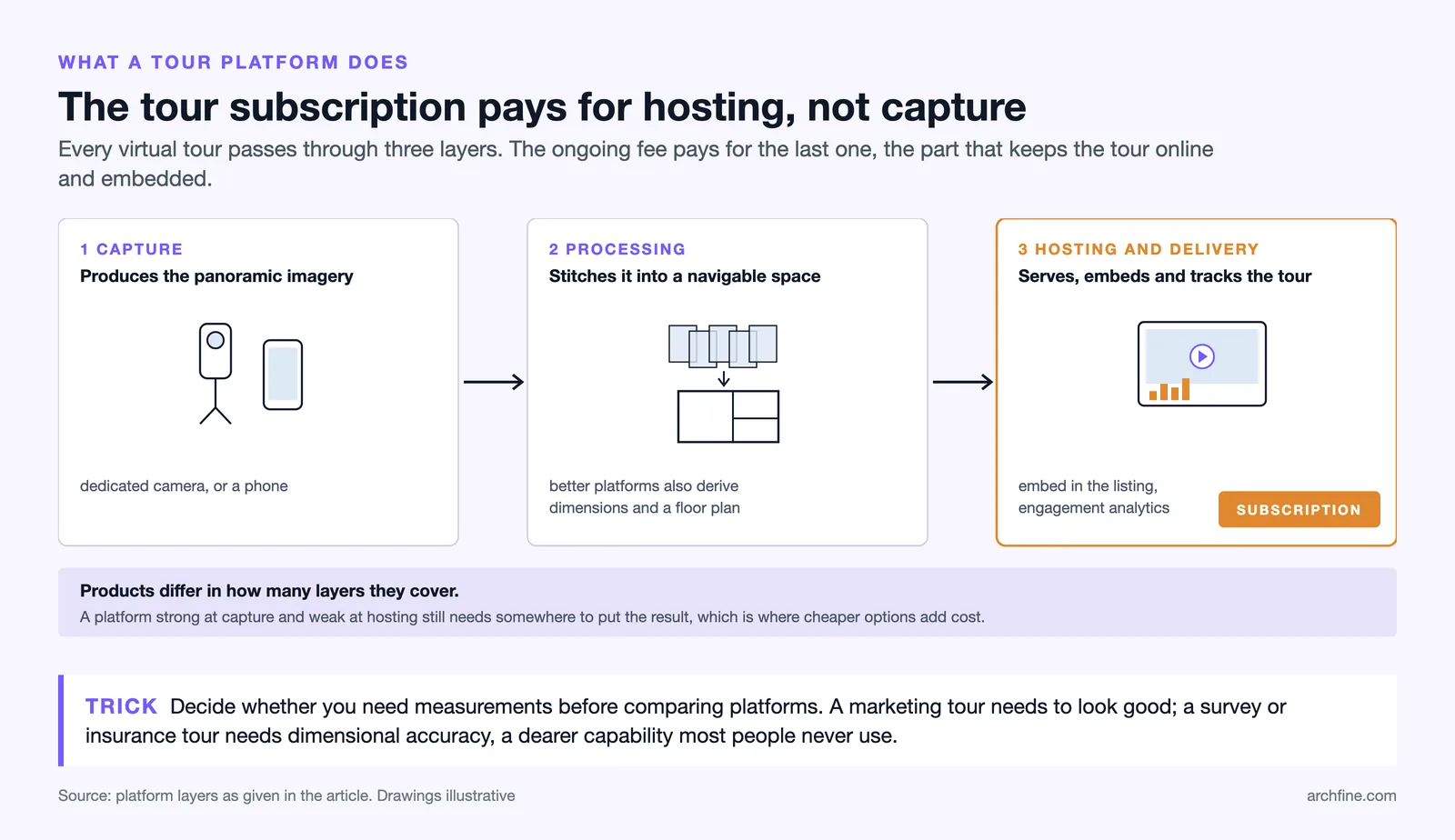
Three things, and products differ in how many they cover. Capture produces the panoramic imagery, either with a dedicated camera or a phone.
Processing stitches those captures into a navigable space and, in the better platforms, derives dimensions and a floor plan from them.
Hosting and delivery serves the tour to viewers, embeds it in a listing and tracks engagement, which is the part that carries the ongoing subscription.
A platform strong at capture and weak at hosting still needs somewhere to put the result, which is where apparently cheaper options accumulate cost.
💡 Pro Tip
Work out whether you need measurements before comparing platforms. A tour for marketing needs to look good, and a tour used for survey or insurance purposes needs dimensional accuracy, which is a different and more expensive capability. Most people pay for accuracy they never use.
What Each Matterport Alternative Offers
Seven platforms, named, and what each is actually for. They do not compete on the same ground: two produce floor plans (only one of them to a measurement standard), three are hosting platforms that assume you bring your own camera, and one removes the camera entirely.
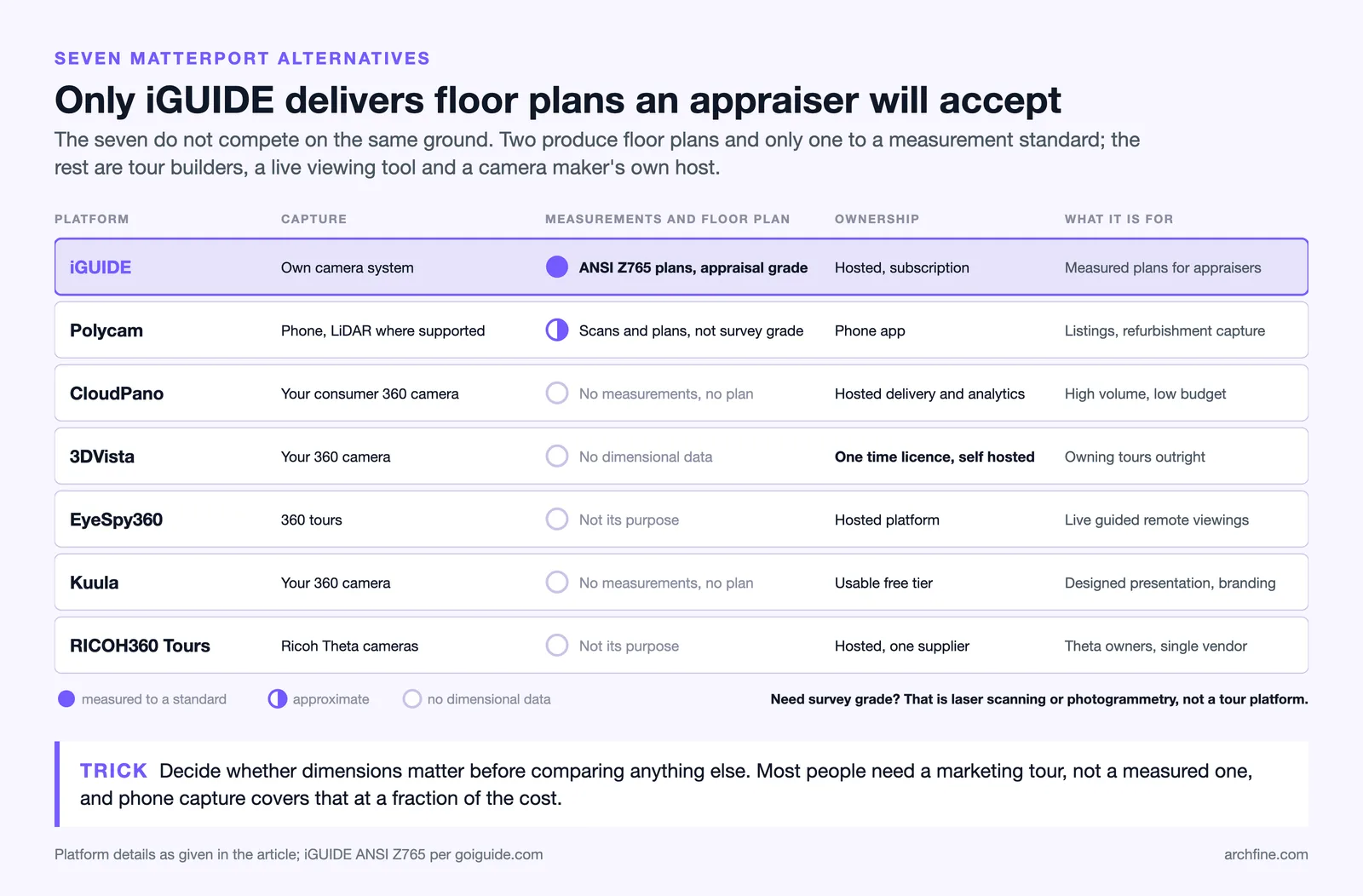
iGUIDE
iGUIDE is the alternative for anyone who needs the floor plan to be trusted rather than indicative. It produces plans compliant with ANSI Z765, the residential measurement standard used in appraisal, which is a different claim from “approximate dimensions” and the reason it appears in valuation and insurance workflows.
Capture uses its own camera system, so this is the closest structural equivalent to Matterport: proprietary hardware, hosted delivery, subscription.
Best for: Measured floor plans that have to stand up to an appraiser.
Watch for: Hardware cost and a subscription, so the saving over Matterport is smaller than with the hosting-only platforms.
CloudPano
CloudPano is a hosting and delivery platform rather than a capture system. You shoot with a consumer 360 camera, upload, and it handles the tour, the embed and the analytics.
Because the camera is yours and the platform is only the delivery layer, total cost drops sharply at volume. What it does not do is derive spatial data: there are no measurements and no automatic floor plan.
Best for: High listing volume on a low budget, where the tour is marketing and nothing more.
Watch for: No measurements, no floor plan. If you need either, this is the wrong category.
3DVista
3DVista is the only option here sold as a one-time licence rather than a subscription, and tours are self-hosted, so they live on your own server and do not disappear if a vendor does.
That single difference answers the longevity problem described below better than any hosted platform can. It is a 360 photo tour builder, so there is no dimensional data and no floor plan generation.
Best for: Practices that want to own their tours outright and stop paying monthly.
Watch for: Self-hosting is your problem to solve, and there is no measurement capability at all.
EyeSpy360
EyeSpy360 is built around live guided viewings: an agent walks a remote buyer through the tour in real time, talking over it.
That is a sales capability rather than an imaging one, and it is the reason to choose it. Tour quality is comparable to the other 360 platforms; the live session is what Matterport does not do.
Best for: Agencies selling remotely, and anywhere the viewing conversation matters more than the imagery.
Watch for: Judge it on the live feature. On static tour quality alone there is no reason to prefer it.
Kuula
Kuula comes at this from photography rather than property. It is a 360 tour platform with far more control over presentation (custom skins, hotspots, colour and branding) than the listing-oriented platforms.
It has a genuinely usable free tier, which makes it the cheapest way to find out whether tours are worth producing at all before committing to a platform.
Best for: Photographers, and anyone who wants the tour to look designed rather than templated.
Watch for: Presentation-led, not data-led. No measurements, no floor plans.
Polycam
Polycam removes the dedicated camera entirely. It captures with the phone, using LiDAR on supported devices, and produces 3D scans and floor plans from a walkthrough.
Accuracy is good enough for marketing and for a first pass at an existing building, and nowhere near survey grade. The real change it brings is availability: anyone with a phone can capture, which changes how often tours actually get made rather than how good they are.
Best for: Everyday listings, and quick existing-condition capture on refurbishment work.
Watch for: Spot-check any dimension before anyone relies on it. Phone capture drifts over long runs.
RICOH360 Tours
RICOH360 Tours is the camera manufacturer’s own platform, built around the Theta 360 cameras that most of the hosting-only platforms assume you already own.
Buying camera and platform from the same vendor removes the compatibility and workflow friction that a mixed setup creates, which is the usual hidden cost of the cheaper route.
Best for: Anyone already shooting on a Theta, or starting from zero and wanting one supplier.
Watch for: Ties you to one camera family.
One route has no product entry above because it is not a platform: for genuinely measured accuracy, laser scanning or photogrammetry produces survey-grade data, at survey-grade cost and effort. It is a different product from a marketing tour and is worth understanding as such.
Comparison
| Route | Hardware | Measurements | Best for |
|---|---|---|---|
| Dedicated platform camera | Purpose built | Good | Volume, consistent quality |
| Phone capture app | Phone only | Approximate | Everyday listings |
| 360 camera plus host | Consumer camera | Limited | Cost sensitive volume |
| Laser scan | Survey equipment | Survey grade | Existing building work |
What You Give Up
Consistency is the first. A platform with its own camera produces uniform output, and mixed capture methods across a portfolio produce tours that vary noticeably.
Integration is the second. Established platforms embed into portal listings and agency systems, and a cheaper alternative may need manual handling for every listing.
Longevity is the third and the most overlooked. A tour hosted on a platform disappears if that platform does, and tours linked from listings that are years old is a real scenario in property.
Floor plan quality is the fourth, and it matters because the plan is frequently more valuable to a buyer than the tour, as our guide to rendered floor plans covers.
Where Tours Sit Against Other Imagery
Tours support a listing rather than carrying it. Buyers look at photographs first, then the floor plan, then the tour, and a listing with an excellent tour and poor photographs performs badly.
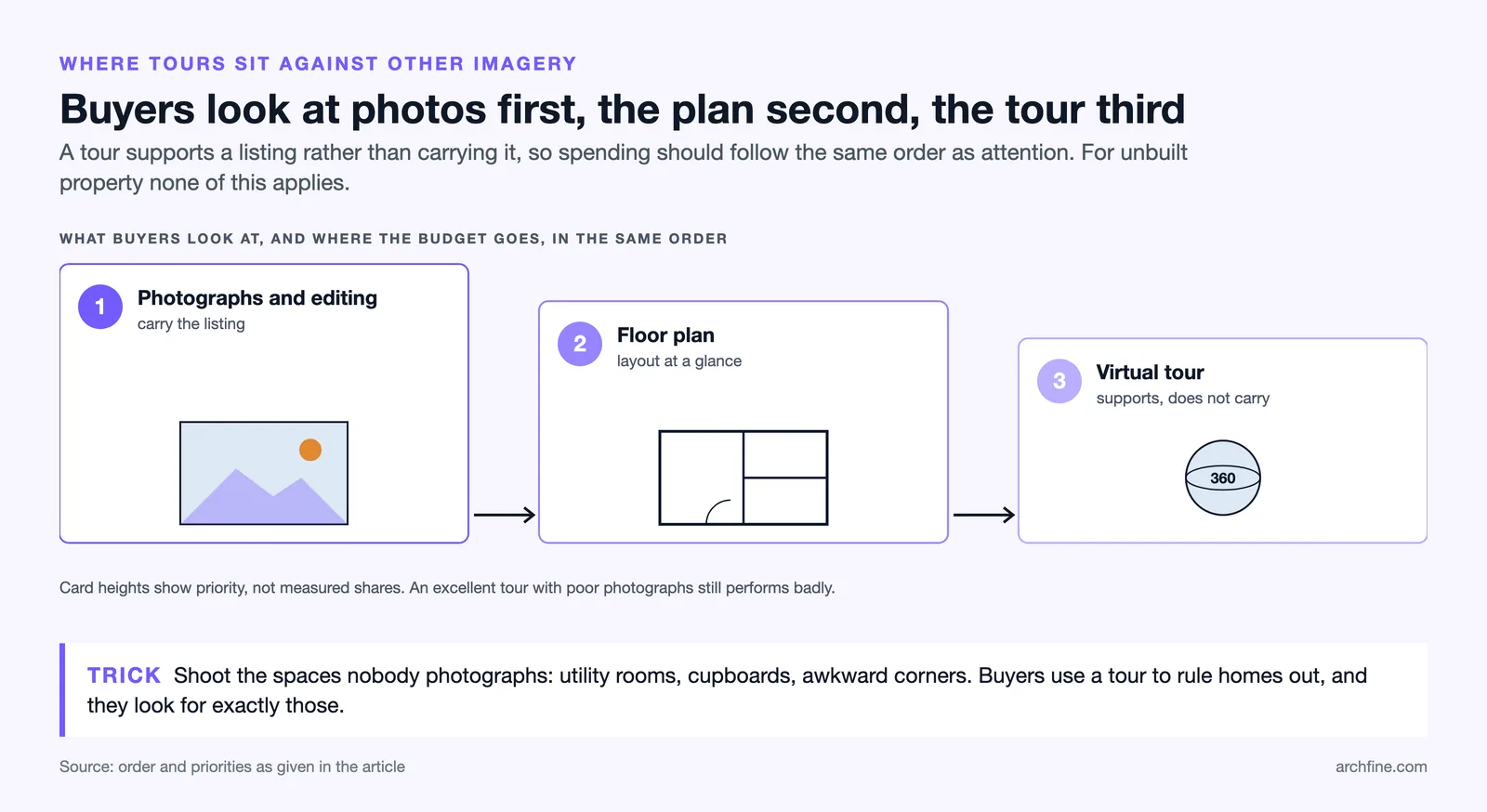
Spending priority should follow that order. Photography and editing first, floor plan second, tour third, an ordering covered in our guide to real estate photo editing.
For unbuilt property none of this applies, since there is nothing to capture. That work is rendered rather than photographed, as our guides to AI real estate visualization and development marketing cover.
The original platform’s own positioning at Matterport’s own published plans is a useful benchmark for what a full featured product includes, and the honest question when comparing is which of those features your work uses.
Choosing
For an agency doing a handful of listings a month, phone capture is sufficient and the saving is substantial.
For volume work where consistency matters commercially, a dedicated platform is easier to justify.
For existing building survey rather than marketing, none of the marketing platforms are the right tool and a measured survey is what you actually need.
Bottom Line: Most people looking for a Matterport alternative need a marketing tour rather than a measured one, and phone capture now covers that at a fraction of the cost. Decide whether dimensions matter before comparing anything else.
What Buyers Actually Do With a Tour
Tours get used to filter rather than to decide. A buyer uses one to rule properties out without visiting, which is valuable to them and to the agent whose time is not wasted on unsuitable viewings.
That changes what a tour needs to do. Completeness matters more than polish, since a tour missing a room raises exactly the suspicion the tour was meant to remove.
Capture every space including the ones nobody photographs. Utility rooms, cupboards and awkward corners are what buyers look for in a tour, precisely because the photographs excluded them.
Tour plus floor plan
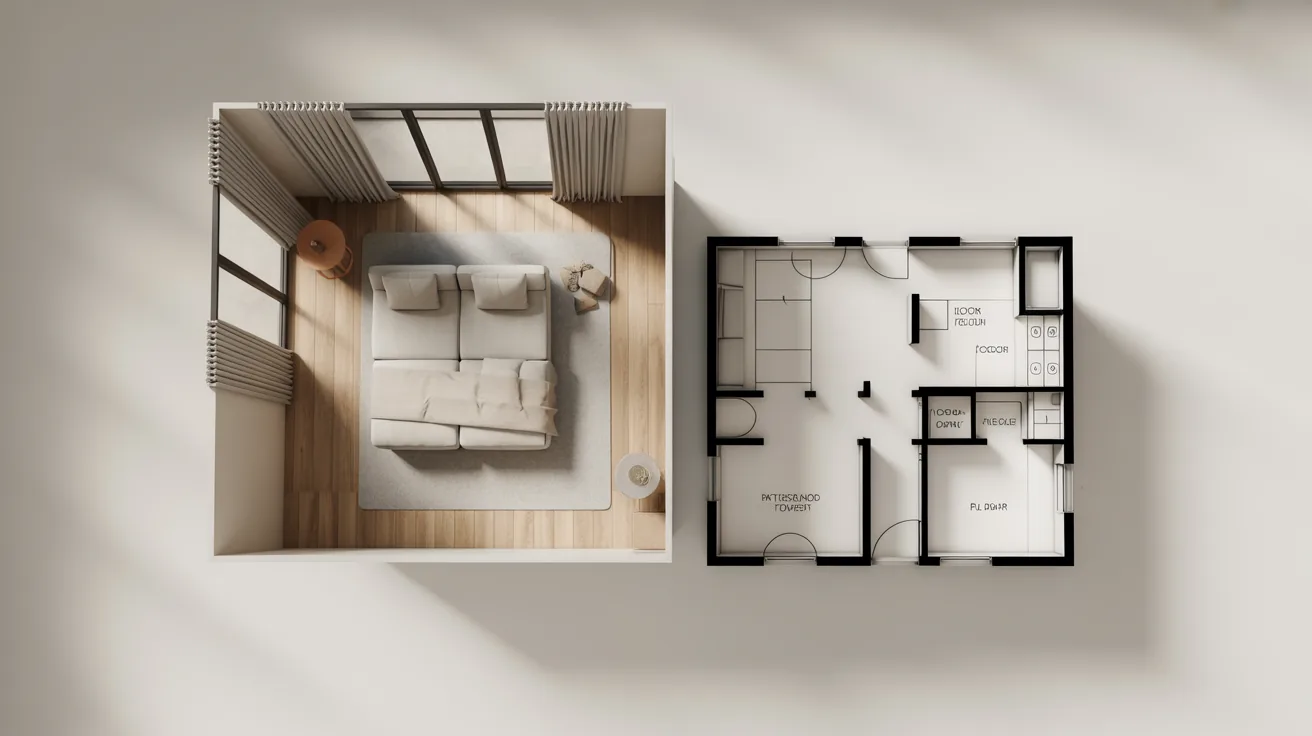
The combination outperforms either alone. The plan gives the layout at a glance and the tour answers what a space feels like, and platforms that produce both from one capture are worth a premium for that reason, as our guide to rendered floor plans covers.
For unbuilt units neither exists, which is where rendered walkthroughs substitute, with the disclosure obligations covered in our guide to development marketing.
Hosting, Ownership and Exit
The tours belong to whoever hosts them, in practice if not in contract. Moving a portfolio of tours between platforms is generally not possible, since each stores its data in its own format.
Ask what happens to existing tours if you stop paying before you commit. Some platforms keep them accessible on a reduced tier and some remove them, and the difference matters for listings that stay live for months.
Keep the raw capture where the platform allows it. Panoramic source images can be rebuilt into a tour elsewhere, and a platform that does not release them is holding the work rather than hosting it.
Embedding and portal rules
Portals restrict what can be embedded and how, and a tour that will not embed cleanly loses most of its value. Check the specific portals you list on before choosing a platform rather than after.
Load speed matters too. A tour that takes fifteen seconds to open loses viewers, and file size optimisation varies considerably between platforms.