Ancient Roman concrete durability is not a myth or an exaggeration. Structures built with Roman concrete over two thousand years ago remain standing in conditions that would destroy modern Portland cement mixes within decades. Harbor walls submerged in saltwater, aqueducts exposed to freeze-thaw cycles, and the Pantheon’s unreinforced dome all survive because of a material composition and curing chemistry that modern science is only now beginning to understand fully.
What Is Roman Concrete and How Was It Made?

The Role of Pozzolana and Seawater

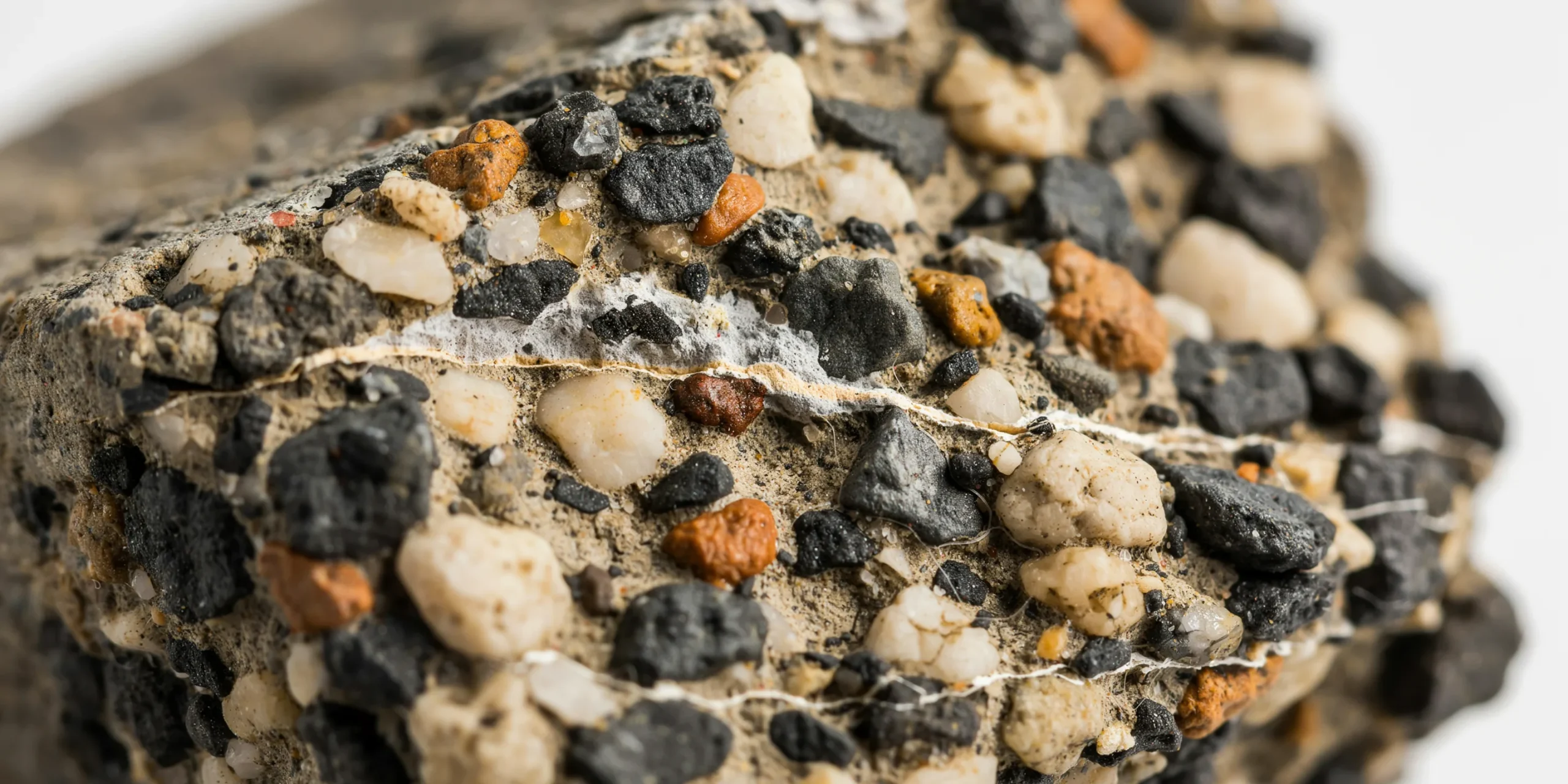
Roman concrete, known as opus caementicium, was made by mixing volcanic ash called pozzolana with lime and, in marine structures, seawater. The volcanic ash came primarily from the area around Pozzuoli, near Naples, which gave the material its name. Unlike modern concrete, which relies on Portland cement as its binding agent, Roman concrete used a chemical reaction between the calcium in lime and the alumina and silica in volcanic ash to form a calcium-aluminum-silicate-hydrate bond.
The use of seawater was long considered a deficiency or a matter of convenience. Researchers have since discovered that it was, in fact, a critical ingredient. The salt in seawater triggered the formation of mineral crystals within the concrete that actually strengthened the material over time rather than weakening it.
Opus Caementicium: The Original Poured Concrete
The Romans did not invent concrete, but they were the first civilization to use it as a primary structural material at scale. Opus caementicium was poured into timber formwork, layered with rubble aggregate such as broken brick and tufa, and allowed to cure slowly. The result was a monolithic mass that could take the shape of arches, vaults, and domes that would have been impossible in cut stone alone.
The Pantheon in Rome, completed around 125 AD, remains the largest unreinforced concrete dome in the world. Its span of 43.3 meters has never been matched in unreinforced concrete. The fact that it still stands after nearly two millennia is the most visible proof that Roman building materials were doing something modern mixes do not.
📌 Did You Know?
The Pantheon’s dome was cast using progressively lighter aggregate as the structure rose. Near the base, the Romans used heavy travertine, followed higher up by terracotta tiles and tufa. Near the oculus at the top, they switched to lightweight volcanic pumice. This is essentially the same variable-density concrete strategy used in advanced engineering today.
Why Does Roman Concrete Last So Much Longer?
The Crystallization Process That Modern Concrete Misses
Modern Portland cement concrete is designed to be inert after curing. Once it sets, the chemical reactions are largely complete. Any further chemical activity, such as the intrusion of saltwater or sulfates, tends to damage the material by causing expansion and cracking.
Roman concrete works in the opposite direction. When seawater penetrates the pozzolanic matrix, it triggers a slow crystallization process that fills voids and microcracks with new mineral growth. The concrete does not just resist deterioration. It repairs itself at a molecular level through ongoing chemical interaction with its environment.
Tobermorite and the Self-Healing Property
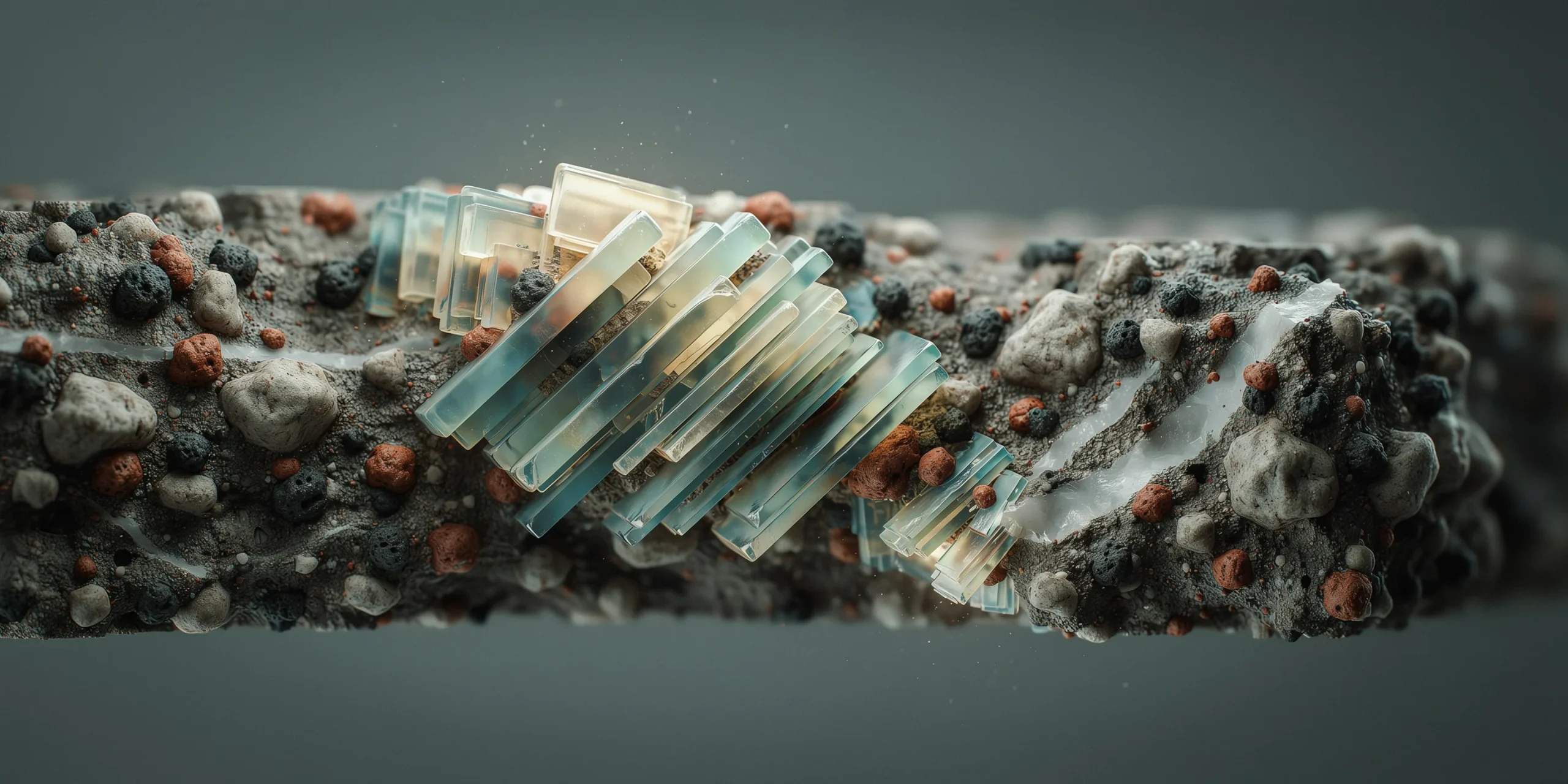

The key mineral involved is aluminous tobermorite, a rare crystal that forms within the concrete when seawater reacts with the volcanic ash and lime matrix. Tobermorite is extremely stable and grows in plate-like formations that reinforce the concrete structure internally. Researchers at UC Berkeley identified tobermorite crystals growing within Roman marine concrete samples taken from harbor structures along the Italian coast.
This self-healing property is the single most significant difference between Roman and modern concrete. Modern concrete deteriorates when exposed to seawater. In Roman concrete, new minerals grow in the cracks and reinforce the binding matrix.
Comparing Roman and Modern Concrete
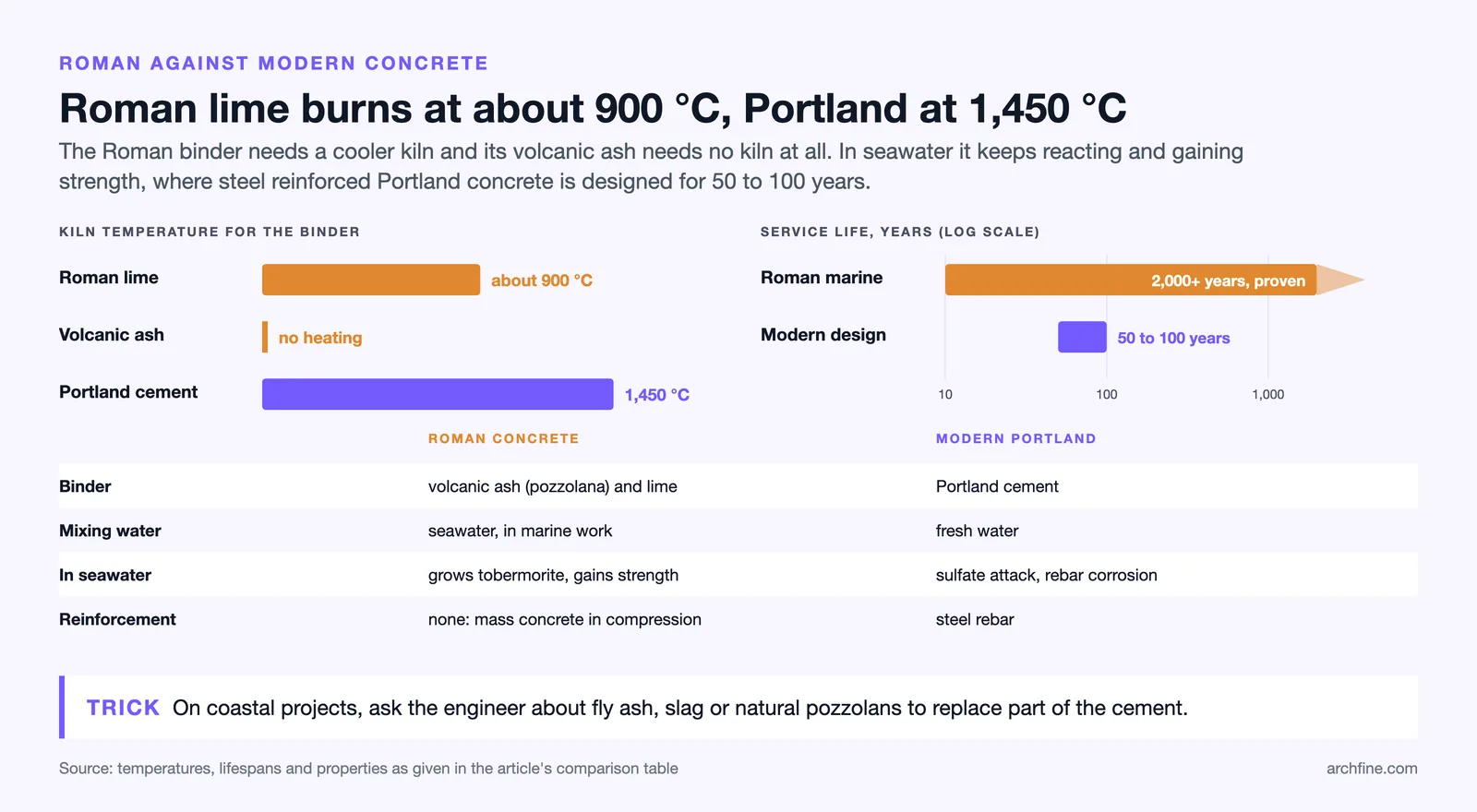
| Feature | Roman Concrete | Modern Portland Cement |
|---|---|---|
| Primary Binder | Volcanic ash (pozzolana) + lime | Portland cement (calcium silicates) |
| Mixing Liquid | Seawater | Fresh water |
| Reaction to Seawater | Strengthens over time (tobermorite growth) | Weakens and cracks (sulfate attack, rebar corrosion) |
| Curing Behavior | Continues to cure and crystallize for centuries | Reaches design strength in 28 days, then degrades |
| Reinforcement | None (unreinforced mass) | Steel rebar (vulnerable to corrosion) |
| Carbon Footprint | Lower (lime production at lower temperatures) | High (cement kilns at 1,450°C) |
| Typical Lifespan | 2,000+ years (proven) | 50-100 years (design life) |
What Researchers Have Discovered in the Last Decade
The UC Berkeley and PNNL Studies (2017-2023)
A series of studies conducted by researchers at the University of California, Berkeley and Pacific Northwest National Laboratory between 2017 and 2023 analyzed drill cores from Roman marine structures including the harbor at Portus Cosanus and breakwaters along the coast near Naples. These studies used X-ray microdiffraction and electron microscopy to identify the mineral structures forming inside the ancient concrete.
The findings confirmed that aluminous tobermorite and phillipsite crystals were growing within the concrete matrix, filling pores and binding aggregate fragments together more tightly than the original mix. The research, published in journals including American Mineralogist and others, provided the first scientific explanation for why Roman marine concrete gained strength in conditions that destroy modern equivalents.
Can We Replicate Roman Concrete Today?
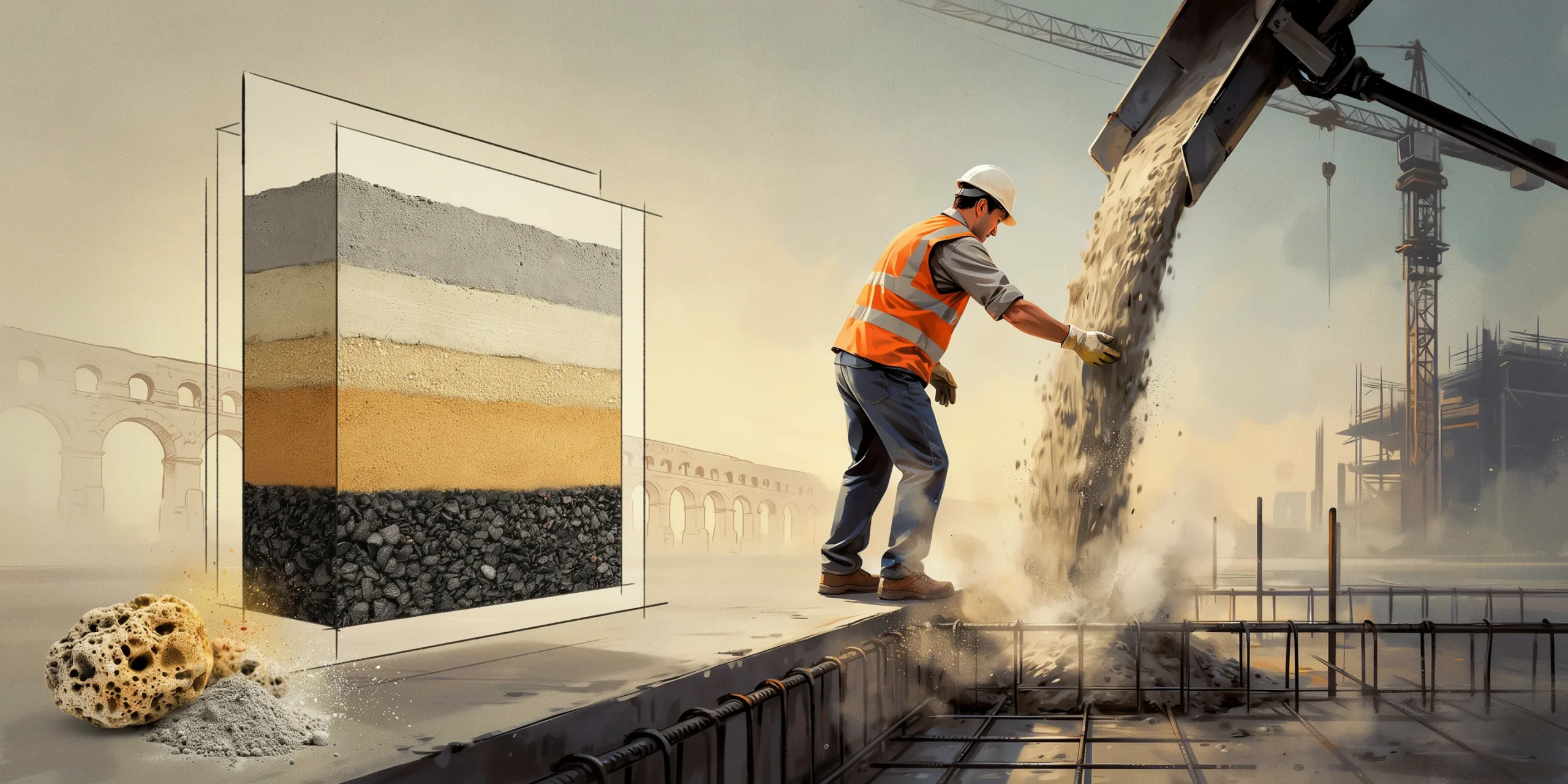
The short answer is: partially. Researchers have successfully produced pozzolanic concrete mixes that exhibit some of the same self-healing behavior observed in Roman samples. The challenge is that modern building codes and construction timelines are not designed for a material that takes years or decades to reach full strength. Roman concrete cured slowly, sometimes over months or years. Modern construction demands predictable 28-day strength targets.
There is also a supply question. The specific volcanic ash the Romans used came from a particular geological formation near Pozzuoli. While similar pozzolanic materials exist elsewhere, including fly ash from coal combustion and volcanic deposits in Iceland and the western United States, the exact mineral composition varies and produces different results.
💡 Pro Tip
If you are specifying concrete for a project with long-term marine or coastal exposure, ask your structural engineer about supplementary cementitious materials (SCMs) such as fly ash, slag, or natural pozzolans. These are the closest commercially available equivalents to the Roman pozzolanic approach and can measurably extend the service life of concrete in aggressive environments.
Practical Implications for Contemporary Architecture
Low-Carbon Concrete Alternatives Already in Use
The lessons from Roman architecture extend beyond durability into carbon reduction. Portland cement production is responsible for approximately 8% of global CO2 emissions. Every ton of cement requires heating limestone and clay to around 1,450°C, releasing both combustion emissions and process emissions from the chemical conversion of limestone to calcium oxide.
Roman-style pozzolanic reactions occur at significantly lower temperatures. Lime production requires kiln temperatures of roughly 900°C, and volcanic ash requires no heating at all. Several concrete companies are now developing low-carbon concrete formulations that replace a portion of Portland cement with pozzolanic materials, reducing both the energy input and the carbon output of the mix.
⚠️ Common Mistake to Avoid
Assuming that “Roman concrete” is a direct replacement for modern structural concrete. It is not. Roman concrete was used as unreinforced mass in compression. It was not designed for the tensile loads that modern reinforced concrete handles. The lessons are about chemistry and durability, not about abandoning rebar.
Where Pozzolanic Mixes Are Being Applied Now
Pozzolanic concrete mixes are already being specified in infrastructure projects where long-term durability in marine or chemically aggressive environments matters most. The Concrete Centre and similar industry bodies have published guidance on the use of fly ash and ground granulated blast furnace slag as partial cement replacements in structural concrete.
In architecture, the implications are most relevant for buildings with expected lifespans of 100 years or more, for coastal construction, and for projects where carbon accounting is a design constraint. The Roman example shows that concrete longevity in architecture is not a theoretical ceiling. It is a proven outcome of the right material choices, and those choices are becoming available again.
✅ Key Takeaways
- Roman concrete used volcanic ash and seawater, creating a mix that strengthens over time instead of degrading.
- The mineral tobermorite grows within Roman concrete when exposed to seawater, effectively healing cracks and filling voids.
- Modern Portland cement concrete reaches peak strength at 28 days and then slowly deteriorates, especially in marine environments.
- Recent research at UC Berkeley and PNNL has provided the first scientific explanation for Roman concrete’s exceptional durability.
- Low-carbon concrete alternatives using pozzolanic materials are now commercially available and draw directly on the same chemistry the Romans used.