ChatGPT for architects is most useful on the written and administrative half of practice rather than on design. Specification drafting, planning correspondence, meeting notes, fee proposals and document summarising all absorb hours that nobody bills happily, and generated first drafts genuinely reduce that.
Where it is least useful is anything requiring judgement about a specific building, because it has no access to your project and no way to verify what it says. ChatGPT for architects is a drafting assistant rather than a design one.
The line between those two is the whole subject.
Where ChatGPT for Architects Actually Helps
Specification platforms such as NBS already structure much of this work, and generated text sits alongside rather than replacing them.
Document drafting is the strongest case. Design and access statements, planning covering letters, specification clauses and project descriptions all follow conventions, and a first draft written to those conventions saves real time.
Summarising is the second. Consultant reports, planning policy documents and long email chains reduce to something readable in seconds, which changes whether they get read at all.
Correspondence is the third and the most underrated. The difficult email to a client about a cost increase is easier to write when something else produces a starting point to react against.
Research framing is the fourth. Explaining an unfamiliar standard, comparing construction approaches or listing what a submission usually contains works well as a starting point that you then verify.
⚠️ Common Mistake to Avoid
Never accept a regulation, standard number or dimension without checking it. Language models produce confident specific answers including invented clause numbers, and a specification citing a standard that does not say what you claimed is the practice’s problem rather than the software’s. Verify every citation against the source.
Where It Does Not Help
Anything requiring knowledge of your project. It has not seen your drawings, your site or your client, so advice about the design is generic by definition.
Regulatory compliance. Building regulations differ by jurisdiction, are published by national authorities in their own documents, change regularly, and are exactly the kind of specific factual content where confident invention is most likely.
Structural or technical calculation. It will produce a number and the number may be wrong, and there is no way to tell from the output which it is.
Design judgement. Whether a scheme is any good is not a question with a computable answer, which is the theme our guide to whether AI will replace architects works through.
Adjacent Disciplines
Interior designers use the same tools for client communication, mood board framing and specification writing, with the visual work covered separately in our guide to AI interior design rendering.
Landscape architects face the same limitation as everywhere else in this category: plant knowledge is specific, seasonal and regional, and generated planting advice is unreliable, as our guide to AI garden design covers.
Urban planners get more from the analytical tools than from language models, since the questions are spatial and data driven, which is what platforms such as the one in our Autodesk Forma review address.
By task
| Task | Useful? | Verification needed |
|---|---|---|
| Drafting a letter or statement | Yes | Facts and figures only |
| Summarising a report | Yes | Check key conclusions |
| Specification clauses | Partly | Every standard reference |
| Regulation questions | No | Use the source document |
| Calculations | No | Use an engineer |
| Design decisions | No | Not applicable |
Client Confidentiality
This is the part practices handle worst. Pasting a client’s brief, a fee proposal or a consultant report into a general tool sends it to a third party, and most appointment agreements have something to say about that.
Check what your tool does with input before using it on anything project specific. Business tiers generally offer stronger data handling than consumer ones, and the difference is contractual rather than technical.
Anonymise where you can. A specification clause does not need the client’s name in it, and a summarising task rarely needs identifying information.
Professional guidance from bodies such as RIBA and the AIA treats client information as a duty rather than a preference, and no software changes that.
💡 Pro Tip
Give it your practice’s own writing as the model rather than asking for a generic document. Pasting two previous statements and asking for a third in the same voice produces something that sounds like your office, which is the difference between a usable draft and one that needs rewriting entirely.
Building It Into Practice
Decide what it may be used for and write it down. Practices without a position end up with everyone making individual judgements about client data.
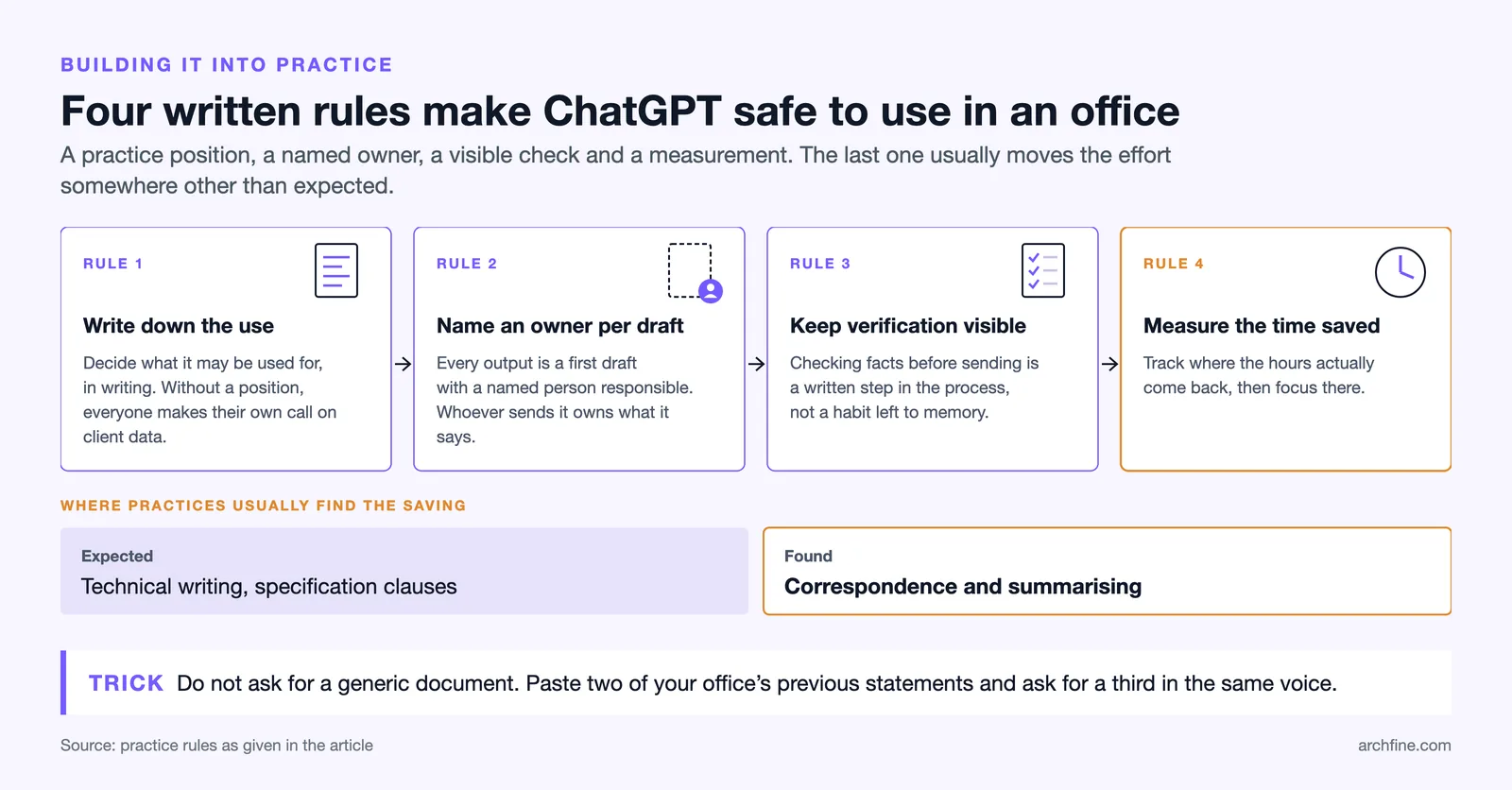
Treat every output as a first draft with a named person responsible for it. Whoever sends a document owns what it says, regardless of what wrote the first version.
Keep the verification step visible. The habit that prevents problems is checking facts before sending, and habits survive better when they are written into a process rather than left to memory.
Measure whether it actually saves time. Practices frequently find the saving is in correspondence and summarising rather than in the technical writing they expected, which changes where to focus.
Bottom Line: ChatGPT is a drafting and summarising tool for the administrative half of practice, and it is unreliable on anything specific and factual. Use it where a first draft saves time, verify every number and citation, and keep client information out of it.
What Good Prompting Looks Like Here
Supply context rather than asking for expertise. Pasting the relevant policy extract and asking for a response to it produces something usable, while asking what the policy says produces something invented.
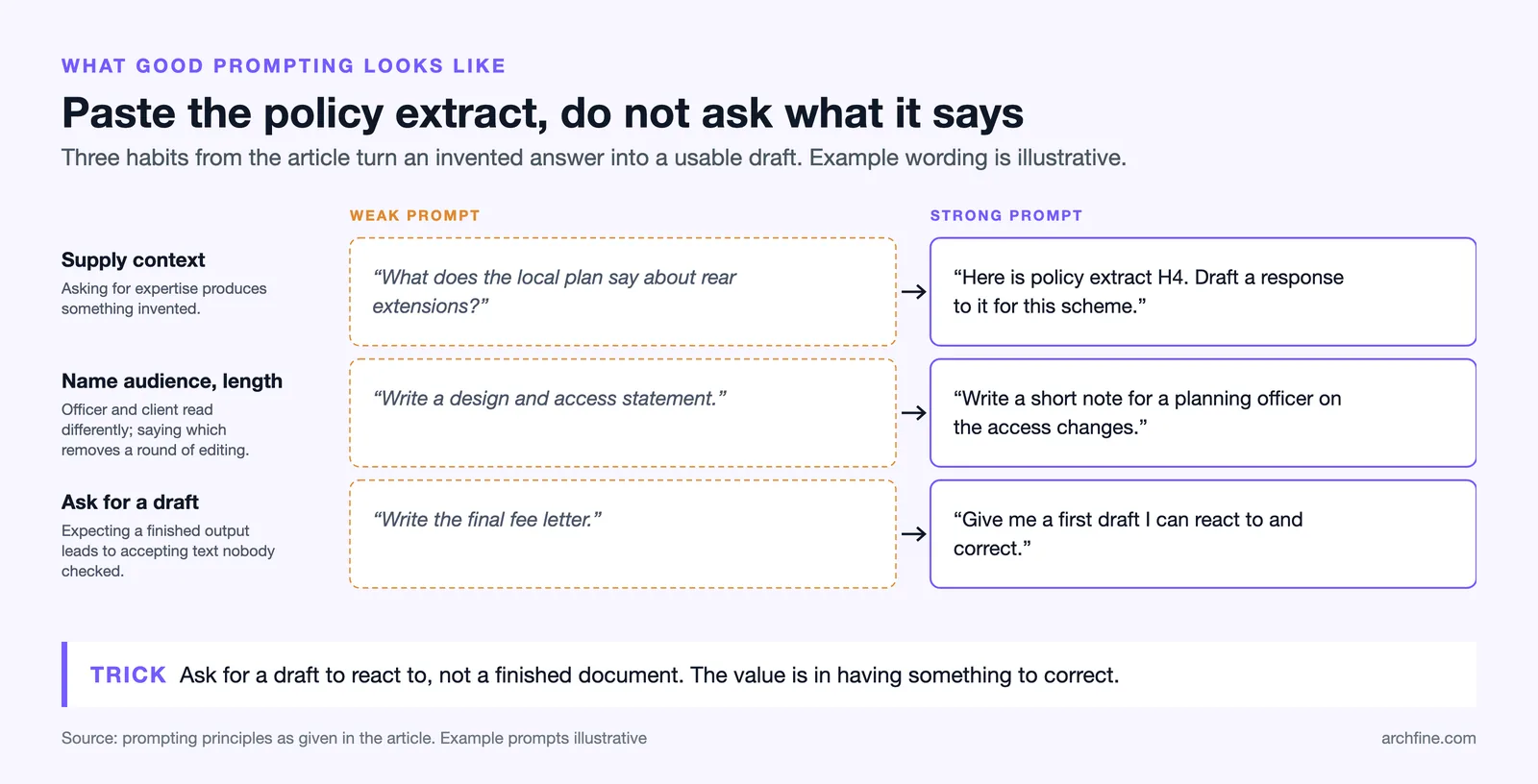
Specify the audience and length. A statement for a planning officer and a note for a client read differently, and stating which one you want removes a round of editing.
Ask for a draft to react to rather than a finished document. The value is in having something to correct, and expecting a finished output leads to accepting text nobody checked.