Will AI replace architects is the wrong question, and the more useful one is which parts of the job it replaces. The answer so far is the production work: images, first draft documents, option generation and repetitive drawing. The parts that involve judgement, liability and negotiating between people remain untouched.
That distinction matters because the production work is a large share of what junior staff do, which is where the real disruption sits. Asking will AI replace architects therefore points at the wrong level of the profession.
Here is an honest look at what has actually changed, what has not, and what the profession should be watching.
What AI Has Already Changed
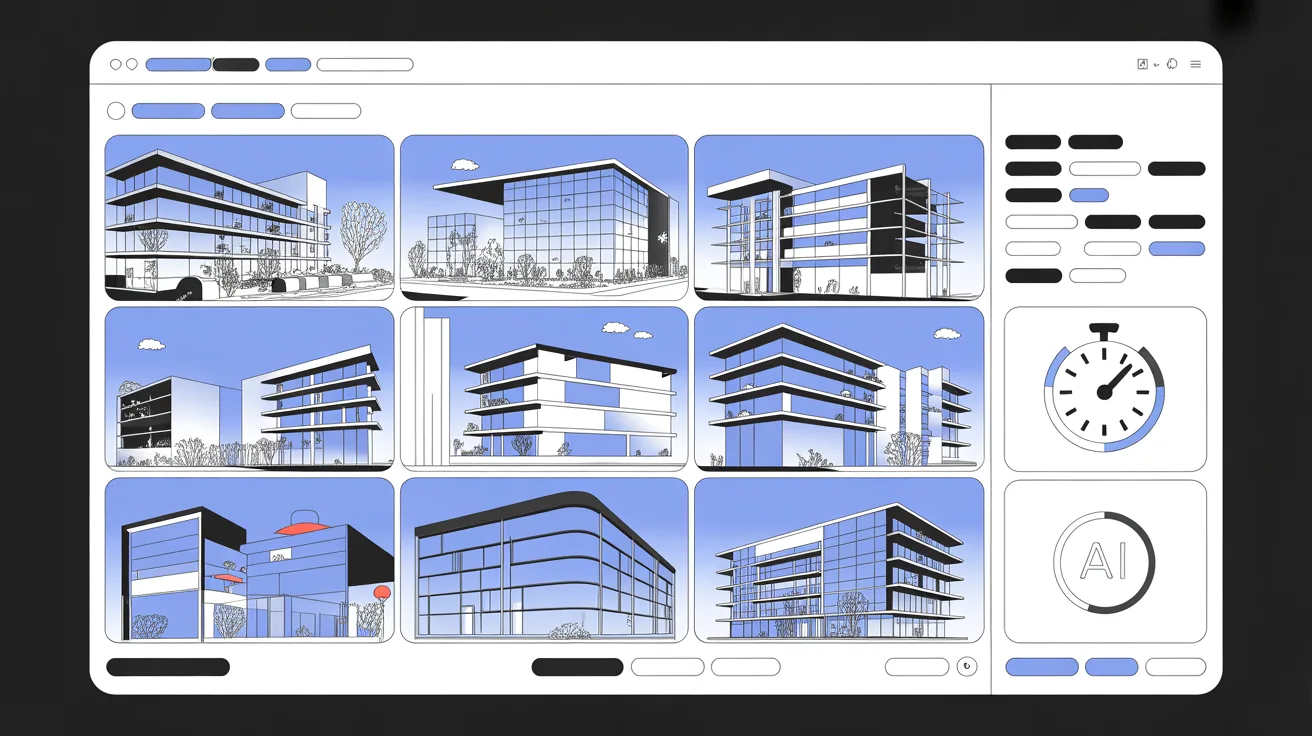
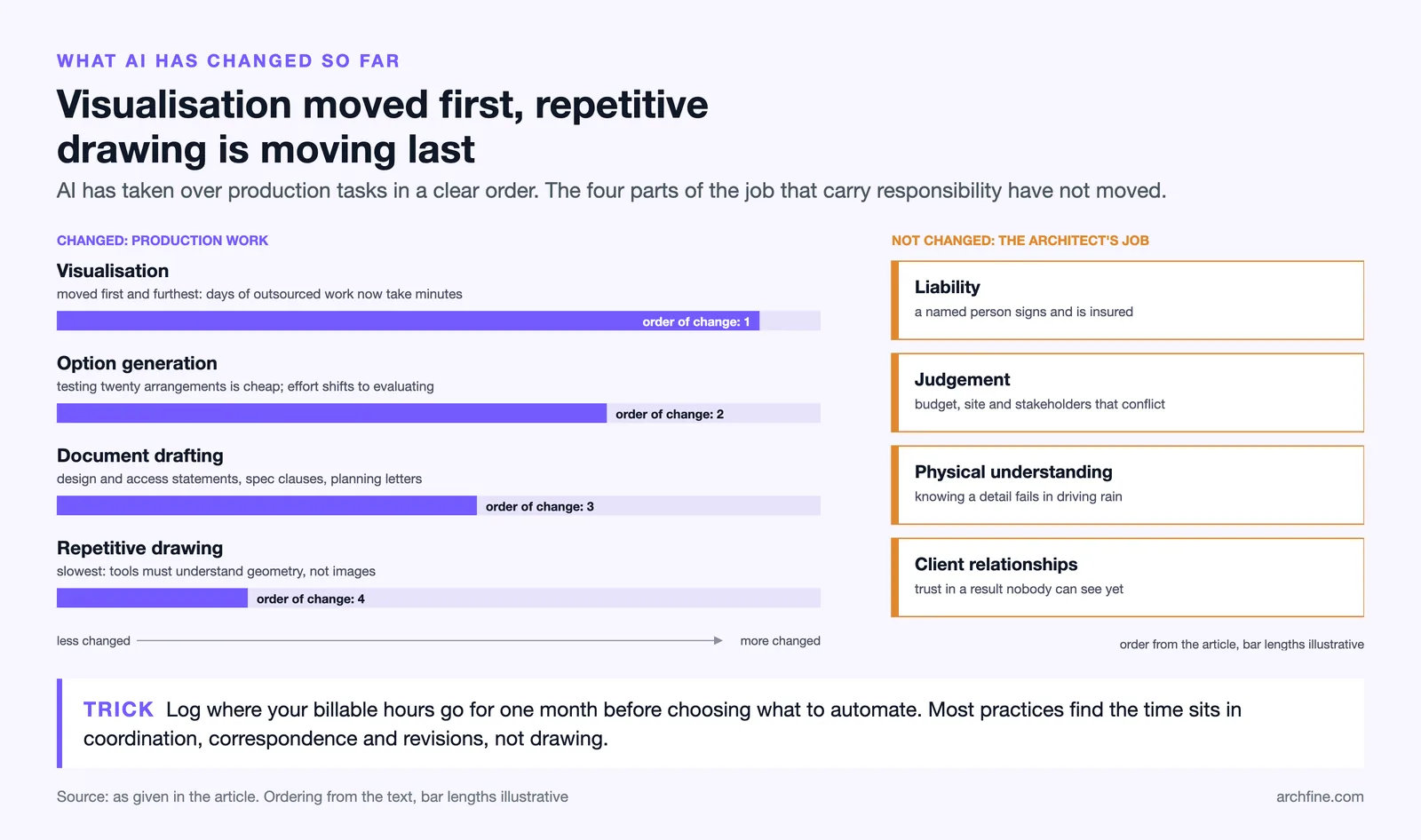
Visualisation moved first and moved furthest. Images that cost hundreds of pounds and several days now cost minutes, which has removed a whole tier of outsourced work from small practice budgets.
Option generation changed next. Testing twenty arrangements is now cheap, which shifts effort from producing options to evaluating them.
Document drafting changed quietly and substantially. Design and access statements, specification clauses and planning correspondence all absorb time that generated first drafts reduce.
Repetitive drawing is changing more slowly, since the tools that automate it need to understand geometry rather than images, which is a harder problem.
Will AI Replace Architects on What It Has Not Changed?
Liability sits with a person. Someone signs the drawings, and professional indemnity insurance attaches to a named individual with a duty of care. No current legal framework allows that to transfer to software.
Judgement under conflicting constraints is the second. Every project involves a budget that will not cover the brief, a site that resists the plan, and stakeholders who want incompatible things. Resolving that is negotiation rather than optimisation.
Physical understanding is the third. Knowing that a detail will fail in driving rain, that a material will stain, or that a space will feel oppressive comes from having seen buildings age.
Client relationships are the fourth and the most underrated. A significant part of architectural practice is persuading people to trust a decision they cannot yet see the result of.
💡 Pro Tip
Track where your billable hours actually go for a month before deciding what to automate. Most architects assume the answer is drawing and discover it is coordination, correspondence and revisions. The tools that help are rarely the ones the profession is talking about.
The Junior Staff Problem
The genuine structural risk is not to architects as a profession but to the entry level roles that trained them.
Traditional practice taught through production work. Drawing details, producing images and marking up revisions is how people learned what buildings are made of, and it was billable while they learned.
If that work is automated, the training path narrows. A practice that no longer needs three people producing visuals also no longer has three people gaining experience, and the profession loses its intake mechanism.
Practices thinking about this seriously are redesigning what junior roles do rather than reducing them, which is a harder and more useful response than either denial or headcount cuts.
What the Tools Cannot Do Yet
| Capability | Current state | Why it is hard |
|---|---|---|
| Consistent images of one building | Unsolved without a model | Image models have no persistent subject |
| Code compliant layouts | Not attempted seriously | Regulations differ by jurisdiction |
| Structural feasibility | Absent from design tools | Requires engineering, not pattern matching |
| Cost implications of a design | Invisible | Depends on local market and method |
| Taking responsibility | Not possible | Legal rather than technical |
Copyright and Authorship
Who owns a generated image is unsettled in most jurisdictions, and practices using them commercially are relying on terms of service rather than on settled law.
The training data question is separate and equally unresolved. Models learned from images that architects and photographers made, and no mechanism currently compensates them.
For a practice the practical position is to read the licence of any tool used commercially, and to avoid presenting generated imagery as a design proposal without saying what it is.
⚠️ Common Mistake to Avoid
Do not put a generated image into a planning or tender submission. Whatever the tool’s licence says, the image makes claims about a building that no model supports, and the practice that submitted it carries that. Marketing use and submission use are different categories with different consequences.
What Professional Bodies Are Saying
Guidance from bodies such as RIBA and the AIA has focused on disclosure, competence and responsibility rather than on prohibition, which is the sensible position.
The consistent thread is that using a tool does not transfer responsibility. An architect who issues a drawing is responsible for it regardless of what produced the first draft.
Coverage of how the profession is adapting appears regularly on ArchDaily, and the pattern across practices is adoption at the front of projects and caution at the delivery end.
A Reasonable Position to Take
Use the tools where they are genuinely good, which is exploration, imagery and first drafts. Refusing on principle costs time and produces no advantage.
Check everything that leaves the office. The check step is short and it is the whole difference between a tool and a liability.
Invest in the parts of the job that are not automatable, which are judgement, detail knowledge and client relationships. Those have become more valuable rather than less as production has got cheaper.
Keep the model as the source of truth. Practices that let images drift away from geometry accumulate problems, which is the argument for tools that read a model rather than an image, as our roundup of AI design tools and our guide to what rendering actually is both set out.
Bottom Line: AI has replaced production tasks, not architects. The real question facing the profession is not survival but how people will learn the job once the work they learned it through is automated.
What Practices Are Actually Doing
Adoption is uneven and follows practice size rather than enthusiasm. Small practices adopted fastest because the visualisation budget was the constraint, and large practices moved slowly because process and liability matter more than speed.
The common pattern is generation at the front of a project and traditional methods at the delivery end, with a check step in between that nobody had two years ago.
What has changed less than expected is headcount. Practices report doing more with the same people rather than fewer, largely because the work expands to fill the capacity, as our roundup of AI design tools and our guide to rendering cost both reflect.
The skills that got more valuable


Judging an image critically, knowing what a detail does in the rain, and explaining a decision to someone who disagrees. None of these were automated, and all of them became scarcer relative to production capacity.
What to Watch Next
Model based tools closing the accuracy gap is the development that matters most, because it removes the main reason to keep AI imagery away from project work.
Regulatory awareness would be the second, and nothing credible exists yet. A tool that understood local code would change design work rather than production work.
Liability frameworks are the third and the slowest. Until someone other than the signing architect can carry responsibility, the shape of the profession is fixed regardless of what the tools can do.
What is unlikely to change is the value of judgement about physical things, which is why detail knowledge and material understanding have become more valuable rather than less.