Quiet architecture and memorable buildings share a relationship that runs counter to what the media cycle rewards. The buildings that generate the most attention at completion are often the noisiest: the tallest, the most unusual in form, the most aggressively styled. But the buildings people remember decades later, the ones that architects study and visitors return to, tend to be restrained. They earn their place in memory not through spectacle but through the quality of the experience they create for the people inside them. Understanding why this pattern holds is useful for anyone designing buildings intended to last.
What Is ‘Quiet Architecture’?
Restraint vs. Minimalism: Not the Same Thing
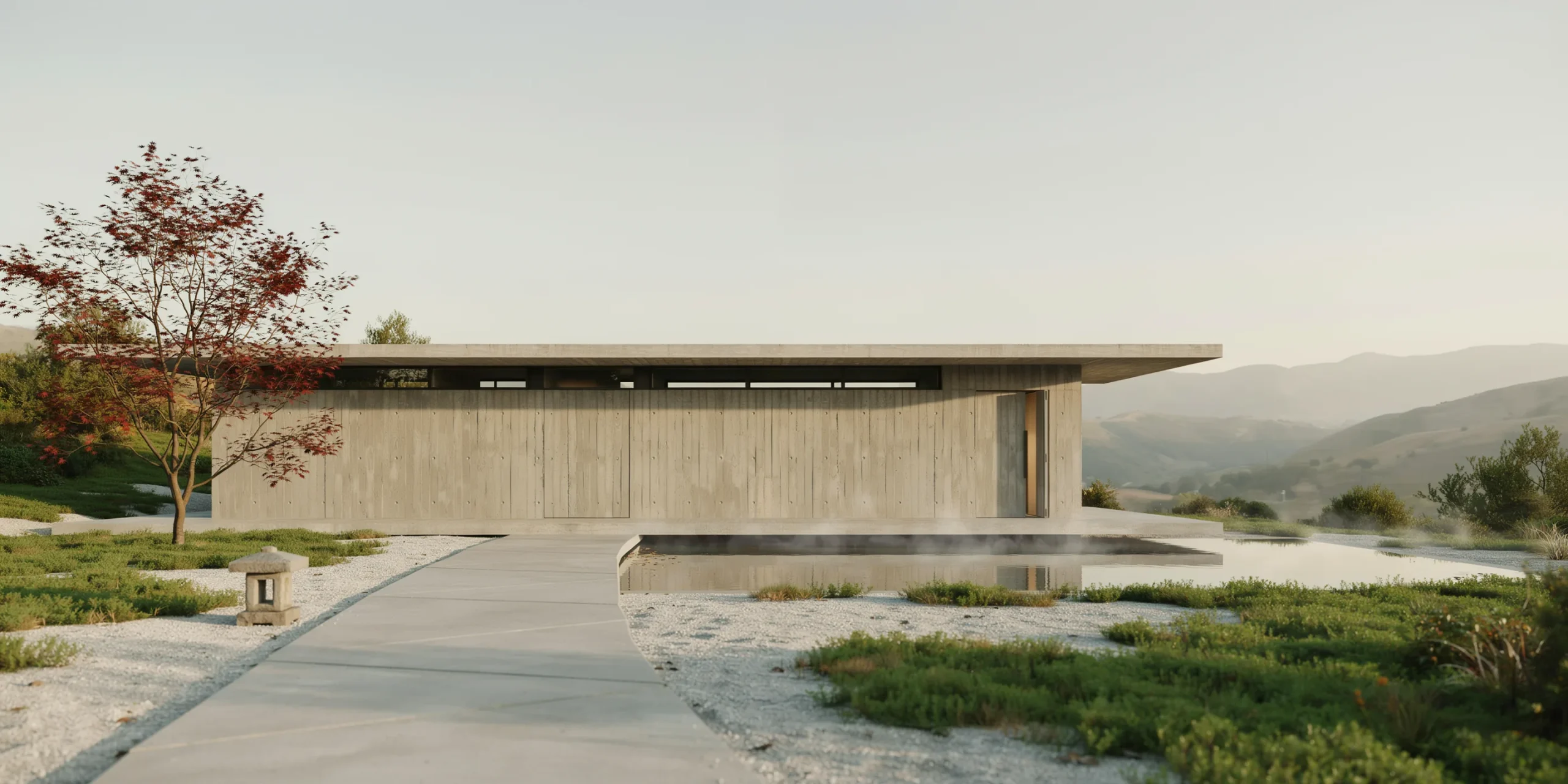
Quiet architecture is often confused with minimalism, but the two are distinct. Minimalism is a formal strategy: reduce the number of elements, simplify the palette, eliminate ornament. It can produce quiet buildings, but it can also produce buildings that are aggressively minimal, where the reduction itself becomes the spectacle. A building with a single material, no visible joints, and razor-thin edges can be louder than a building with multiple materials and traditional details, because the extreme reduction draws attention to itself.
Restraint in architecture is something different. It is the decision to let the building recede slightly so that the occupant’s experience comes forward. A restrained building may use several materials, include ornamental details, and have a complex plan. What makes it quiet is that none of these elements compete for attention. They work together to support the experience of being in the space rather than looking at the building from outside.
How Context Determines Whether a Building Shouts or Listens
A building’s loudness or quietness is always relative to its context. A glass tower in a historic district shouts. The same glass tower in a business park barely registers. A brick building with traditional proportions in a row of brick terraces listens to its neighbors. The same building dropped into a modernist campus might feel like a provocation.
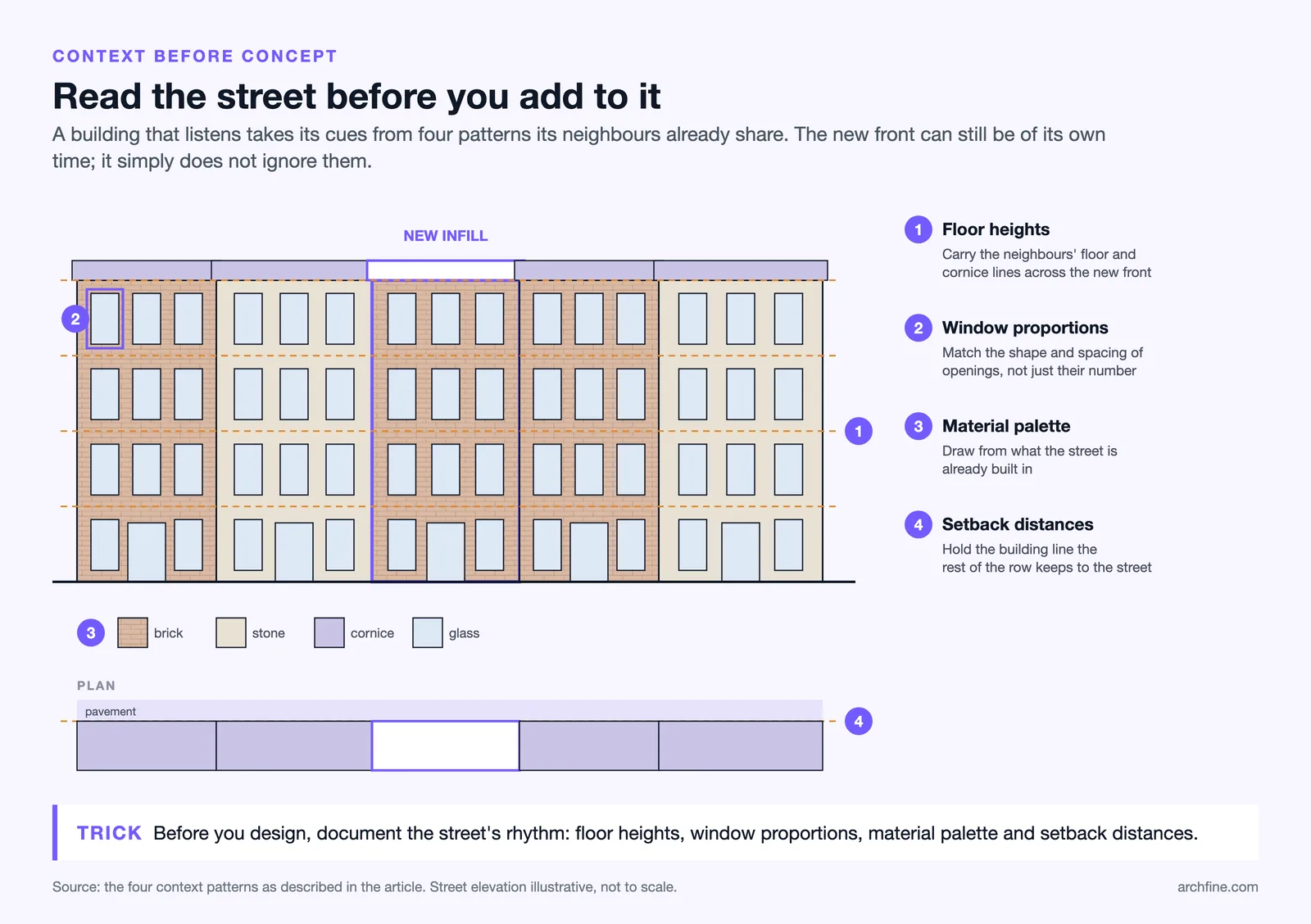
Contextual architecture and its lasting impact depend on this sensitivity to surroundings. Buildings that respond to their context, taking cues from neighboring buildings’ scale, materials, and rhythm, tend to age better than buildings that assert their independence from everything around them. The quiet building is not timid. It is confident enough to belong to its place rather than demanding to stand apart from it.
💡 Pro Tip
Before starting the design of any building, spend time documenting the visual rhythm of the street or site context: the typical floor heights, the window proportions, the material palette, the setback distances. A building that acknowledges these patterns, even while introducing something new, will feel more grounded and more likely to endure than one that ignores them entirely.
Why Loud Buildings Often Don’t Age Well
Spectacle as a Strategy That Depends on Novelty
Buildings designed for maximum visual impact at the moment of completion face a structural problem: impact depends on novelty, and novelty fades. A building that surprises with its form in 2010 is familiar by 2015 and dated by 2025. The visual strategy that generated press coverage and social media attention at opening becomes, over time, the thing that makes the building look like a product of a specific era rather than a timeless addition to its city.
This is not a judgment about the quality of the design. It is an observation about how human perception works. We habituate to visual stimuli. A building that relies on being visually startling will inevitably become unstartling. Architecture that endures works through qualities that do not depend on surprise: light, proportion, material texture, spatial sequence, and the quality of the relationship between interior and exterior.
What Happens When the Surprise Is Gone
When the novelty of a spectacular building wears off, what remains is the building’s everyday performance: how it feels to walk through, how it handles rain, how its materials age, how it works for the people who use it daily. Many loud buildings perform poorly on these measures because the design energy was directed toward the exterior image rather than the occupant experience.
Buildings that age well, by contrast, tend to reveal their qualities slowly. A visitor who returns to Peter Zumthor’s Therme Vals ten years after their first visit notices details they missed before: the way light falls differently in winter, the way the stone surface changes color when wet, the sound of water in the corridors. The building rewards repeated experience because its qualities are not exhausted in a single visit. Loud buildings often deliver their entire message on first encounter, leaving nothing to discover on return.
📌 Did You Know?
When architectural critics compile lists of the greatest buildings of the 20th century, the results are dominated by quiet buildings: the Salk Institute, the Kimbell Art Museum, the Barcelona Pavilion, the Farnsworth House. Very few buildings known primarily for their spectacular form appear on these lists. The buildings that endure in critical esteem are almost always those that prioritize spatial experience over visual shock.
Buildings That Became Memorable Through Restraint
Sverre Fehn’s Nordic Pavilion, Venice
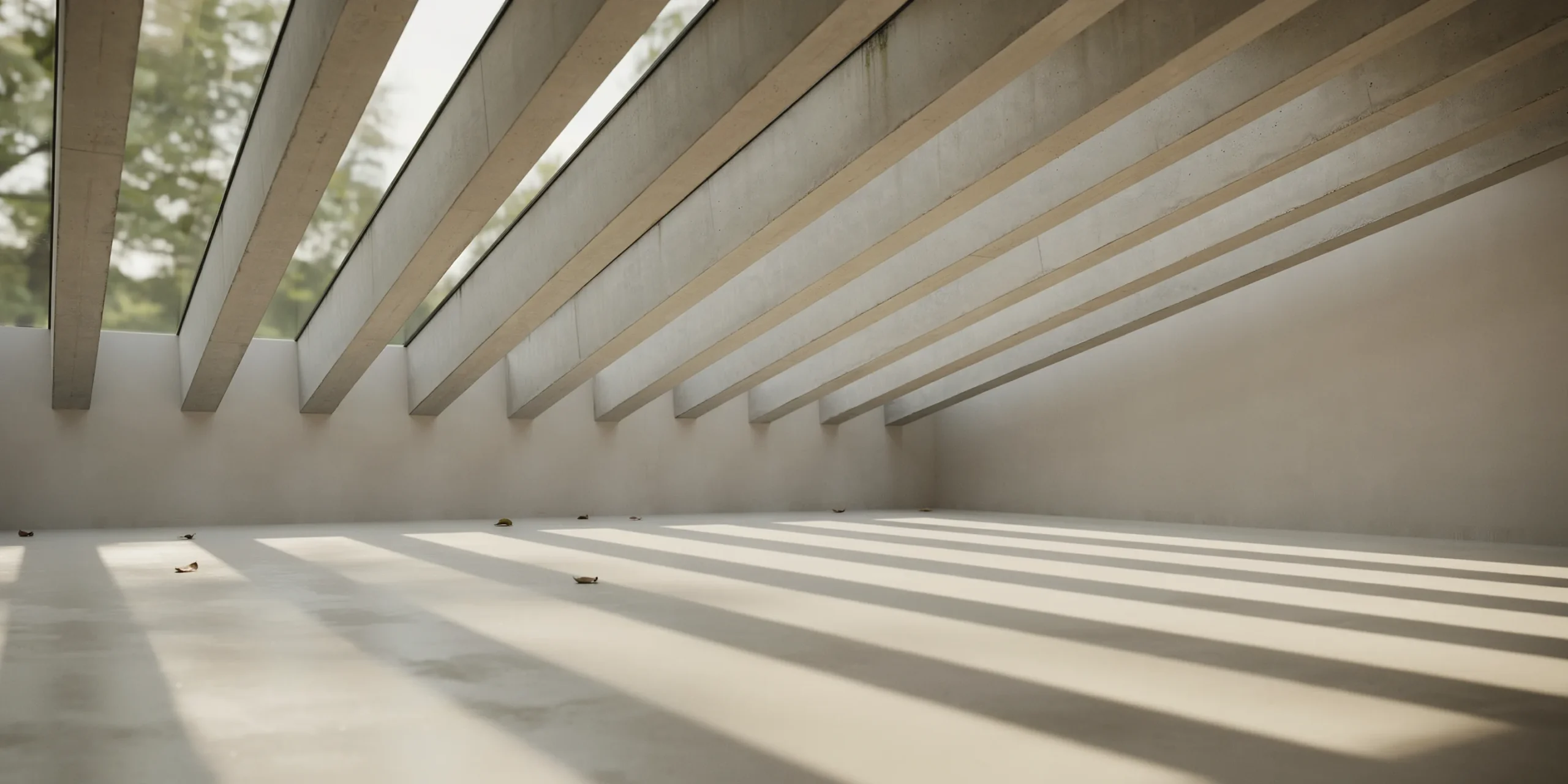
The Nordic Pavilion in the Giardini della Biennale in Venice, designed by Norwegian architect Sverre Fehn and completed in 1962, is a single-story concrete structure with a slatted concrete roof that filters daylight into the gallery below. The building sits among trees, and the roof structure was designed to allow existing trees to grow through it, blurring the boundary between building and landscape.
There is nothing loud about the Nordic Pavilion. It is a simple rectangular volume with a refined roof structure. Its power lies in the quality of the light inside: a soft, even illumination that changes throughout the day as the sun moves across the roof slats. Visitors remember the experience of being inside the building long after they have forgotten the details of the facade. The building is quiet, and that quietness is precisely what makes it memorable.
Álvaro Siza’s Portuguese Pavilion, Expo 98
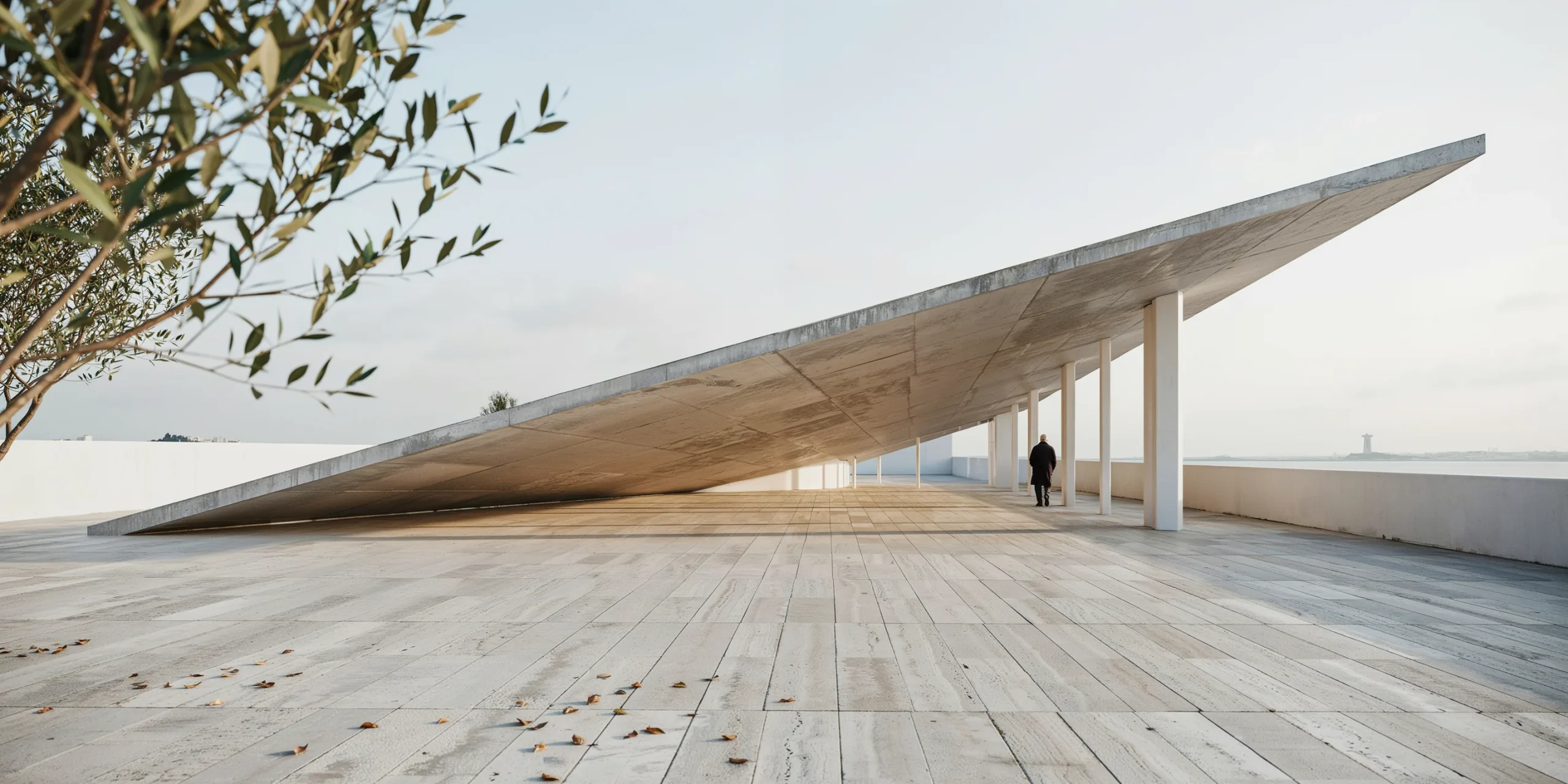
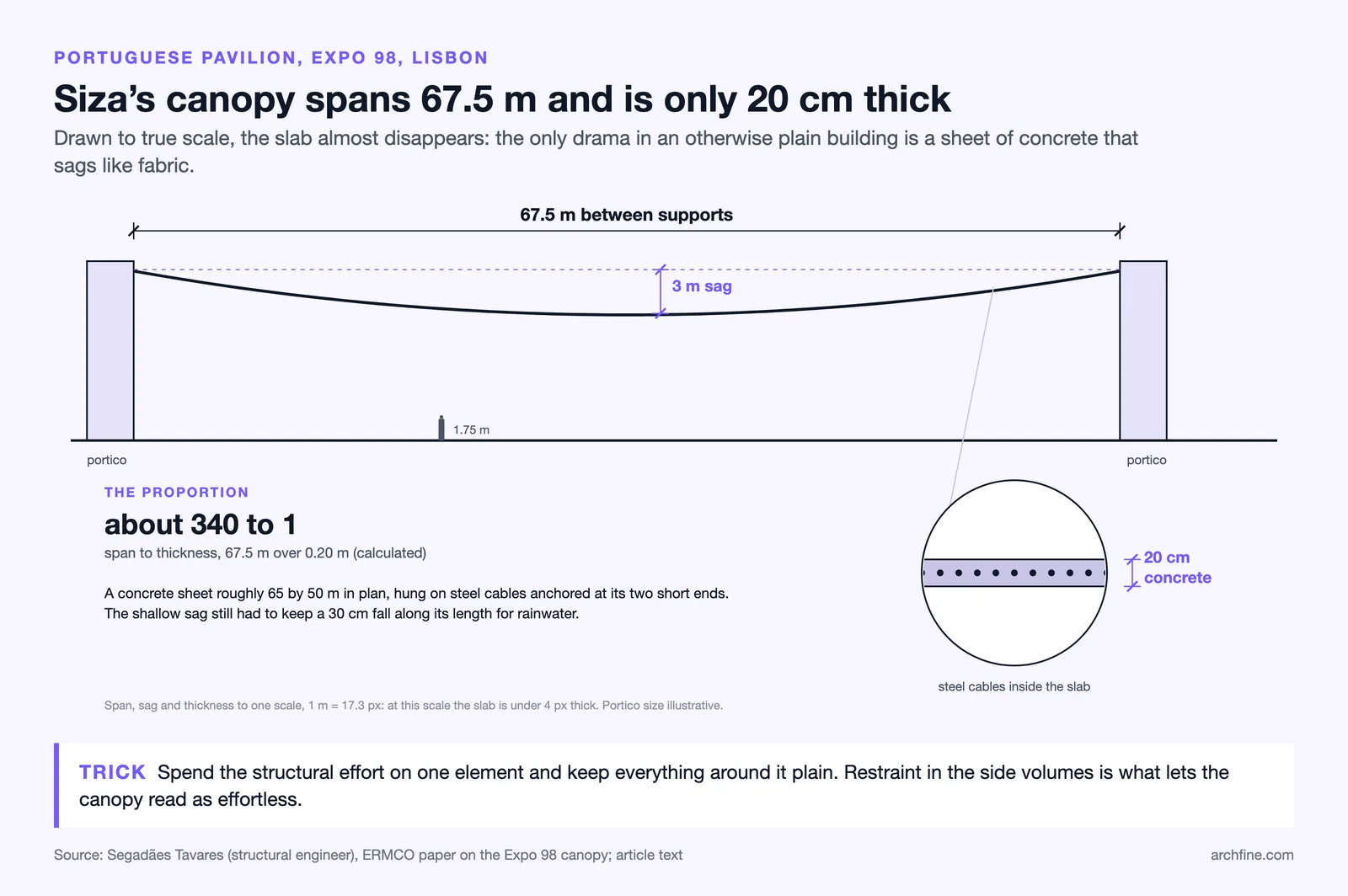
Siza’s Portuguese Pavilion for the 1998 Lisbon Expo is defined by a single dramatic element: a thin concrete canopy that spans an outdoor plaza between two buildings, sagging slightly under its own weight like a sheet of fabric. The rest of the building is restrained to the point of severity: white rendered walls, simple rectangular volumes, minimal detailing.
The canopy is spectacular, but the building as a whole is quiet. Siza did not attempt to make every surface compete for attention. He concentrated the architectural energy on one element and allowed everything else to support it through simplicity. The result is a building where the understated architecture examples of the side volumes make the canopy more powerful, not less. Restraint amplifies the one moment of drama.
🏗️ Real-World Example
The concrete canopy of Siza’s Portuguese Pavilion spans 67.5 meters between its supports and is only 20 centimeters thick. The engineering required to achieve this span in a sheet this thin was considerable, but the visual effect is one of effortless simplicity. The building does not announce its technical achievement. It presents it as something natural, even inevitable. That understatement is what makes it so striking.
Peter Zumthor’s Thermal Baths at Vals
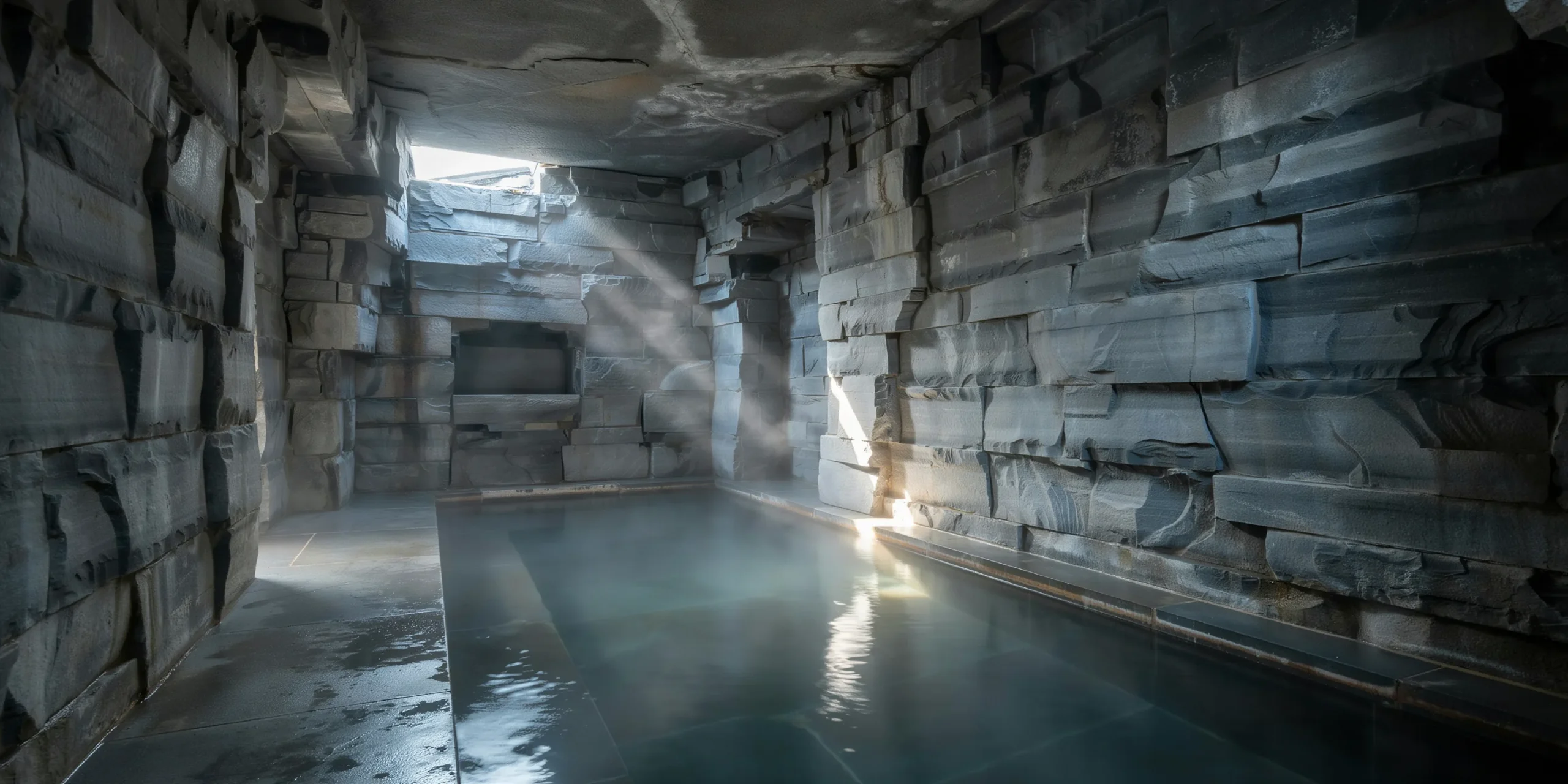
Zumthor’s Therme Vals, completed in 1996, is built into a hillside in the Swiss Alps using locally quarried gneiss stone. The building is organized as a series of stone-lined chambers containing pools of varying temperature, connected by narrow passages and illuminated by carefully controlled slots of natural light. The exterior is barely visible from the village: a grass-covered roof and a stone wall that appears to grow from the landscape.
The building is among the most celebrated of the last fifty years, and it achieves this status entirely through the quality of the interior experience. There is no signature facade, no dramatic form, no immediately recognizable silhouette. The architecture is felt rather than seen. The Pritzker Prize jury cited Zumthor’s ability to create buildings of extraordinary sensory richness through material, light, and spatial sequence rather than through formal invention. Vals is the definitive example of minimalist memorable architecture that works through experience rather than image.
What Quiet Architecture Requires From the Architect
The Discipline of Removing Rather Than Adding
Designing a quiet building is harder than designing a loud one. Loudness can be achieved through addition: more material, more color, more formal complexity, more engineering. Quietness requires subtraction: removing everything that does not contribute to the spatial experience and trusting that what remains is sufficient. This requires confidence, because a quiet design can look unfinished or ordinary on paper, even when it performs beautifully in reality.
The discipline of reduction means making fewer decisions, but making each one with greater precision. The mortar joint width, the exact shade of the stone, the position of a window relative to the light it admits: in a quiet building, these details are the architecture. They cannot be hidden behind visual noise or compensated for by dramatic form.
Trusting the Occupant’s Experience Over the Rendering
Quiet buildings are difficult to sell through renderings and photographs. A rendering rewards visual drama: strong shadows, vivid colors, unusual angles. A quiet building’s greatest qualities, including the way light moves through a room, the texture of a wall under a hand, and the acoustic quality of a corridor, cannot be captured in a still image.
This creates a professional challenge. Architects are selected for projects largely through visual presentations, and a quiet design may struggle to compete with a visually louder alternative in a competition or client pitch. The architects who produce the most enduring quiet work tend to be those who have built enough trust with their clients to be judged on completed buildings rather than on renderings. The Architectural Review and similar publications have noted that many of the most admired buildings of the past half-century were designed by architects who were already trusted by their clients, allowing them to propose designs that relied on experience rather than image.
💡 Pro Tip
If you are presenting a restrained design to a client or jury, supplement renderings with physical material samples, light studies (physical models photographed in natural light), and reference visits to completed buildings with similar qualities. Quiet architecture communicates through direct experience better than through images. Bring the experience into the room.
The Relationship Between Quiet Architecture and Longevity
The connection between restraint and durability is not coincidental. Buildings that rely on spectacle are tied to the aesthetic moment of their creation. When that moment passes, the building can feel dated in a way that a restrained building does not. A well-proportioned stone wall, a carefully placed window, a room with good light: these qualities do not belong to any particular decade. They are properties of space and material that remain effective regardless of changing tastes.
This is why simple buildings are memorable over long periods. They do not carry the burden of a strong stylistic signature that must be maintained against shifting fashion. They present themselves as what they are: space, light, material, proportion. These are the permanent elements of architecture, the ones that survive the cycle of novelty and rejection that loud buildings inevitably face.
The buildings that age well do so because they were designed around durable qualities rather than temporary effects. The quiet building does not need the world to stay still in order to remain relevant. It adapts to changing uses, changing tastes, and changing occupants because its qualities are fundamental rather than fashionable. That is the case for restraint, and it is supported by the evidence of every great building that has endured while its louder contemporaries have been forgotten or demolished. That argument has a name and a discipline behind it, which our guide to minimalist architecture sets out.
✅ Key Takeaways
- Quiet architecture is not the same as minimalism. Restraint means letting the occupant’s experience take priority over the building’s visual impact.
- Loud buildings depend on novelty, which fades. Quiet buildings depend on spatial quality, light, and material texture, which do not.
- The Nordic Pavilion, the Portuguese Pavilion, and the Therme Vals are among the most celebrated buildings of the past century, and all achieve their power through restraint rather than spectacle.
- Designing quiet buildings requires greater precision in detailing and the confidence to trust that a restrained design will perform better in reality than it looks on paper.
- Buildings that age well are almost always those built around durable architectural qualities rather than temporary stylistic effects.