Airports have evolved far beyond functional transit hubs. Today, the world’s most ambitious terminals push the boundaries of structural engineering, parametric design, and sustainable architecture. From starfish-shaped mega-terminals in Beijing to indoor rainforests in Singapore, these projects represent some of the boldest architectural achievements of the 21st century. In this guide, we explore the most futuristic airport designs ever built and examine what makes each one a landmark of contemporary architecture.
1. Beijing Daxing International Airport, China

Architect: Zaha Hadid Architects (ZHA) & ADP Ingénierie (ADPI)
Completed: 2019
Terminal Area: 700,000 m² (7.5 million sq ft)
Annual Capacity: 45 million passengers (initial), up to 100 million at full build-out
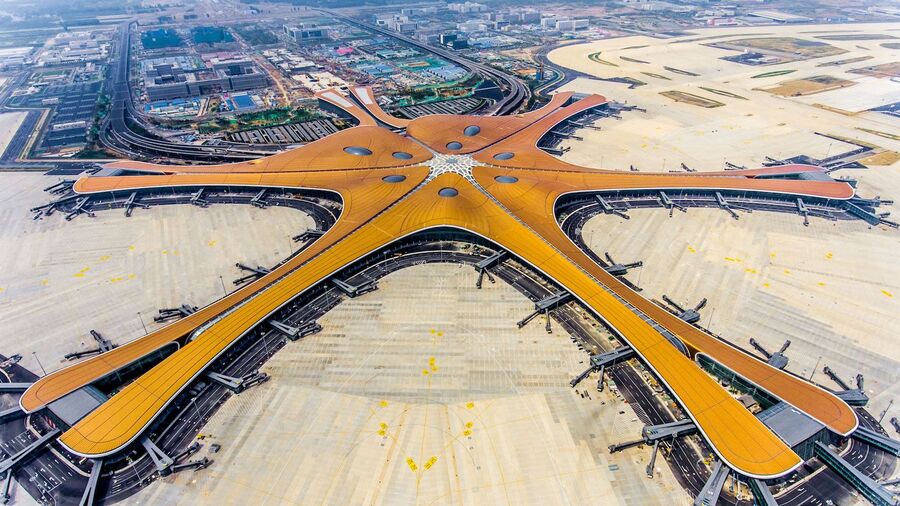
Beijing Daxing stands as possibly the most futuristic airport terminal in the world. Designed by Zaha Hadid Architects in collaboration with ADPI, the terminal draws on principles of traditional Chinese architecture, organizing interconnected spaces around a central courtyard. Six flowing forms within the vaulted roof reach down to ground level, serving as both structural supports and sources of natural light. The project is extensively documented on ArchDaily.
The compact, radial layout of the building is one of its most innovative features. Despite covering 700,000 m², the farthest boarding gate is accessible within an eight-minute walk from the center. This was achieved by stacking international and domestic levels vertically around a central retail atrium, which facilitates direct routes for passengers, particularly those with connecting flights.
The terminal’s steel roof structure spans over 350,000 m² and contains more than 170,000 individual steel members. Engineering firm Arup designed the large-span hyperboloid grid structure with 420 load combinations. The project cost approximately $11.5 billion, with over 40,000 workers on site at peak construction. The airport features four civilian runways and integrates with Beijing’s high-speed rail network.
Sustainability was central to the design. The airport includes photovoltaic panels generating at least 10 MW of power, a ground-source heat pump system covering nearly 2.5 million m², and a rainwater collection system capable of processing up to 2.8 million cubic meters of water through constructed wetlands and streams. The project won multiple awards including the Architizer A+ Award for Transportation Infrastructure in 2020.
Cristiano Ceccato, ZHA’s aviation project lead, described the design philosophy as prioritizing minimum connection times through the star-shaped form and moving walkways along each spoke. The parametric approach allowed the team to create generous column-free public spaces with structural spans of up to 100 meters. A detailed profile of the completed airport is available on Dezeen.
2. Singapore Changi Airport & Jewel Changi
Architect: Safdie Architects (Jewel) / Multiple firms (terminals)
Completed: 2019 (Jewel)
Jewel Area: 135,700 m² (1.46 million sq ft)
Airport Capacity: 65+ million passengers annually
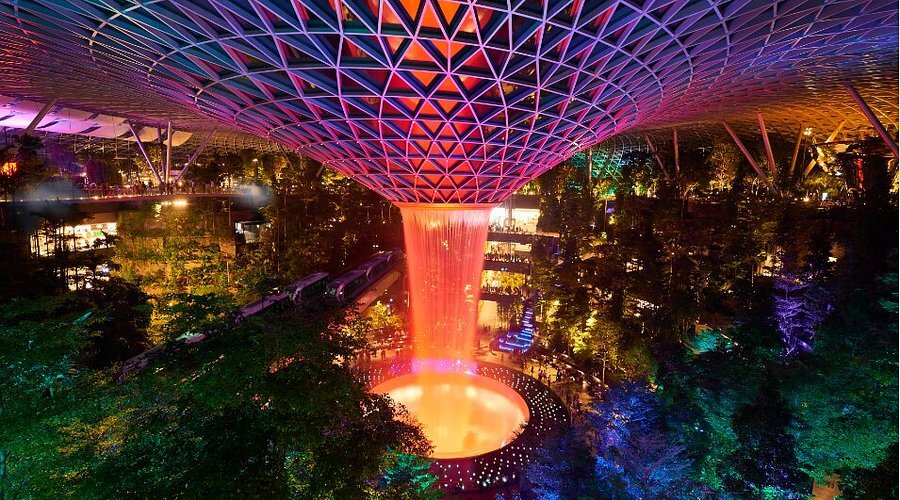
Changi Airport has consistently been named the world’s best airport by Skytrax, and the opening of Jewel in 2019 cemented its status as a destination in its own right. Designed by Moshe Safdie and his firm Safdie Architects, Jewel is a masterwork of biophilic design, merging an immense tropical garden with a retail marketplace inside a toroidal glass dome.
At the apex of the dome sits the Rain Vortex, the world’s tallest indoor waterfall at 40 meters. The waterfall was engineered by WET Design, a California-based firm run by former Disney Imagineers. During Singapore’s powerful thunderstorms, recirculated natural rainwater flows through the oculus at rates exceeding 10,000 gallons per minute. The waterfall is not merely decorative; it actively contributes to cooling the interior space and collecting rainwater for reuse throughout the building.
Jewel’s glass dome is constructed from over 9,300 custom-cut, double-glazed panels, and no two panels are identical. The facade was engineered by BuroHappold Engineering. The slightly off-center placement of the Rain Vortex, designed to avoid an existing inter-terminal tram line, gave the building its distinctive irregular torus shape.
The five-story Shiseido Forest Valley houses more than 2,000 trees and 100,000 shrubs representing over 200 plant species. The landscape was designed by PWP Landscape Architecture. Visitors can explore walking trails that climb 30 meters in elevation, bounce on suspended nets 25 meters above the ground, and cross a glass-bottom bridge. On the fifth level, the Canopy Park includes a hedge maze, mirror maze, and event plaza for 1,000 guests.
Safdie described his intention to create something timeless rather than Disney-like, aiming to uplift passengers from the stress of travel. Today, approximately 60% of Jewel’s visitors are Singapore residents with no travel plans, demonstrating how successfully the design transformed an airport into a genuine public gathering space. Architectural Record published an in-depth technical review of the project.
3. Istanbul Airport, Turkey
Architect: Grimshaw Architects, Nordic Office of Architecture, Haptic Architects
Completed: 2018 (Phase 1)
Terminal Area: ~1,000,000 m² (Phase 1)
Annual Capacity: 90 million passengers (Phase 1), up to 200 million at completion
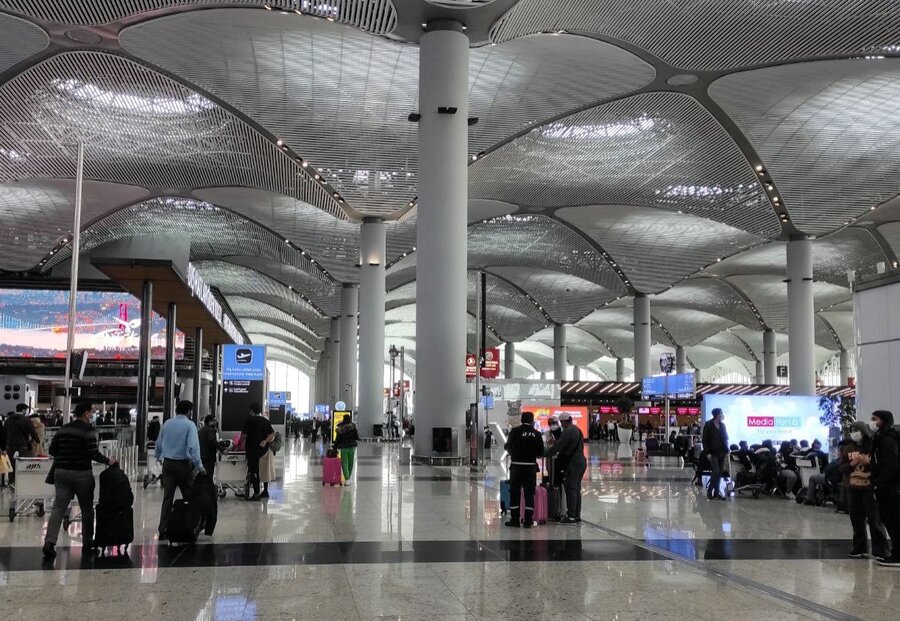
Istanbul Airport is one of the largest airport terminals in the world under a single roof. The concept design by Grimshaw, Nordic Office of Architecture, and Haptic Architects was intended to reflect the city’s rich cultural heritage spanning Byzantine, Ottoman, and modern Turkish traditions. The terminal’s vaulted ceilings, pierced with carefully positioned skylights, evoke the spatial grandeur of Istanbul’s historic mosques while serving a thoroughly modern purpose.
The design uses focused beams of natural daylight to highlight key functional areas such as check-in counters, security checkpoints, and retail zones. This approach serves double duty: it reduces energy consumption from artificial lighting while creating an intuitive wayfinding system for passengers. The interior color palette draws from the ever-changing hues and tones of Istanbul, with layered slatted roof elements revealing a subtle range of blue tones and geometric patterns. The project’s full design documentation is available on ArchDaily.
Istanbul Airport demonstrates how cultural narrative and passenger flow optimization can be designed simultaneously. The vaulted canopy geometry provides a strong sense of directionality from landside to airside while the roof’s structural logic echoes the city’s rich architectural heritage. This dual-purpose approach is increasingly becoming a standard for mega-airport design.
Located on the Black Sea coast 35 kilometers from the city center, the airport is masterplanned by Arup and integrated with Istanbul’s metro, rail, and bus networks through a transportation hub at its entrance. The tulip-shaped control tower pays homage to Turkey’s national flower and has become an architectural icon in its own right.
4. Kansai International Airport, Japan
Architect: Renzo Piano Building Workshop
Completed: 1994
Terminal Length: 1.7 km
Location: Man-made island in Osaka Bay
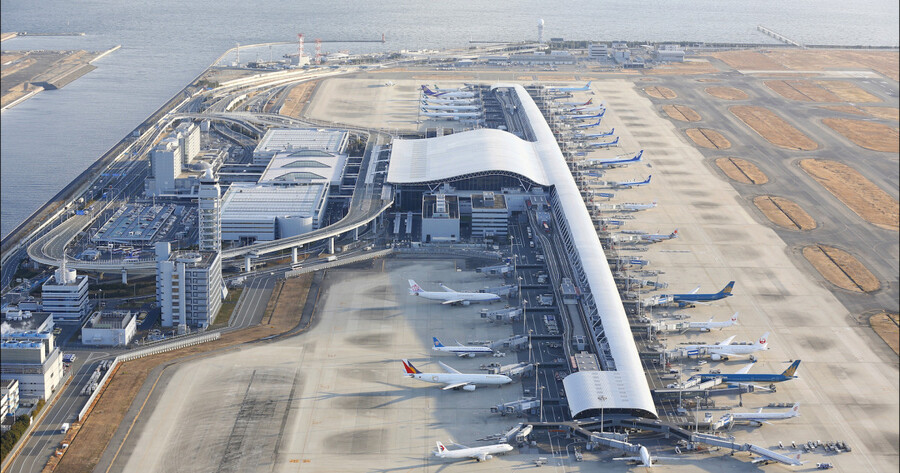
Kansai International Airport remains one of the most remarkable engineering achievements in aviation history. Built entirely on a man-made island stretching four kilometers into Osaka Bay and connected to the mainland by a bridge, the airport was designed by Renzo Piano to sit harmoniously within its marine environment.
Piano shaped the terminal building like a wave or airfoil, with a gently curving roof canopy that extends 1.7 kilometers and connects 42 boarding gates. The aerodynamic form was not just aesthetic; the curved roof was specifically engineered to withstand Japan’s frequent earthquakes and typhoon-force winds. Just four months after opening, Kansai survived the devastating 6.9-magnitude Kobe earthquake in 1995 with minimal damage, validating the structural approach.
Kansai’s survival of the 1995 Kobe earthquake proved that innovative airport design need not sacrifice structural integrity for aesthetic ambition. The airport’s curved roof canopy effectively distributes seismic loads, a principle that has influenced subsequent airport designs in earthquake-prone regions worldwide.
The interior features an open-plan layout that allows natural light to flood through the curved glass walls, reducing the need for artificial lighting during daylight hours. Structural canyons running through the terminal provide natural illumination to lower levels, contributing to reduced energy consumption. Kansai pioneered many of the sustainable design principles now standard in modern airport architecture.
5. Denver International Airport, USA

Architect: Fentress Architects
Completed: 1995
Site Area: 13,726 hectares (53 sq mi)
Annual Passengers: 69+ million
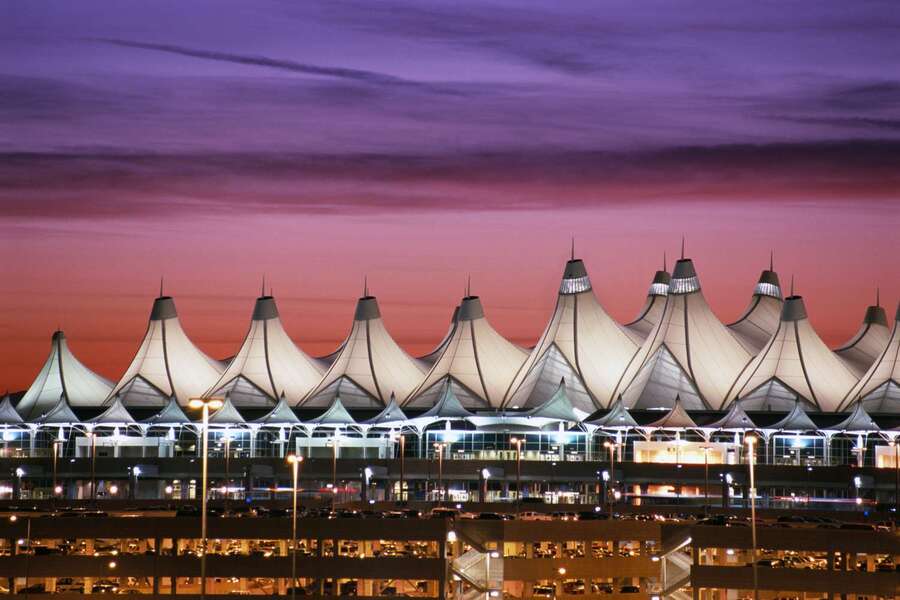
Denver International Airport transformed airport design by demonstrating that a terminal building could become a city’s defining architectural symbol. Designed by Fentress Architects, its iconic tensile fabric roof evokes the snow-capped Rocky Mountains visible from the terminal. The peaked white fabric canopy has become one of the most recognizable airport silhouettes in the world.
The roof material was chosen for practical as well as aesthetic reasons. The Teflon-coated fiberglass fabric allows 10% of natural daylight to filter through, dramatically reducing the need for artificial lighting. Given that Denver enjoys roughly 300 days of sunshine per year, this translates to significant energy savings. The fabric also reflects approximately 90% of solar radiation, substantially reducing cooling loads inside the terminal.
Denver’s tensile roof spans 34 tent-like peaks, each raised on its own mast, with the masts set in two rows. The airport sits on one of the largest sites of any airport in the world at over 53 square miles. The 327-foot-tall air traffic control tower, also by Fentress, was designed to blend with the city’s skyline and is flooded with natural light through its crow’s nest-like observation deck.
To speed up construction, the design team moved the terminal’s mechanical systems underground instead of onto the roof, which let the translucent fabric roof bring daylight deep into the Great Hall, a recurring theme in Fentress’s airport work that prioritizes the passenger experience.
6. Hamad International Airport, Qatar
Architect: HOK (masterplan and design)
Completed: 2014
Terminal Area: 600,000+ m²
Annual Capacity: 53 million passengers
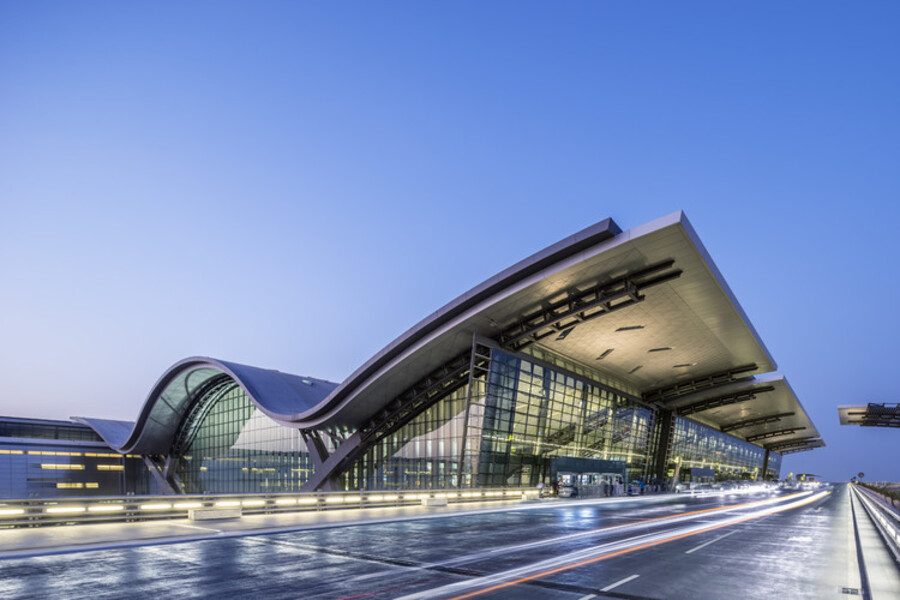
Hamad International Airport in Doha exemplifies the Middle Eastern approach to airport design, where terminals function as cultural showcases and luxury destinations. The interiors resemble a contemporary art museum rather than a conventional transit facility, featuring large-scale installations including the iconic 7-meter-tall Lamp Bear sculpture by Urs Fischer and curated works from artists worldwide.
The terminal complex features soaring spaces with sophisticated lighting design and premium materials throughout. Qatar Airways lounges operate more like five-star boutique hotels, complete with spas, sleep pods, and fine-dining restaurants. The retail environment includes luxury boutiques from global fashion houses alongside local designers, creating a commercial experience that rivals major shopping destinations.
Hamad International represents a significant shift in how Gulf states use airport architecture as a tool for nation branding. The terminal’s art collection, curated retail experience, and premium passenger facilities reflect Qatar’s broader strategy of positioning itself as a global cultural and commercial hub.
7. Madrid-Barajas Airport Terminal 4, Spain
Architect: Rogers Stirk Harbour + Partners & Estudio Lamela
Completed: 2005
Terminal 4 Length: ~1.2 km
Annual Capacity: 35 million passengers (T4)
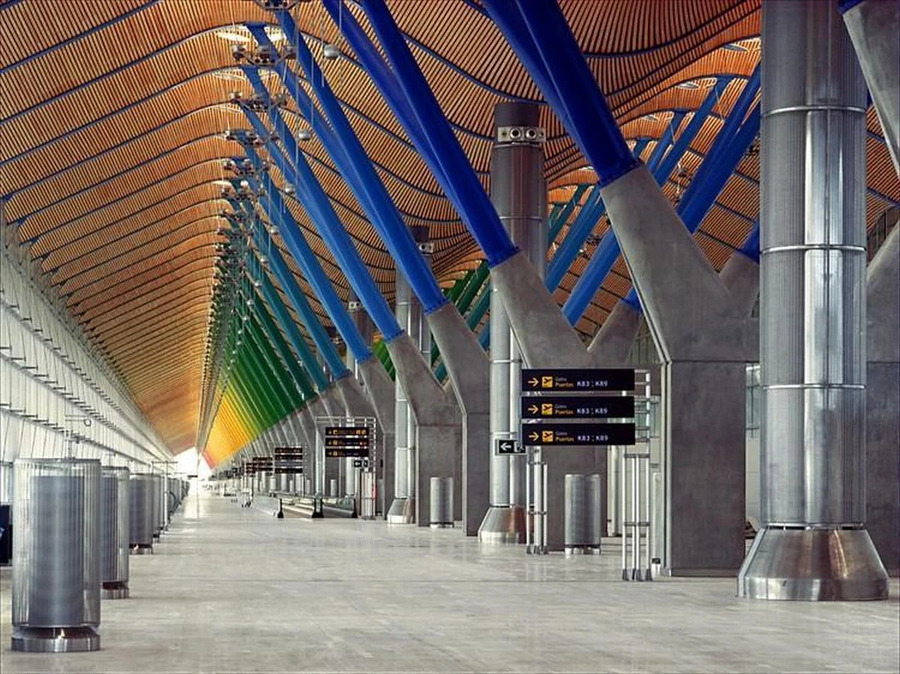
Terminal 4 at Madrid-Barajas is widely regarded as one of the most beautiful airport interiors ever constructed. Designed by Rogers Stirk Harbour + Partners in collaboration with Estudio Lamela, the terminal features a dramatic undulating bamboo-clad ceiling supported by a forest of tree-like steel columns painted in a rainbow gradient of colors. The palette shifts from warm yellows at one end to cool blues at the other, creating an intuitive color-coded navigation system.
The main building, whose boarding pier runs about 1.2 kilometers, was designed to function as three linear modules, each distributing passenger circulation according to arrival and departure flows. An expansive structural system incorporates energy-efficient cooling, extensive facade shading, and roof-mounted light wells that flood the interior with diffused natural daylight. The result is a terminal that feels spacious and warm despite handling tens of millions of passengers annually.
8. Kuala Lumpur International Airport (KLIA), Malaysia
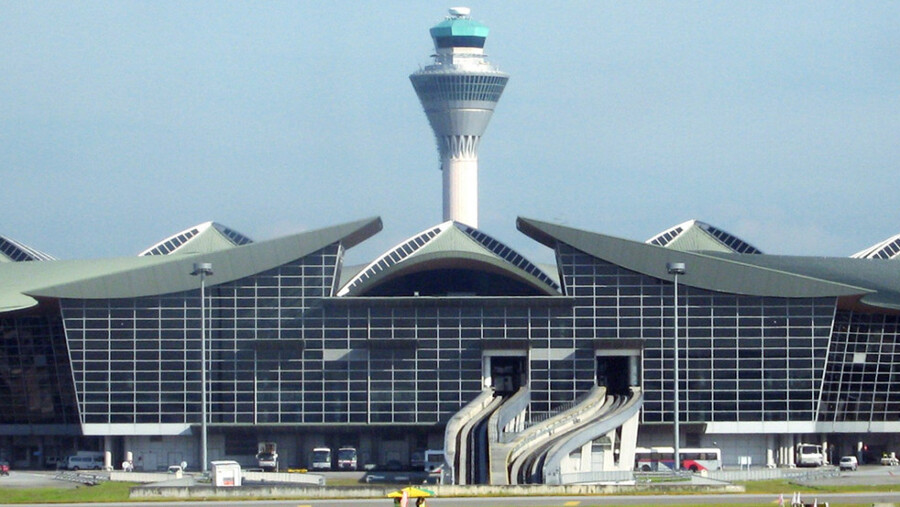
Architect: Kisho Kurokawa
Completed: 1998
Concept: Airport in the forest, forest in the airport
Annual Capacity: 70 million passengers
Kuala Lumpur International Airport was designed by Japanese architect Kisho Kurokawa under the poetic concept of creating an airport within a forest and a forest within an airport. The architecture and design of the roof, facade, and ceiling represent a sophisticated fusion of Malay and Islamic architectural traditions.
The terminal is surrounded by preserved tropical rainforest, and internal garden courts bring greenery deep into the building. The hyperbolic paraboloid roof shells, a recurring motif throughout the terminal, were inspired by traditional Islamic geometric patterns while serving as efficient structural forms that span large column-free spaces. The design established a powerful precedent for integrating regional cultural identity with international airport functionality.
Comparison: The World’s Most Futuristic Airports
| Airport | Architect | Year | Key Innovation | Capacity |
|---|---|---|---|---|
| Beijing Daxing (PKX) | Zaha Hadid Architects + ADPI | 2019 | Radial starfish layout, 8-min max walk | 45–100M |
| Changi Jewel (SIN) | Safdie Architects | 2019 | Indoor rainforest & 40m waterfall | 65M+ |
| Istanbul (IST) | Grimshaw + Nordic + Haptic | 2018 | Largest terminal under one roof | 90–200M |
| Kansai (KIX) | Renzo Piano | 1994 | Man-made island, earthquake-proof airfoil | 30M+ |
| Denver (DEN) | Fentress Architects | 1995 | Tensile fabric roof, iconic silhouette | 69M+ |
| Hamad (DOH) | HOK | 2014 | Art museum-level cultural interior | 53M |
| Madrid-Barajas T4 (MAD) | Rogers + Lamela | 2005 | Color-gradient wayfinding columns | 35M (T4) |
| KLIA (KUL) | Kisho Kurokawa | 1998 | Forest-airport hybrid, Islamic geometry | 70M |
Key Design Trends Shaping Future Airports
Biophilic Design and Indoor Ecosystems
The success of Changi’s Jewel and KLIA’s forest concept has inspired a global trend toward incorporating living ecosystems within terminal buildings. Modern airport design increasingly treats greenery not as decoration but as a functional component that reduces stress, improves air quality, manages acoustics, and provides passive cooling. New terminals in Bangalore (SOM‘s Terminal 2) and Singapore (the upcoming Terminal 5 by Heatherwick Studio and KPF) continue to push this approach further.
Parametric and Computational Design
Beijing Daxing’s complex roof geometry, with its 170,000 unique steel members and C-shaped mega-columns, would have been impossible without parametric modeling tools. Today, computational design enables architects to optimize structural efficiency, daylighting, passenger flow, and energy performance simultaneously. This technology is transforming how architects approach the unique spatial challenges of airport terminals, where vast spans, complex geometries, and millions of passengers must coexist.
Sustainability and Net-Zero Goals
Future airports are being designed with net-zero carbon targets. Features like solar panel arrays, ground-source heat pumps, rainwater harvesting systems, and displacement ventilation are becoming standard rather than aspirational. Airports in Carrasco (Uruguay) and Oslo are leading examples of energy-positive terminal design, generating more renewable energy than they consume. The Airports Council International (ACI) has set industry-wide targets for net-zero carbon emissions by 2050.
Smart Terminal Technology
Facial recognition check-in, automated baggage systems, AI-powered navigation, and autonomous transport pods are increasingly integrated into airport design from the earliest concept stages. Beijing Daxing’s fully automated domestic departures mezzanine, where passengers can move from entry to gate using only their smartphones, represents the current state of the art.
Visualizing Airport Concepts with AI
The complexity of futuristic airport design makes visualization one of the most challenging aspects of the architectural process. Communicating a parametric roof system or a multi-level indoor ecosystem to clients, stakeholders, and the public requires high-quality renderings that convey both the spatial experience and the technical ambition of a design.
AI-powered architectural visualization tools are transforming this workflow. Instead of spending weeks on manual rendering, architects and designers can now generate photorealistic concept images from sketches, floor plans, or even text descriptions in minutes. This accelerates the design iteration process and makes it possible to explore far more options during the critical early stages of a project. ArchFine‘s AI rendering engine transforms architectural sketches and ideas into stunning photorealistic visualizations in seconds — perfect for concept presentations, design competitions, and client pitches.
Frequently Asked Questions
What is the most futuristic airport in the world?
Beijing Daxing International Airport, designed by Zaha Hadid Architects, is widely considered the most futuristic airport ever built. Its starfish-shaped terminal covering 700,000 m² features parametric architecture, smart terminal technology, and a radial design that allows passengers to reach any gate within eight minutes.
Which airport has the world’s tallest indoor waterfall?
Jewel Changi Airport in Singapore features the Rain Vortex, a 40-meter-tall indoor waterfall designed by WET Design as part of Safdie Architects’ biophilic complex. It can channel over 10,000 gallons of recirculated rainwater per minute.
Which airport is built on a man-made island?
Kansai International Airport in Osaka, Japan, designed by Renzo Piano, was built on a man-made island stretching four kilometers into Osaka Bay. It was the first ocean airport in the world and survived the 1995 Kobe earthquake with minimal damage.
What is the largest airport terminal in the world?
Beijing Daxing International Airport is one of the largest single-building terminals in the world at approximately 700,000 m² (7.5 million sq ft). Istanbul Airport’s terminal, at nearly 1 million m², is among the largest under a single roof when all connected areas are included.
How is AI used in airport architectural visualization?
AI-powered tools like ArchFine allow architects to generate photorealistic renderings from sketches, floor plans, or text descriptions in minutes rather than days. This accelerates design iteration during early concept phases, making it easier to explore parametric forms, material options, and lighting scenarios for complex terminal designs.
What makes an airport design futuristic?
Futuristic airport design typically combines several elements: parametric or computational architecture, biophilic integration of nature, smart technology for passenger flow, sustainable energy systems, innovative structural engineering, and cultural storytelling through form and materials. The best examples achieve all of these while maintaining intuitive passenger navigation.
Final Thoughts
The airports featured in this guide represent more than engineering feats. They are statements about how nations see themselves and how architects imagine the future of human mobility. From Renzo Piano’s island airport in Osaka to Zaha Hadid’s parametric starfish in Beijing, each project pushed the limits of what was structurally, technologically, and aesthetically possible at the time of its construction.
As sustainable design mandates tighten and passenger expectations rise, the next generation of airports will need to be even more ambitious. Whether you are designing a terminal, preparing a competition entry, or simply exploring what modern architecture can achieve, these projects offer an essential reference library for understanding where airport design has been and where it is heading.