Few architectural movements provoke such intensely divided reactions as brutalism. To some, these raw concrete structures represent cold, authoritarian design at its worst. To others, they are among the most honest, sculptural, and spatially powerful buildings ever created. Whether you admire or despise them, brutalist buildings demand your attention — and they refuse to be ignored.
Born from the urgency of postwar reconstruction in the 1950s, brutalism spread across the globe over three decades, transforming city skylines from London to Dhaka, Montreal to São Paulo. The movement’s name derives not from the English word “brutal” but from the French term béton brut, meaning raw concrete — a material championed by Le Corbusier that became the defining signature of an entire architectural era.
Today, many of these buildings are experiencing a dramatic cultural renaissance. Buildings once slated for demolition are now photographed, debated, protected, and celebrated by a new generation discovering their uncompromising beauty through social media, photography books, and films like the 2024 Oscar-winning epic The Brutalist.
In this guide, we explore the most breathtaking brutalist buildings from around the world — structures that challenged conventions, redefined public space, and continue to inspire architects and designers today.
What Defines Brutalist Architecture?
Before diving into specific buildings, it helps to understand what makes a structure “brutalist” rather than simply modern or concrete. Brutalism was never merely a visual style — it was, at its core, an ethical position about how buildings should be made and experienced.

The movement emerged from the work of British architects Alison and Peter Smithson in the early 1950s, drawing heavily on Le Corbusier‘s use of unfinished concrete in France. Architectural critic Reyner Banham formalized the concept in his influential 1955 essay, connecting the raw aesthetic to deeper principles of structural honesty and social purpose. The Royal Institute of British Architects (RIBA) recognizes brutalism as one of the most significant architectural movements of the 20th century.
Five characteristics typically define a brutalist building: the prominent use of raw, exposed concrete (often bearing the marks of its timber formwork); massive, monolithic geometric forms that emphasize weight and permanence; a near-total absence of decorative ornamentation; clearly expressed structural and functional elements visible from the exterior; and a deliberate sense of monumental presence within the urban landscape.
Not every concrete building is brutalist. A structure can feature exposed concrete and still belong to late modernism, structural expressionism, or an entirely different tradition. Brutalism is defined less by a single material than by a combination of form, honest construction, and intent — the building’s appearance should be inseparable from how it is built and how it functions. For a deeper exploration, see the Le Corbusier World Heritage site, which documents 17 buildings across seven countries that shaped the modern movement.
The Smithsons articulated brutalism as something deeper than aesthetics. They spoke about a reverence for materials expressed honestly — seeing wood for its “woodness” and sand for its “sandiness.” Banham insisted a brutalist structure must demonstrate formal legibility of plan, clear exhibition of structure, and honest valuation of materials. These principles explain why the movement resonated so powerfully with public institutions: universities, libraries, civic centers, and housing projects all embraced brutalism as an architecture of democratic ideals.
15 Breathtaking Brutalist Buildings You Need to See
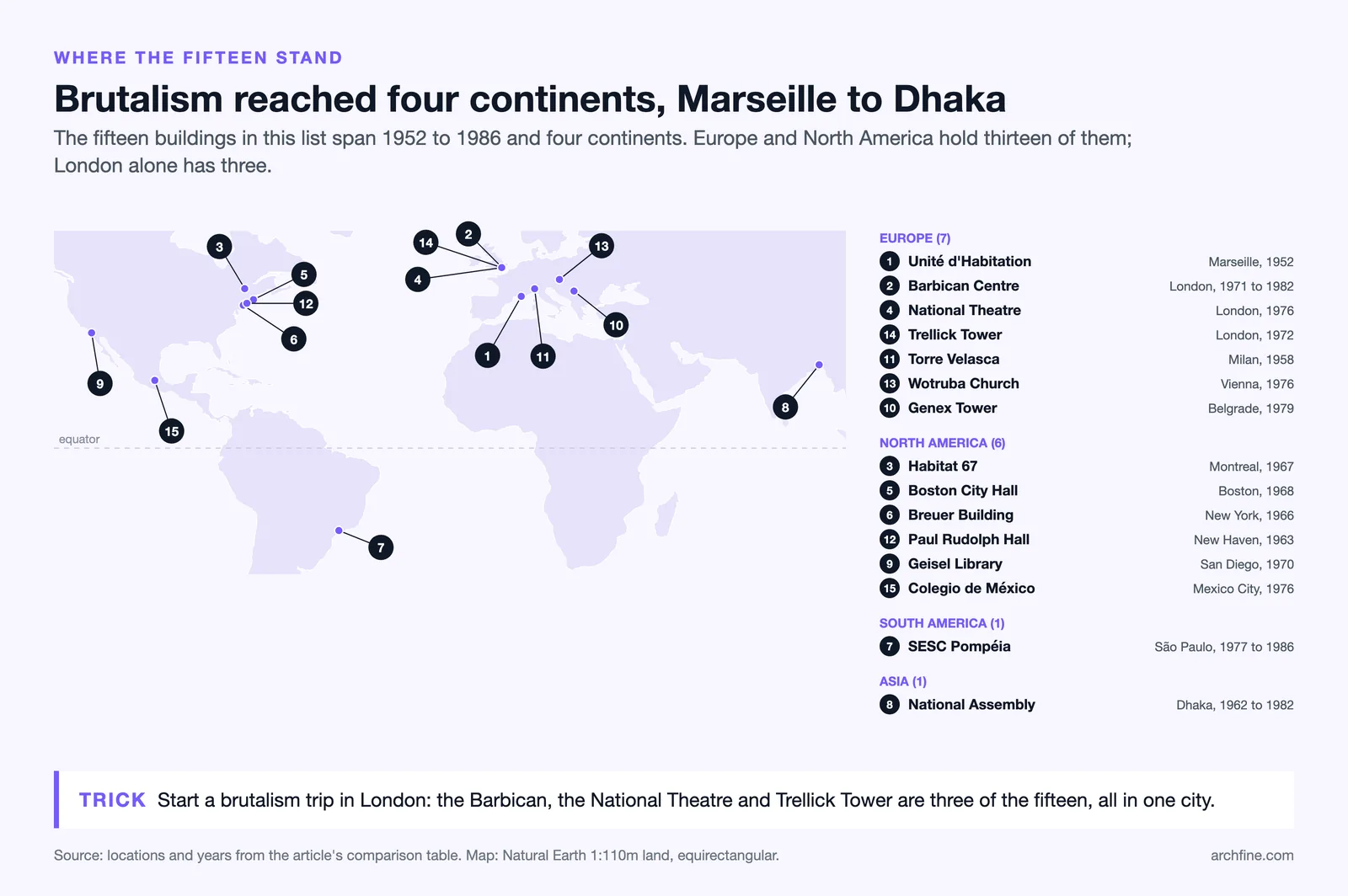
From housing megastructures and civic monuments to museums, libraries, and churches, these 15 buildings represent the full range and global reach of brutalism at its most powerful and visually stunning.
1. Unité d’Habitation — Marseille, France (1952)
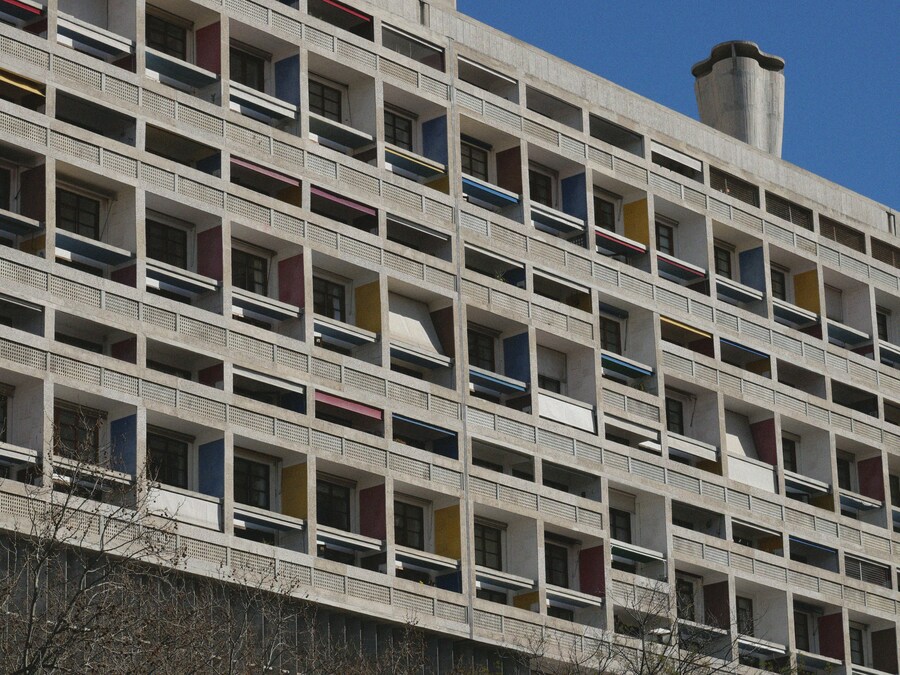
Architect: Le Corbusier | Type: Residential Complex | Status: UNESCO World Heritage Site
Often cited as the birthplace of brutalism itself, Le Corbusier’s monumental housing complex in Marseille was designed to be a self-contained “vertical city.” The massive béton brut structure holds 337 apartments, a shopping street, a gym, a school, and a rooftop terrace — all within a single building elevated on massive pilotis (concrete stilts). Le Corbusier described it as showcasing the “new splendor of bare concrete,” and it became the prototype for social housing projects across Europe. Originally intended for working-class families, the building ironically became popular with Marseille’s intellectual community. Now a UNESCO World Heritage Site — one of 17 Le Corbusier works inscribed on the list — it stands as arguably the most influential brutalist building ever constructed. You can explore the building’s history and visitor information through the Marseille Tourism Office.
2. Barbican Centre — London, United Kingdom (1971 to 1982)
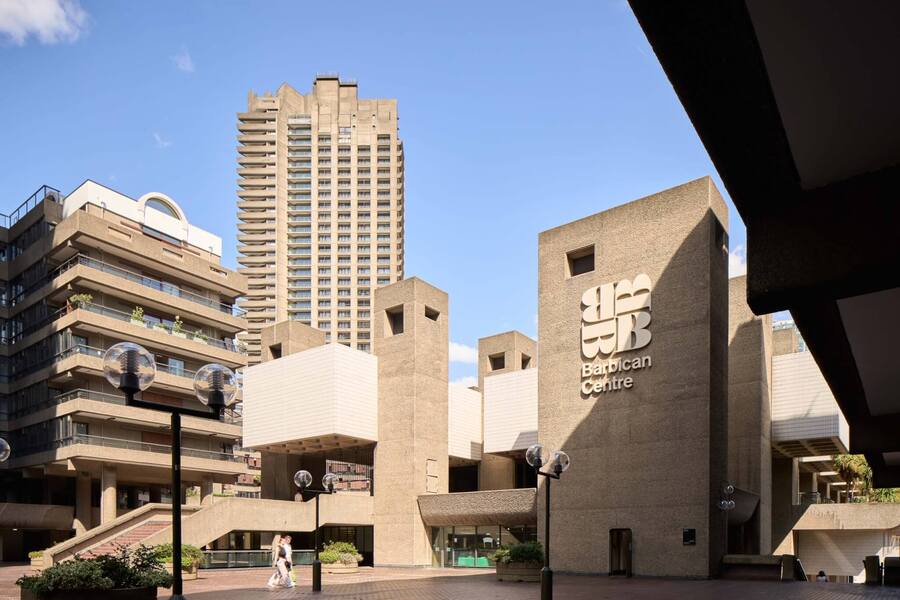
Architects: Chamberlin, Powell and Bon | Type: Mixed-Use Complex | Status: Grade II Listed
One of London’s most iconic architectural landmarks, the Barbican took over a decade to complete and occupies a site devastated by World War II bombing. The architects drew inspiration from the site’s ancient history as the location of Roman London’s main fort — hence the name, adapted from the Latin barbecana, meaning fortified gateway. The complex houses an arts center, cinema, restaurants, schools, a library, and roughly 2,000 apartments connected by elevated walkways, with integrated green spaces and a tranquil lake. The architects created the estate’s distinctive textured facades by hammering away at cast concrete, and the cantilevered balconies are enlivened with cascading plants. Once dismissed as a concrete maze, the Barbican was granted Grade II listed status by Historic England in 2001 and is now one of London’s most sought-after residential addresses.
3. Habitat 67 — Montreal, Canada (1967)
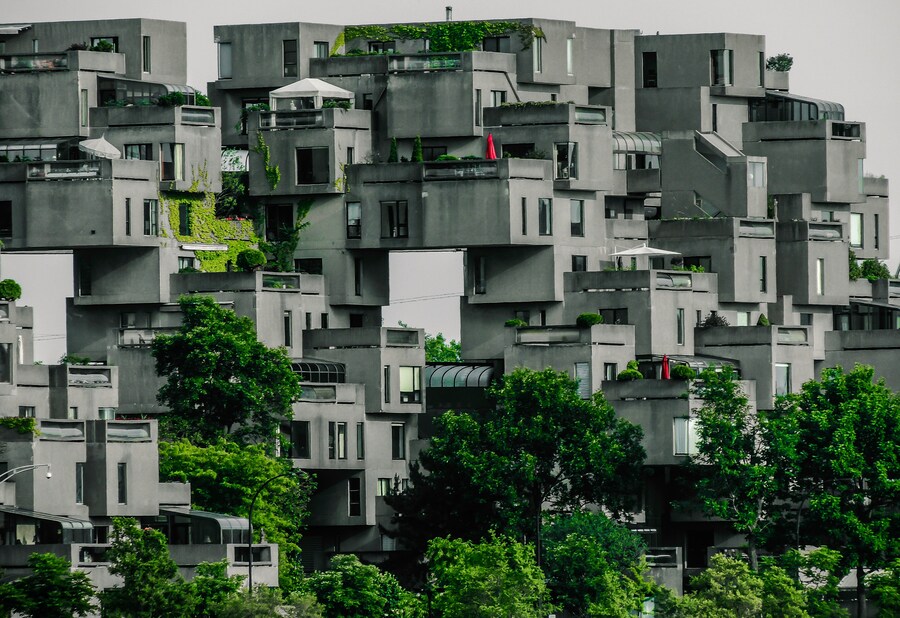
Architect: Moshe Safdie | Type: Residential Complex | Status: Heritage Site
Perhaps the most visually distinctive brutalist building in the world, Habitat 67 looks more like a colossal three-dimensional puzzle than a housing complex. Designed by Israeli-Canadian architect Moshe Safdie — originally as his McGill University thesis project — it debuted at Montreal’s 1967 World’s Fair. The building consists of 354 identical prefabricated concrete modules stacked in seemingly random configurations to create 158 apartments, each with its own roof garden. Safdie’s vision was to bring suburban qualities like privacy, fresh air, and private gardens into a high-density urban structure. The building proved that concrete construction could be deeply sculptural, introducing the concept of modular high-rise living to the world. You can explore the complex and its history through Habitat67.com.
Habitat 67’s modular, stacked-cube aesthetic is one of the most popular styles for AI architectural visualization experiments. With tools like ArchFine, you can quickly generate photorealistic renderings of modular brutalist concepts inspired by Safdie’s groundbreaking design approach.
4. National Theatre — London, United Kingdom (1976)
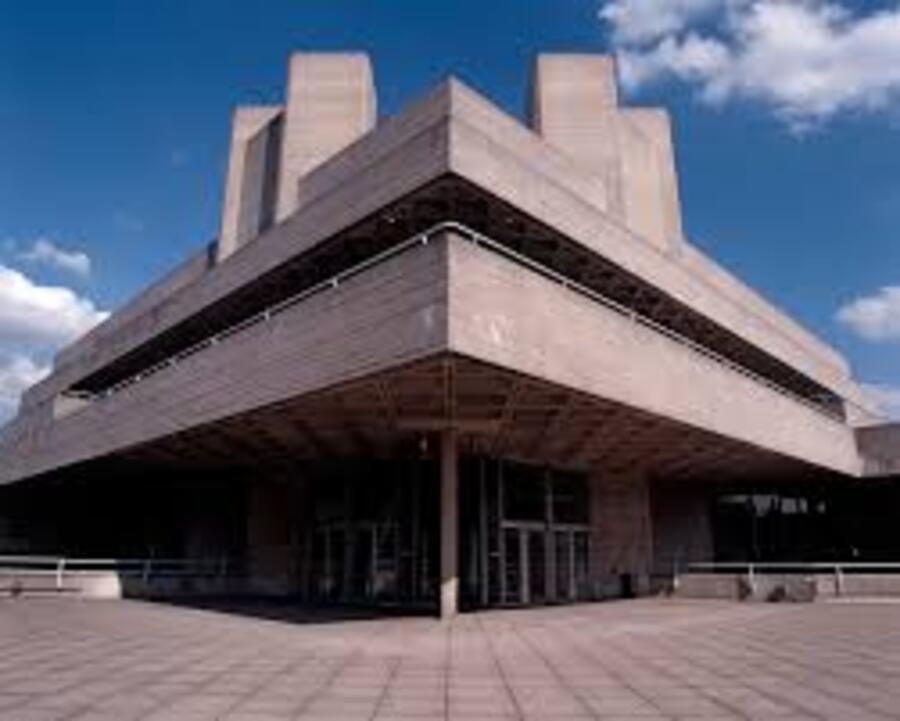
Architect: Denys Lasdun | Type: Cultural / Theatre | Status: Grade II* Listed
Situated on the South Bank of the Thames, Denys Lasdun’s National Theatre is a masterclass in horizontal layering. The building is composed of interlocking terraces of board-marked concrete that cascade down toward the river, creating a series of public platforms and foyers. Lasdun conceived the building as a kind of urban landscape — a place where the city flows into the architecture and the architecture extends into the city. Prince Charles famously compared it to a nuclear power station, but the Royal Institute of British Architects recognized it as one of Britain’s key brutalist buildings. In an unusual reversal, it has enjoyed far greater public affection than critical approval, becoming one of London’s most beloved cultural institutions.
5. Boston City Hall — Boston, USA (1968)
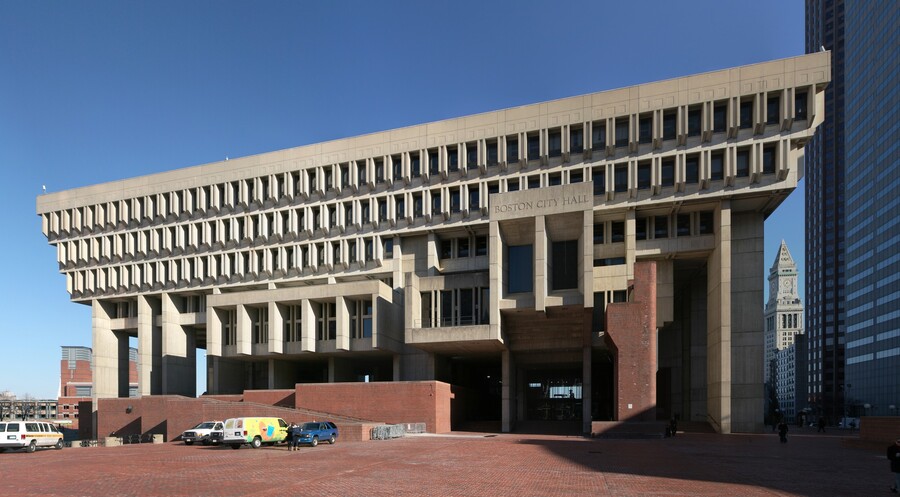
Architects: Kallmann, McKinnell & Knowles | Type: Government / Civic | Status: Listed on National Register
One of the most polarizing buildings in the United States, Boston City Hall has been simultaneously topping “best architecture” and “ugliest building” lists for over half a century. Built as part of an ambitious campaign to revitalize the city, the raw concrete structure features rows of coffered overhangs and protruding modular volumes that express the different governmental functions housed within. Windows into the building’s activities and an outdoor plaza designed to flow seamlessly into the lobby were meant to symbolize governmental transparency. The building is listed on the National Register of Historic Places, and the #SOSBrutalism database records that it moved from “red” (endangered) to “blue” (protected) status — a rare victory for brutalist preservation.
6. Breuer Building (former Whitney Museum) — New York, USA (1966)
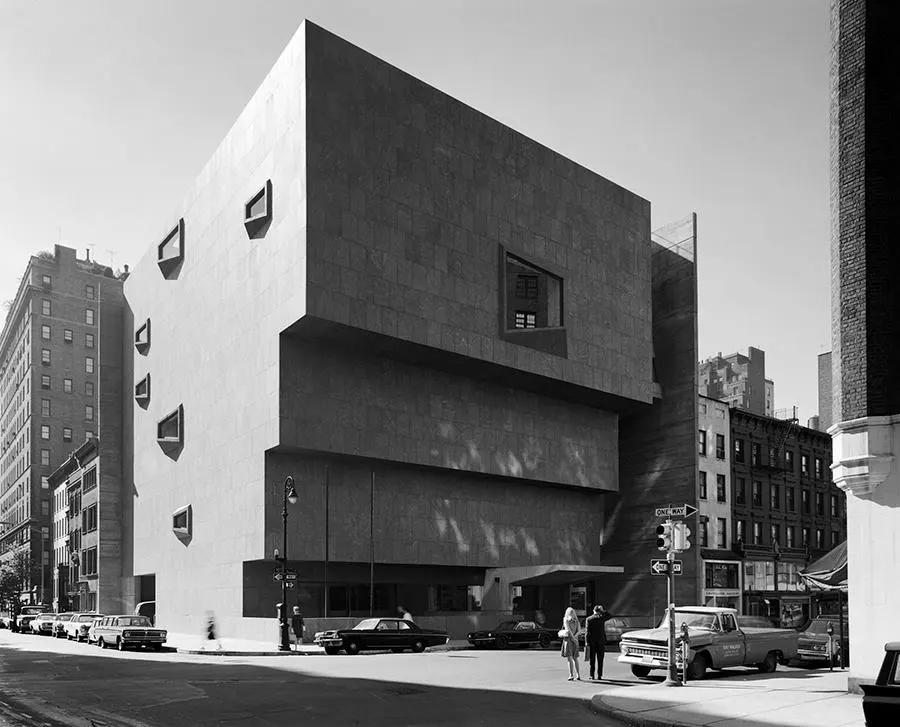
Architect: Marcel Breuer | Type: Museum / Cultural | Status: NYC Landmark
Perched on Manhattan’s Upper East Side, the Breuer Building is a study in muscular urban brutalism. The granite-and-concrete structure defies convention by tapering inward as it rises — growing heavier toward the top rather than lighter. Deeply recessed, asymmetrical windows punctuate the facade, adding to the sense of drama and unpredictability. Originally built for the Whitney Museum of American Art, the building later housed The Metropolitan Museum and The Frick Collection before becoming Sotheby’s global headquarters in 2025. Breuer, trained at the Bauhaus, brought clean functionality into his brutalist work, creating a building deliberately designed to confront and disrupt its genteel surroundings.
7. SESC Pompéia — São Paulo, Brazil (1977–1986)
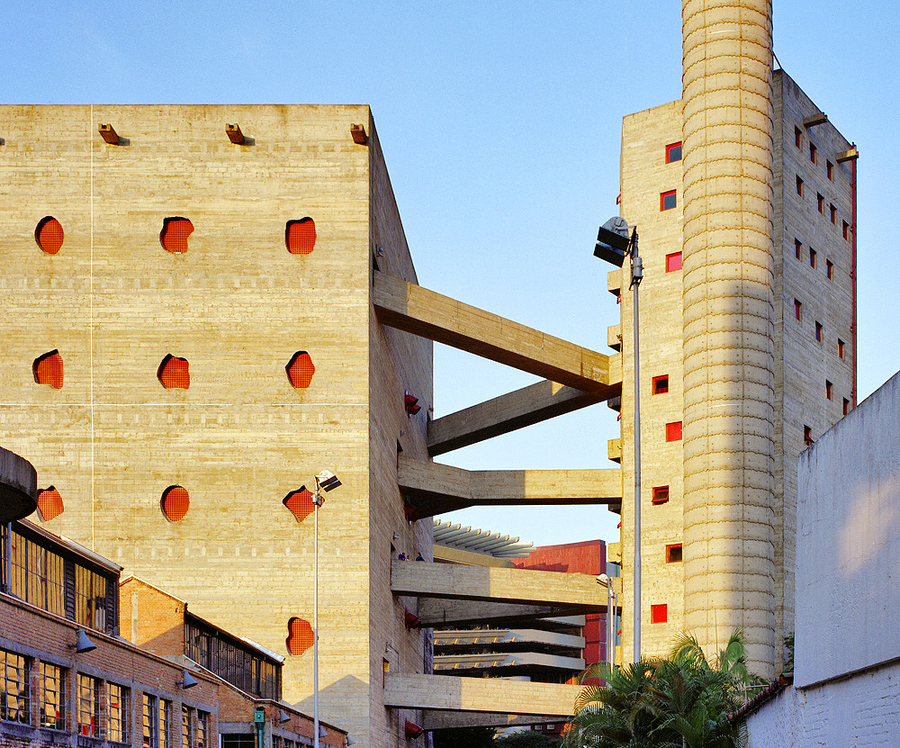
Architect: Lina Bo Bardi | Type: Cultural / Community Center | Status: Cultural Heritage
Lina Bo Bardi’s transformation of an old drum factory into a vibrant cultural center stands as one of the most humanistic examples of brutalist architecture anywhere. Rather than demolishing the existing industrial structure, Bo Bardi stripped the plaster, sandblasted the walls to expose the original brick, and added two monumental concrete towers connected by irregular, criss-crossing aerial walkways. The complex houses sports facilities, exhibition spaces, workshops, and a theater. Bo Bardi called it a “socialist experiment,” and the building has become a beloved community gathering place — proof that brutalism, at its best, can be warm, welcoming, and deeply connected to everyday life. The building is documented by ArchDaily and the DOCOMOMO International modern heritage preservation network.
Brutalism’s strongest examples — like SESC Pompéia and the Barbican — demonstrate that the style was never simply about concrete. At its core, brutalism was an architecture of social purpose: creating public spaces, community infrastructure, and democratic gathering places where material honesty served human connection. Organizations like the World Monuments Fund and DOCOMOMO International actively work to preserve these civic landmarks for future generations.
8. National Assembly Building — Dhaka, Bangladesh (1962–1982)
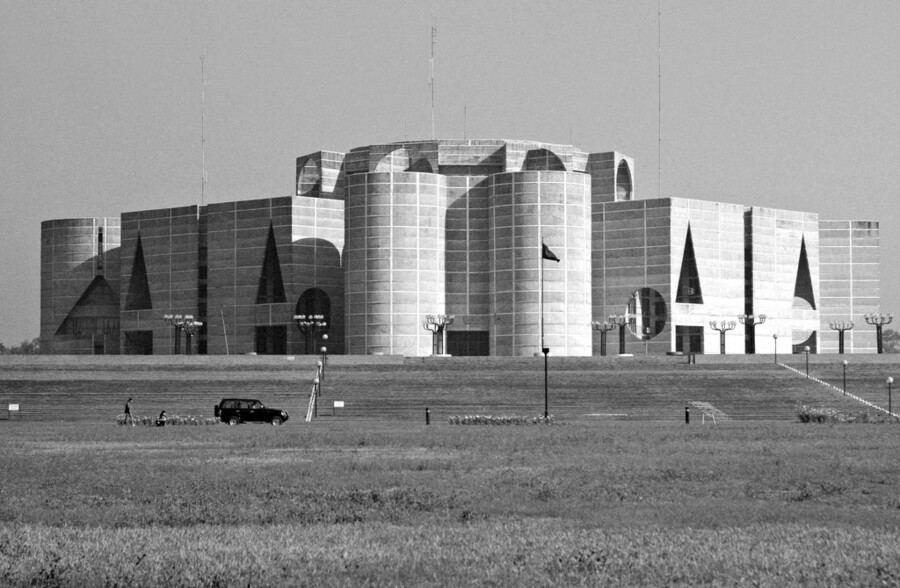
Architect: Louis Kahn | Type: Government / Parliamentary | Status: National Monument
Louis Kahn’s monumental parliament complex in Dhaka is one of the 20th century’s greatest architectural achievements. Blending brutalist principles with Bengali vernacular traditions, the complex uses massive concrete walls pierced by bold geometric openings — circles, triangles, and rectangles — that create extraordinary plays of light and shadow throughout the day. The construction took two decades, surviving political upheaval and a war of independence, yet the completed building conveys an almost spiritual calm. Known locally as Sher-e-Bangla Nagar, the structure demonstrates how brutalism could transcend Western European origins and take on profoundly regional, even sacred dimensions. Kahn’s broader body of work is archived at the University of Pennsylvania Architectural Archives.
9. Geisel Library — San Diego, USA (1970)
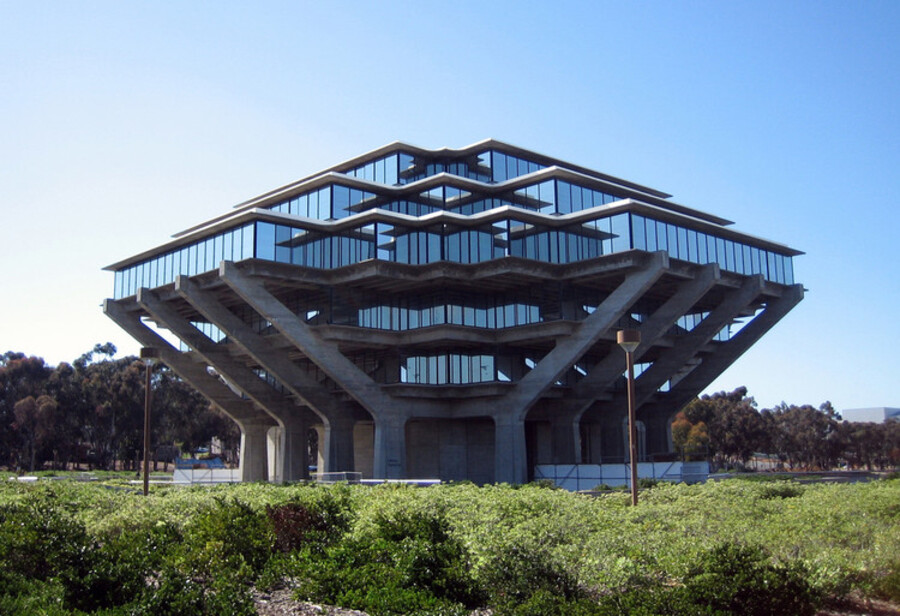
Architect: William Pereira | Type: Library / Educational | Status: Active University Library
Looking like a spacecraft descended upon the campus of the University of California, San Diego, the Geisel Library is one of the most visually arresting buildings in the United States. The structure features dramatic overhanging concrete floors supported by thick, tapering pillars — creating a shape often compared to a giant mushroom or a pair of cupped hands. Named in honor of Theodor Seuss Geisel (better known as Dr. Seuss), the building oscillates between the monumental weight of brutalism and the levitating tension of futurism. Its six above-ground floors progressively widen from bottom to center, creating a dynamic sense of upward expansion.
10. Western City Gate (Genex Tower) — Belgrade, Serbia (1979)
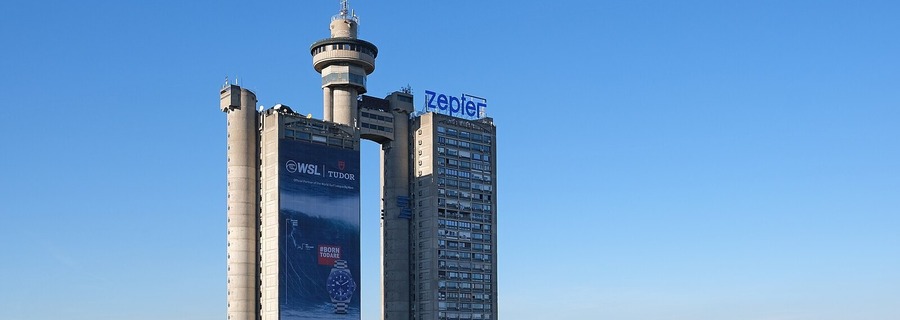
Architect: Mihajlo Mitrović | Type: Mixed-Use Tower | Status: Architectural Landmark
Rising 135 meters above Belgrade, the Genex Tower is one of the most visually striking brutalist skyscrapers ever built. Designed as a symbolic gateway welcoming visitors arriving from the airport, it consists of two concrete towers — one commercial (26 stories) and one residential (30 stories) — connected by a dramatic two-story bridge with a revolving restaurant at the summit. The building blends brutalist aesthetics with elements of structuralism and constructivism, and it remains one of the tallest buildings in Belgrade. Often photographed against moody Balkan skies, it has become a pilgrimage site for architecture enthusiasts and photographers worldwide.
11. Torre Velasca — Milan, Italy (1958)
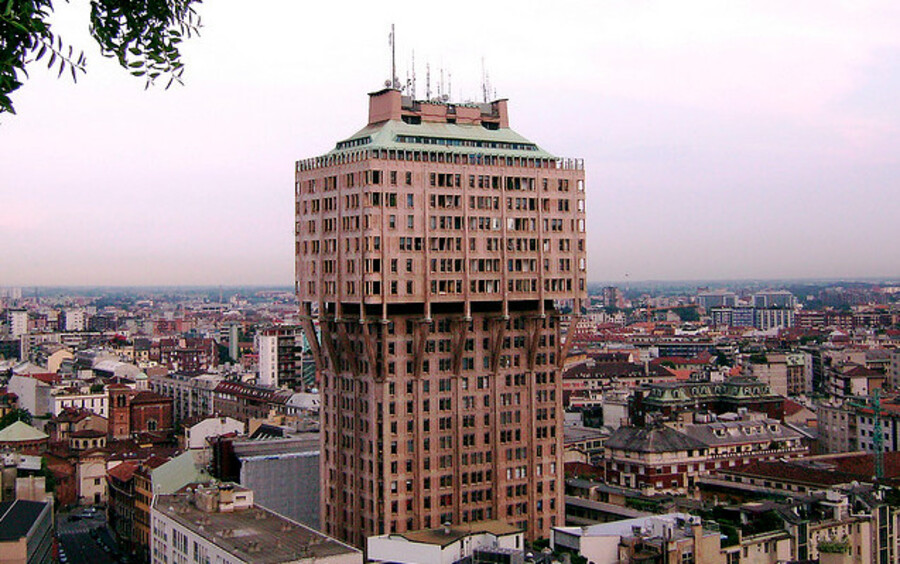
Architects: BBPR (Studio) | Type: Mixed-Use Tower | Status: Cultural Landmark
An iconic symbol of postwar Milanese ambition, Torre Velasca was among the first major brutalist towers in Europe. The 106-meter structure features a distinctive mushroom-like profile: the upper floors expand outward beyond the footprint of the lower levels, creating a silhouette reminiscent of medieval fortified towers. Designed by the BBPR architectural group during Milan’s industrial boom, the building was meant to represent the city’s determination to rise from wartime devastation. While it has provoked fierce debate since its completion — some call it an icon, others consider it an eyesore — its unique marriage of historical reference and brutalist boldness secures its place in architectural history.
12. Paul Rudolph Hall — New Haven, USA (1963)
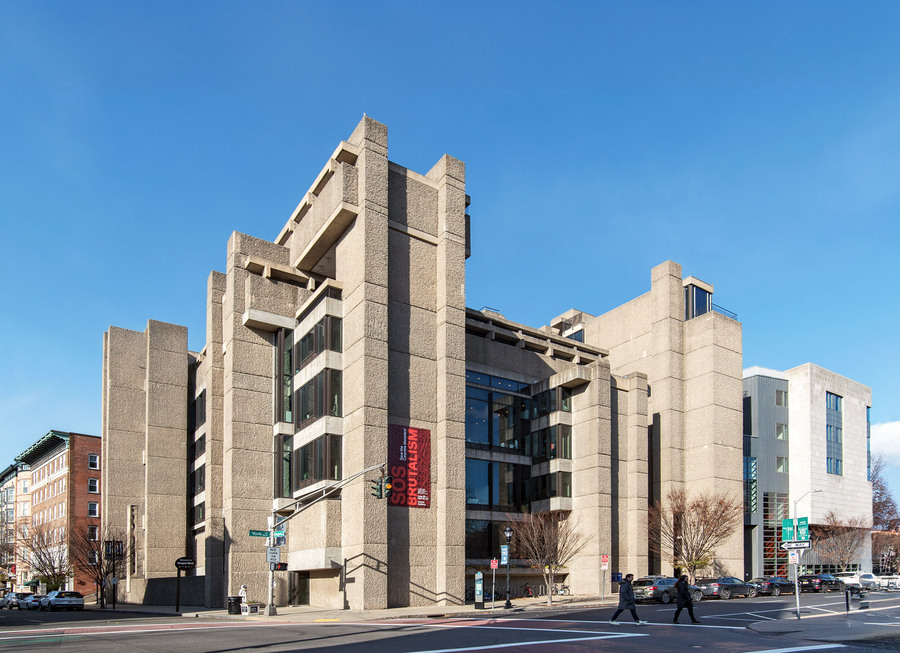
Architect: Paul Rudolph | Type: Educational / University | Status: Restored
Originally known as the Yale Art and Architecture Building, Paul Rudolph Hall is considered one of the first major brutalist buildings in the United States. The building features a complex, multi-level interior with 37 different floor levels within seven stories, creating an extraordinary spatial experience. The exterior is characterized by deeply corrugated concrete walls — the surface was achieved by bush-hammering the cast concrete to create dramatic ridges and shadows. The building was partially destroyed by a suspicious fire in 1969 (arson by a disgruntled architecture student was suspected but never proven), but has since been carefully restored and continues to train future generations of architects. The Paul Rudolph Heritage Foundation maintains an extensive archive of the architect’s work.
13. Wotruba Church — Vienna, Austria (1976)
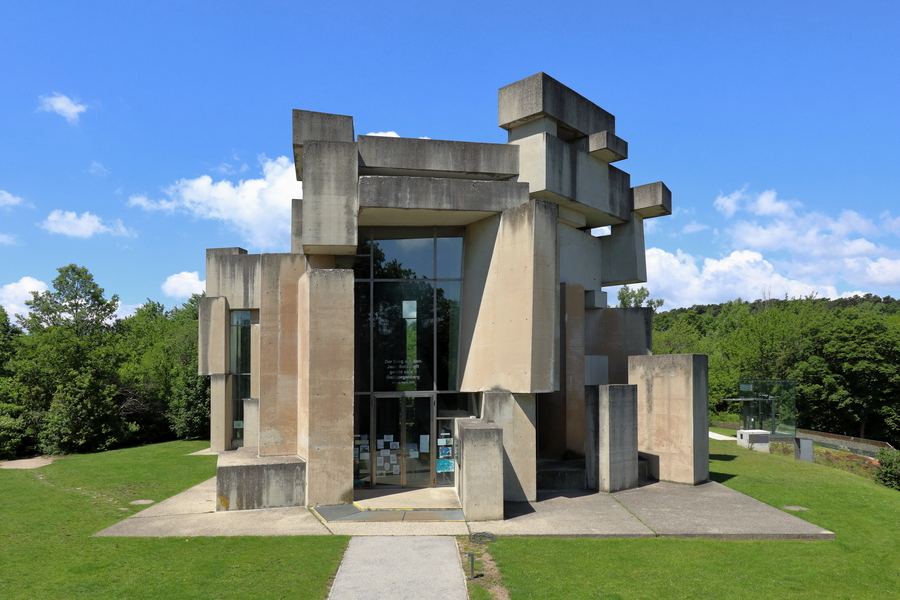
Architect: Fritz Wotruba (sculptor) | Type: Religious | Status: Active Church
Officially named the Church of the Most Holy Trinity, the Wotruba Church is one of brutalism’s most extraordinary creations — and it was designed not by an architect but by a sculptor. Fritz Wotruba composed the church from 152 raw, untreated concrete blocks stacked and balanced against one another, allowing light to filter through the gaps between the blocks. The result is more sculpture than building, sitting in striking contrast to its leafy Viennese neighborhood. Wotruba died before the church was completed, and architect Fritz Gerhard Mayr saw the project through, faithfully preserving the sculptor’s radical vision.
Brutalist buildings frequently appear in science fiction films. The J. Edgar Hoover FBI Building appeared in Robocop. The University of Toronto’s Robarts Library was used as a futuristic prison in Resident Evil: Afterlife. And the German Trudelturm research facility had a cameo in Aeon Flux (2005), its concrete form looking perfectly alien without any special effects.
14. Trellick Tower — London, United Kingdom (1972)
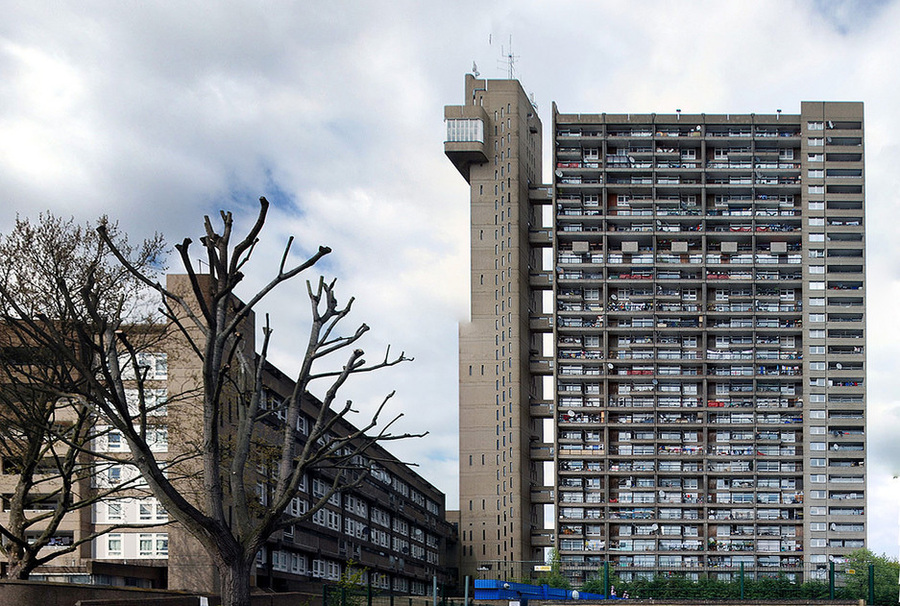
Architect: Ernő Goldfinger | Type: Residential Tower | Status: Grade II* Listed
Designed by Hungarian-born architect Ernő Goldfinger, Trellick Tower stands 31 stories above North Kensington with a bold vertical layout that separates the main residential tower from a freestanding service tower connected by enclosed walkways at every third floor. The building’s imposing concrete facade and narrow windows initially drew fierce criticism, and it suffered from neglect and social problems in the 1970s and 1980s. However, following a major renovation and the introduction of a concierge system, Trellick Tower became one of London’s most desirable brutalist addresses. It was granted Grade II* listed status by Historic England in 1998 and is now celebrated as one of the finest expressions of brutalist residential design in the world.
15. Colegio de México — Mexico City, Mexico (1976)
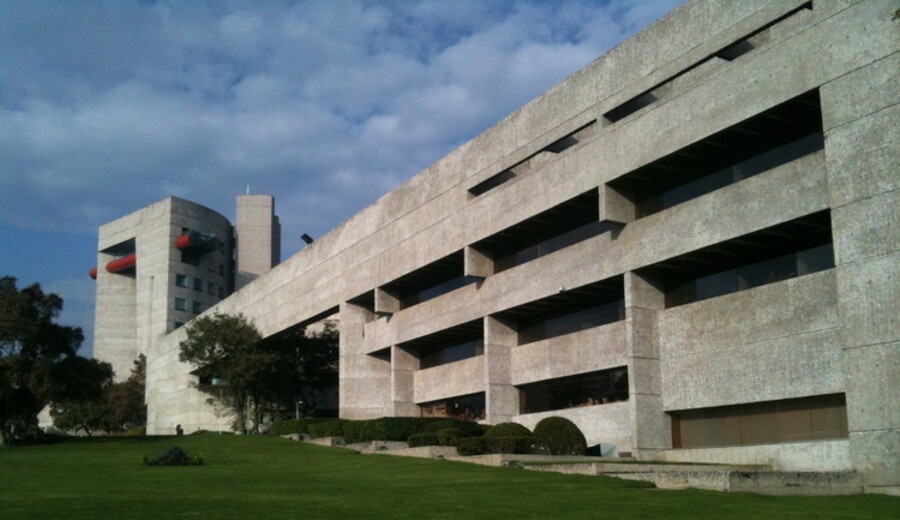
Architects: Teodoro González de León & Abraham Zabludovsky | Type: Educational / University | Status: Cultural Heritage
Sitting on rough, volcanic terrain in southern Mexico City, the Colegio de México demonstrates how brutalism adapted brilliantly to non-European contexts. González de León, who spent a year and a half working with Le Corbusier on the Unité d’Habitation in Marseille, brought European brutalist principles to Mexico and fused them with the country’s rich architectural traditions. The multi-tiered concrete campus is organized around a central circulation spine designed to bring together students from different academic disciplines, encouraging chance encounters and intellectual cross-pollination. The building’s relationship with its challenging volcanic landscape adds a layer of site-specific drama unique in the brutalist canon.
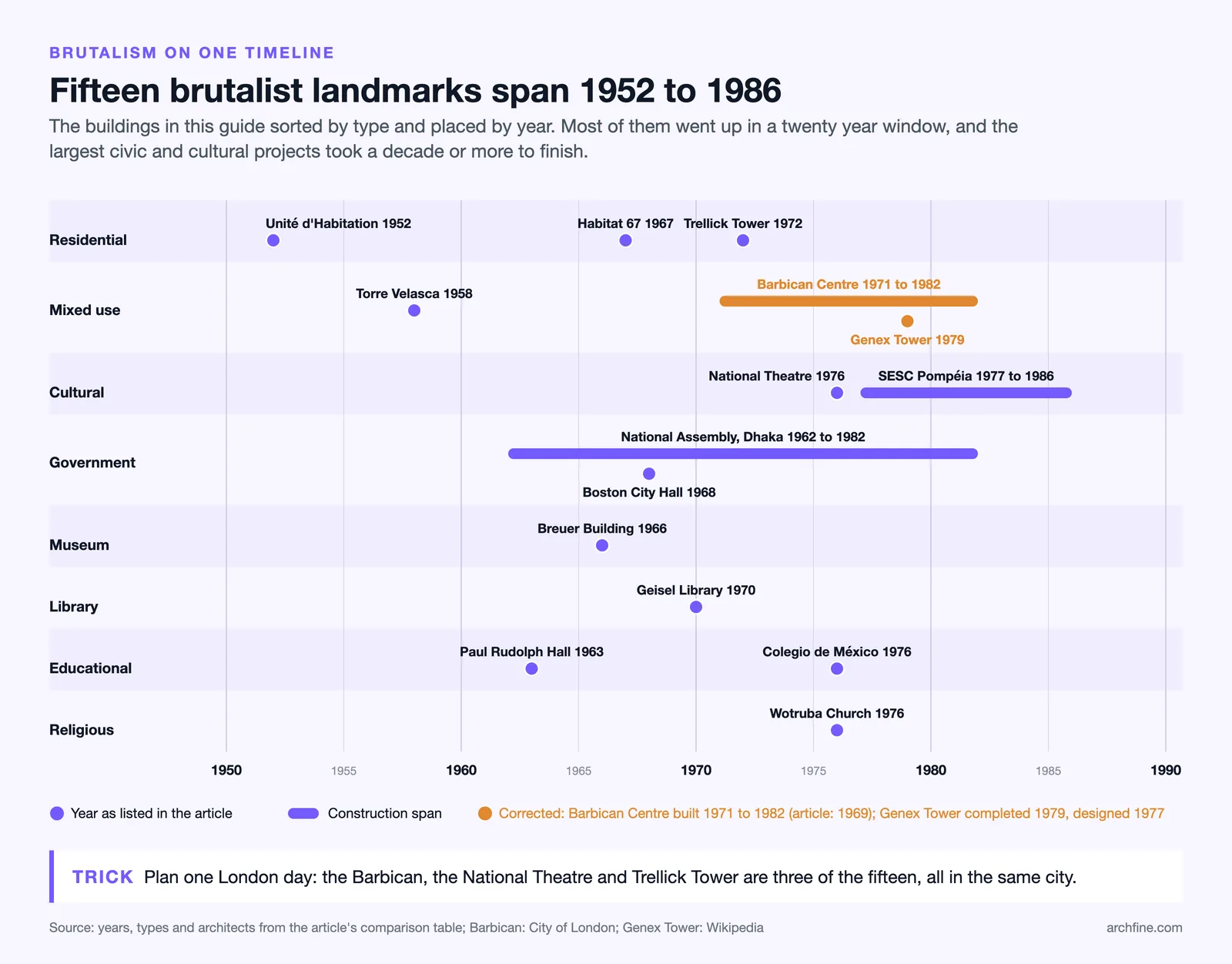
Quick Comparison: 15 Breathtaking Brutalist Buildings
| Building | Location | Year | Architect | Type |
|---|---|---|---|---|
| Unité d’Habitation | Marseille, France | 1952 | Le Corbusier | Residential |
| Barbican Centre | London, UK | 1971 to 1982 | Chamberlin, Powell & Bon | Mixed-Use |
| Habitat 67 | Montreal, Canada | 1967 | Moshe Safdie | Residential |
| National Theatre | London, UK | 1976 | Denys Lasdun | Cultural |
| Boston City Hall | Boston, USA | 1968 | Kallmann, McKinnell & Knowles | Government |
| Breuer Building | New York, USA | 1966 | Marcel Breuer | Museum |
| SESC Pompéia | São Paulo, Brazil | 1977–86 | Lina Bo Bardi | Cultural |
| National Assembly | Dhaka, Bangladesh | 1962–82 | Louis Kahn | Government |
| Geisel Library | San Diego, USA | 1970 | William Pereira | Library |
| Genex Tower | Belgrade, Serbia | 1979 | Mihajlo Mitrović | Mixed-Use |
| Torre Velasca | Milan, Italy | 1958 | BBPR Studio | Mixed-Use |
| Paul Rudolph Hall | New Haven, USA | 1963 | Paul Rudolph | Educational |
| Wotruba Church | Vienna, Austria | 1976 | Fritz Wotruba | Religious |
| Trellick Tower | London, UK | 1972 | Ernő Goldfinger | Residential |
| Colegio de México | Mexico City, Mexico | 1976 | González de León & Zabludovsky | Educational |
Why Brutalism Is Making a Comeback
After decades of neglect, demolition threats, and widespread public hostility, brutalism has staged one of the most remarkable cultural comebacks in architectural history. Several converging forces explain this revival.
Social media and photography platforms have transformed how people encounter brutalist buildings. The bold geometry, dramatic shadows, and raw textures of concrete make these structures extraordinarily photogenic — perfectly suited for visual platforms where striking imagery drives engagement. Buildings that were once ignored or mocked are now among the most shared and discussed architectural images online.
A wave of publishing has also played a role. Books like Brutal London (2015), This Brutal World (2016), SOS Brutalism: A Global Survey (2017), and Phaidon‘s comprehensive Atlas of Brutalist Architecture (2018) brought these buildings to a broad audience well beyond the architecture profession. The #SOSBrutalism platform itself — hosted by the Deutsches Architekturmuseum (DAM) in Frankfurt — has built a growing global database cataloging brutalist structures and advocating for their preservation.
Cultural productions have further boosted awareness. The 2024 film The Brutalist, starring Adrien Brody, won major awards including an Oscar and introduced the style’s aesthetic and social meaning to millions of viewers who might never have encountered these buildings otherwise.
At the architectural level, a movement sometimes called “neobrutalism” has emerged, with contemporary architects reinterpreting brutalist principles using modern techniques and materials. Wang Shu‘s Ningbo Museum — cited in his 2012 Pritzker Prize — the Dezeen-featured UTEC campus in Peru by Grafton Architects, and numerous private residences demonstrate that the raw honesty of brutalism remains a vital and evolving force in 21st-century design.
Visualize Your Own Brutalist Designs with AI
The raw materiality, bold geometry, and dramatic light-and-shadow interplay that define brutalism make it one of the most exciting architectural styles to explore through AI visualization. Whether you are a student experimenting with massing studies, a professional developing a concrete facade concept, or a design enthusiast exploring what a neo-brutalist home might look like, AI-powered rendering tools can accelerate your creative process dramatically.
ArchFine allows architects and designers to transform rough sketches and conceptual drawings into photorealistic visualizations in seconds. Upload a hand-drawn sketch of a stacked modular design inspired by Habitat 67, select a raw concrete material palette, and ArchFine’s AI engine generates high-quality renderings that capture the texture, weight, and atmosphere of brutalist architecture — without spending hours in traditional rendering software.
Frequently Asked Questions
What is brutalist architecture?
Brutalist architecture is a style that emerged in the 1950s, characterized by raw concrete (béton brut), massive geometric forms, exposed structural elements, and minimal ornamentation. The name derives from the French term for raw concrete, not from the English word “brutal.” The movement was rooted in an ethical commitment to material honesty and social purpose.
Why is brutalist architecture controversial?
Brutalist architecture divides opinion because of its uncompromising aesthetic. Critics perceive the style as cold, hostile, and oppressive, while admirers value its structural honesty, sculptural boldness, and democratic ideals. The association of many brutalist buildings with poorly maintained public housing projects has contributed to negative perceptions, though this reflects failures of maintenance and policy rather than architectural design.
What is the most famous brutalist building?
Le Corbusier’s Unité d’Habitation in Marseille (1952) is widely regarded as the most famous and influential brutalist building. Other frequently cited examples include the Barbican Centre in London, Habitat 67 in Montreal, the National Theatre in London, and Boston City Hall.
Is brutalism making a comeback?
Yes. Since the mid-2010s, brutalism has experienced a significant cultural resurgence driven by social media photography, dedicated coffee-table books, preservation campaigns like SOSBrutalism, and a new generation of architects exploring neobrutalist design. The 2024 Oscar-winning film The Brutalist further boosted mainstream interest.
What materials are used in brutalist buildings?
While raw concrete (béton brut) is the most iconic material, brutalist buildings also use brick, steel, glass, timber, rough-hewn stone, and gabions. The defining principle is material honesty — whatever materials are used, they are left exposed and unfinished, revealing the construction process and the inherent qualities of the material itself.
Can AI help visualize brutalist architecture?
Absolutely. AI-powered rendering tools like ArchFine allow architects and designers to generate photorealistic visualizations of brutalist-inspired designs from sketches or concepts. This makes it easy to experiment with concrete textures, geometric massing, and dramatic light-and-shadow effects before committing to detailed design development.
Where can I see brutalist buildings in person?
Brutalist buildings exist on every continent. Major concentrations can be found in London (Barbican, National Theatre, Trellick Tower), the northeastern United States (Boston City Hall, Paul Rudolph Hall at Yale), Montreal (Habitat 67), São Paulo (SESC Pompéia), and across former Eastern Bloc countries. The #SOSBrutalism database is an excellent resource for finding brutalist buildings near any location worldwide, and Wikipedia’s comprehensive brutalist architecture article provides a thorough global overview of the movement. The wider argument about where the style came from, why it was hated and why it is being listed today sits in our guide to brutalist architecture.