AI in construction is used most today for scheduling, progress monitoring, safety detection and cost estimating, rather than for the design work that gets more attention. The reason is that construction generates enormous amounts of structured data, and pattern recognition over that data produces measurable results.
The industry is also unusually resistant to it. Margins are thin, liability is heavy, and a technology that fails on site costs more than it saves. Adoption of AI in construction therefore tracks measurable return rather than capability.
Here is what has actually been adopted, what is still promotional, and where an architect encounters it.
Where AI in Construction Is Genuinely Used

Coverage of adoption across the industry appears regularly on ArchDaily, and professional bodies such as RIBA publish guidance on where responsibility sits.
Progress monitoring is the most established. Site photographs and scans compared against the model identify what has been built and what has slipped, automatically and continuously.
Safety detection runs on site camera feeds, flagging missing protective equipment, people in exclusion zones and unsafe working at height. It is one of the few applications with a clear and measurable return.
Scheduling and delay prediction uses historical project data to flag which activities are likely to slip, which is a genuine forecasting problem rather than a pattern matching one.
Cost estimating from historical data and model quantities produces early figures faster than manual takeoff, with accuracy that depends entirely on the quality of the historical set.
Clash and quality checking extends what coordination software already does, identifying issues in a model before they reach site.
💡 Pro Tip
The applications that work are the ones with a clear feedback loop. Progress monitoring can be checked against reality daily, so errors surface immediately. Design generation cannot, which is why one has been adopted quietly and the other is still being demonstrated at conferences.
Where the Model Comes In

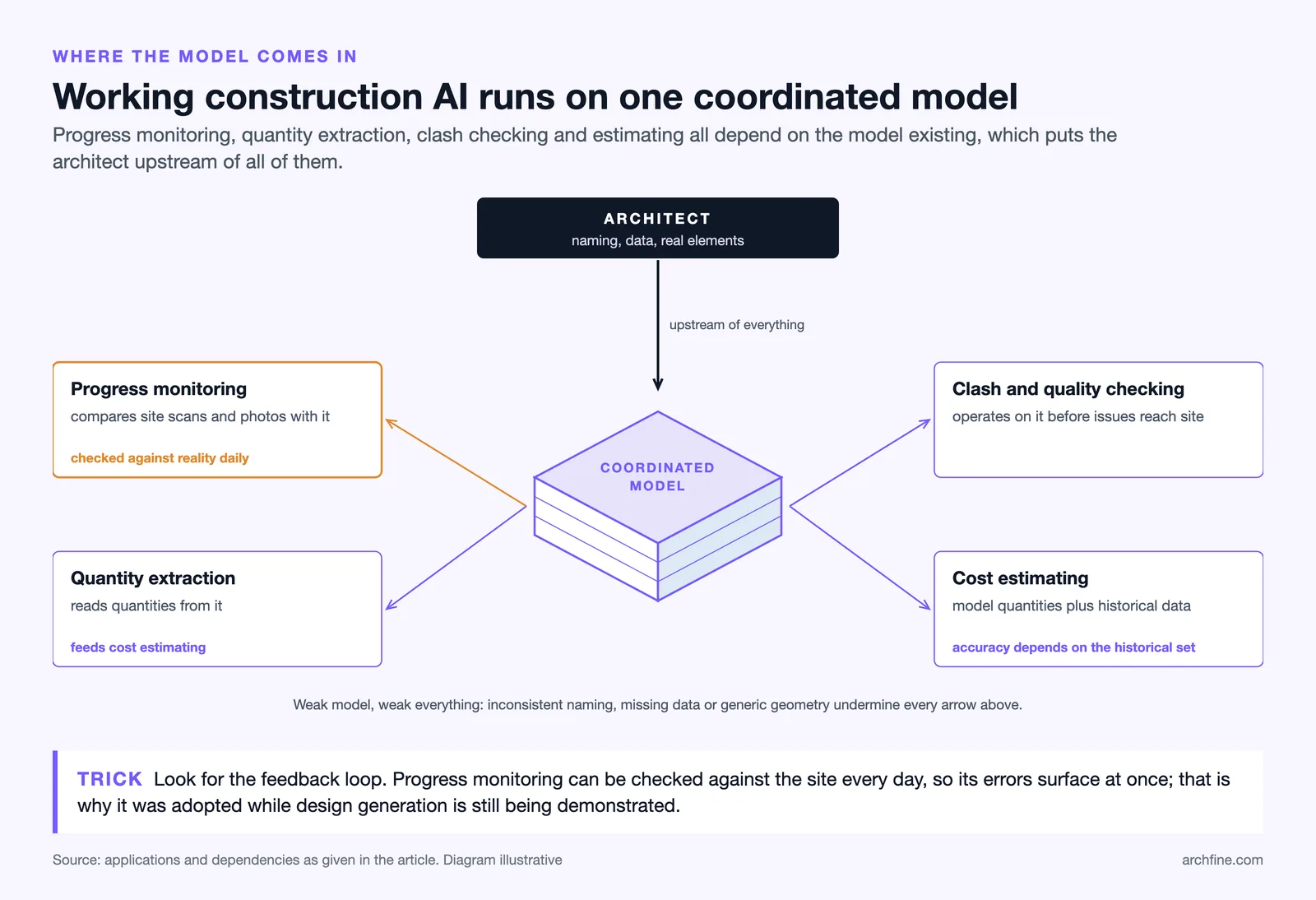
Almost all of this depends on a coordinated model existing. Progress monitoring compares scans against it, quantity extraction reads from it, and clash detection operates on it.
That places the architect upstream of everything. A model with inconsistent naming, incomplete data or elements modelled as generic geometry undermines every downstream application, which is the argument for the standards covered in our guide to architecture file formats.
It also raises the question of what the model is for. A model produced to generate drawings and a model produced to support construction operations are different deliverables, and increasingly clients expect the second while paying for the first.
Practices that understand this scope and price it, rather than absorbing it, are in a considerably better position, as our guide to digital twins covers for the operational stage.
What Is Still Promotional
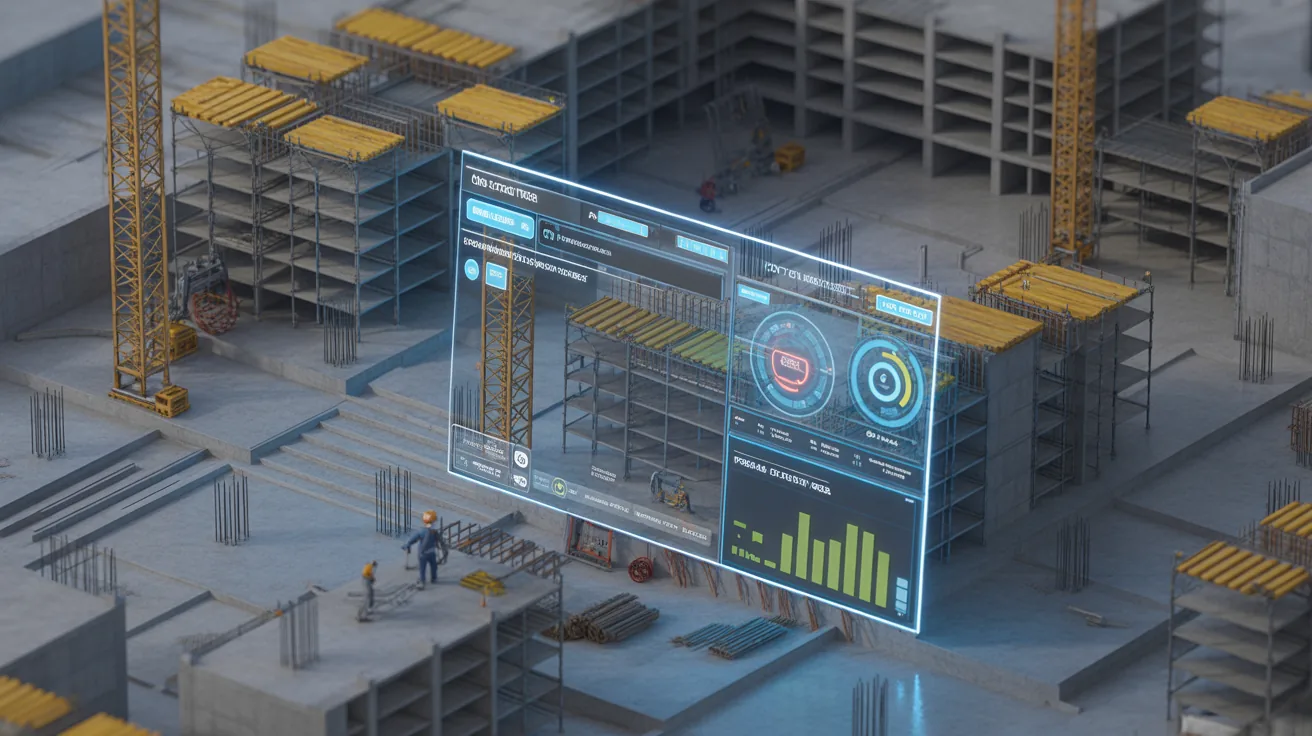
Autonomous construction equipment exists in demonstrations and in a small number of controlled applications, and it is nowhere near general use on a normal site.
Generative design producing buildable schemes remains unsolved, for the reasons covered in our guide to generative design. Nothing currently generates a layout that satisfies structure, services and regulation simultaneously.
Fully automated compliance checking is close in narrow domains and far away generally, because regulations differ by jurisdiction and are written in language rather than in rules.
Robotic assembly is real in prefabrication and factory settings and rare on site, where conditions are variable and tolerances are wide.
Adoption reality
| Application | Maturity | Who uses it |
|---|---|---|
| Progress monitoring | In use | Large contractors |
| Site safety detection | In use | Large contractors |
| Cost estimating | Emerging | Cost consultants |
| Design generation | Exploratory | Designers, early stage only |
| Compliance checking | Narrow cases | Limited |
| Autonomous plant | Demonstration | Almost nobody |
Why Construction Adopts Slowly
Liability is the first reason and it is not conservatism. Someone is responsible when a building fails, and a system that cannot carry responsibility cannot make the decision.
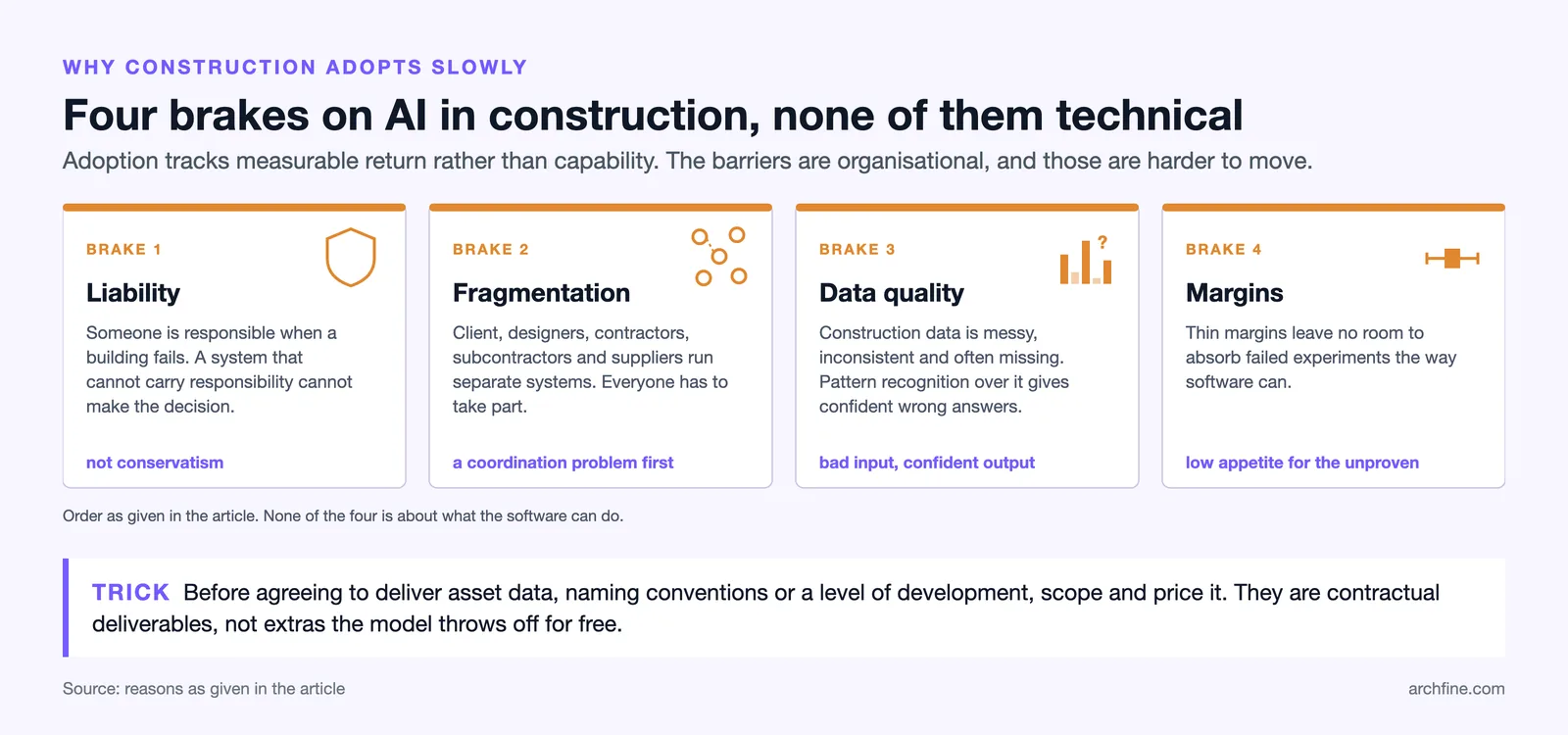
Fragmentation is the second. A project involves a client, designers, contractors, subcontractors and suppliers, all with separate systems, and a technology that requires everyone to participate faces a coordination problem before a technical one.
Data quality is the third. Construction data is messy, inconsistent and frequently missing, and pattern recognition over bad data produces confident wrong answers.
Margins are the fourth. The industry cannot absorb failed experiments the way software can, which makes the appetite for unproven technology genuinely low.
📌 Did You Know?
Construction is consistently identified as one of the least digitised major industries, alongside agriculture in several studies. That gap is why the potential is described as large and also why adoption is slow: the barrier is organisational rather than technical, and organisational change is the harder problem.
What Architects Should Do About It
Model well. Everything downstream depends on the model, and the practices whose models support construction operations are the ones clients return to.
Understand the data requirements before agreeing them. Asset data, naming conventions and level of development are contractual matters, and agreeing to deliver them without scoping the work gives away a deliverable.
Use the tools where they are genuinely good, which for a design practice means visualisation, drafting assistance and option generation rather than anything on site, as our roundup of AI design tools covers.
Stay sceptical of anything demonstrated rather than deployed. The gap between a conference demonstration and a working site process is measured in years, and frameworks published by bodies such as the International Energy Agency and the US Green Building Council deal in measured outcomes rather than in projected ones for the same reason.
Bottom Line: The applications that stuck are the ones with a fast feedback loop and a clear owner: progress monitoring, safety and estimating. Design generation gets the attention and has changed the least, and the architect’s contribution to all of it is the quality of the model.
What to Watch
The applications worth tracking are the ones that improve a feedback loop rather than the ones that promise autonomy.
Automated quantity extraction improving would change cost planning, because it is the step where errors are expensive and the input is already structured.
Model to site verification improving would change quality control, since comparing what was built against what was designed is currently manual and inconsistent.
Neither is glamorous, and both would matter more to a project than any design tool currently being demonstrated.