Elevated Boardwalk Wetland Research Station

Elevated Boardwalk Wetland Research Station

Sustainable Vernacular 21 seconds ArchFine Pro 6 August 2026

Prompt Used

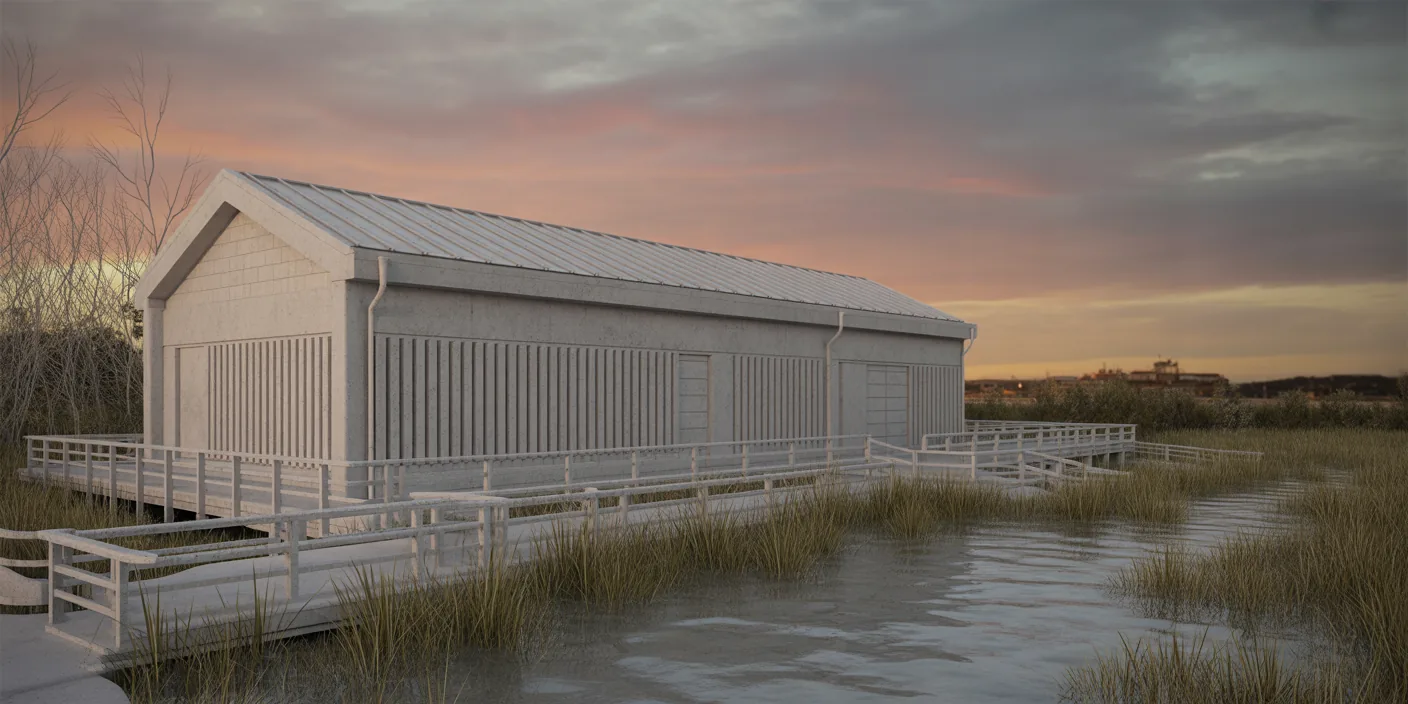
A photorealistic render of a small environmental research station and visitor center elevated on timber piles above a coastal wetland on the Gulf Coast of Louisiana, photographed at sunrise. The building is a simple rectangular form (18m x 9m floor plate, single story) elevated 2.4m above the water surface on pressure-treated cypress timber piles (300mm diameter), with a 3m wide boardwalk wrapping all four facades and continuing as an observation deck over the open water to the east. Structure and cladding: The primary structure is glulam timber portal frames with exposed rafter tails visible at the eave line. The cladding is horizontal cypress weatherboard (150mm width, 18mm thick), left untreated and naturally weathered to a soft silver-gray with remnant amber tones in protected areas under the eaves. The standing seam metal roof (pre-weathered zinc, gray-brown tone) has a low pitch (15 degrees) with deep overhangs (900mm) on all sides for sun and rain protection. A continuous strip of operable louvered vents below the eave (200mm height, pine slats at 45 degrees, white painted) provides passive cooling to the ceiling space. Glazing: The east and west ends of the building are mostly glazed — a combination of operable casement windows (painted white timber frames) and fixed glass panels with a central sliding glass door on the east end opening directly to the observation deck. On the long north and south facades, a series of punched windows (1200mm x 800mm, white painted timber sash) spaced at even intervals. Boardwalk and observation deck: The boardwalk is in ipê hardwood (100mm x 50mm boards, 10mm gaps), grayed with age. The boardwalk railing is a simple system: 2-rail horizontal timber rails (100mm x 50mm, white painted) on 100mm x 100mm turned timber posts at 1800mm spacing. The observation deck extends 4m over the open water, with a built-in bench along the railing and a spotting scope on a stainless steel pedestal. Landscape and wetland: The surrounding landscape is Louisiana coastal marsh — a vast horizontal expanse of spartina grass in warm straw gold (mid-autumn), broken by open water channels reflecting the pink-orange dawn sky. A great blue heron stands motionless on a submerged log 8m from the boardwalk, slightly blurred in the middle ground. Spanish moss hangs from two mature bald cypress trees (approximately 18m tall) to the north, their bases emerging from the water. Floating duckweed in deep green covers the sheltered water under the boardwalk. Sky and sunrise: A dramatic wide Louisiana sky — deep orange and coral directly at the eastern horizon, graduating through dusty pink and warm gray to deep blue overhead. Thin horizontal clouds backlit in orange-gold. The flat wetland landscape creates an enormous sky-to-ground ratio. The water surface reflects the sunrise colors with slight rippling distortion. Camera angle: Three-quarter elevated perspective from the southwest, approximately 20m distance and 3m height (at boardwalk level, as if from a neighboring boardwalk), looking toward the building and the sunrise beyond it. The boardwalk wrap and the observation deck over the water are both visible. Focal length equivalent 35mm. Aspect ratio 16:9. Time of day: 6:45 AM, 20 minutes after sunrise, strong warm orange directional light from the east.

Before & After

Before - original sketch
Before
Elevated Boardwalk Wetland Research Station
After

Elevated cypress timber research station on stilts over Louisiana wetland at sunrise with great blue heron in foreground. Give ArchFine AI a quick sketch of the idea and receive a polished render.

Ideal for ecological and interpretive visitor center projects. Upload site plans or massing studies for coastal context.
Categories: Exterior
Tags: #coastal

Getting Started with This Prompt

1

Grab the Prompt

Tap the copy button above and the entire prompt will be saved to your clipboard, ready to use.

2

Launch Your Renderer

Head over to Archfine AI or any compatible visualization tool you prefer working with.

3

Add Your Design

Drop in your floor plan, elevation sketch, or any reference image - then paste the prompt.

4

Render & Refine

Run the generation and review the output. Swap out a few keywords to explore completely different aesthetics.

Want a faster workflow? Archfine AI lets you skip prompt editing entirely - just upload and render.

How to Get Stronger Renders

1

Describe the Scene

Mention specific materials, time of day, weather, and camera perspective. The more context the AI has, the more realistic the output becomes.

2

Run Multiple Passes

Each generation is unique. Changing even a single adjective can shift the entire mood - so experiment freely and compare outcomes.

3

Blend Prompts Together

Borrow phrases from other entries in our collection and merge them. Hybrid prompts often deliver the most original visuals.

4

Start with a Clean Drawing

Crisp linework and high-contrast sketches give the AI a clear foundation. Blurry or cluttered inputs lead to softer, less defined renders.

Common Questions About This Prompt

Am I allowed to edit or customize this prompt?

Of course. Think of it as a foundation you can build on. Adjust the style, swap materials, change the lighting setup, or rewrite entire sections to fit your specific project needs.

Which rendering platform does this prompt work with?

It has been fine-tuned for Archfine AI, but the descriptive structure translates well to other popular AI visualization engines. You may need minor adjustments depending on the tool.

Does using this prompt cost anything?

Every prompt in our library is completely free. You can copy, adapt, and use them across personal portfolios, client presentations, or commercial marketing materials without restrictions.

What kind of input image gives the best output?

Clean line drawings with strong contrast tend to perform best. The AI reads edges, proportions, and spatial relationships from your input - so a well-drawn elevation or section will consistently outperform a rough napkin sketch.

Can I use the rendered image commercially?

Yes. Renders generated through Archfine AI on any paid plan come with full commercial usage rights. Use them in proposals, publications, social media, or anywhere else your work needs to shine.

Try this prompt yourself

Upload your own sketch and use this prompt to generate a stunning render.

Try on Archfine