Seaside Concrete Bunker Home

Seaside Concrete Bunker Home

Military Adaptive Reuse 23 seconds ArchFine Pro 7 May 2026

Prompt Used

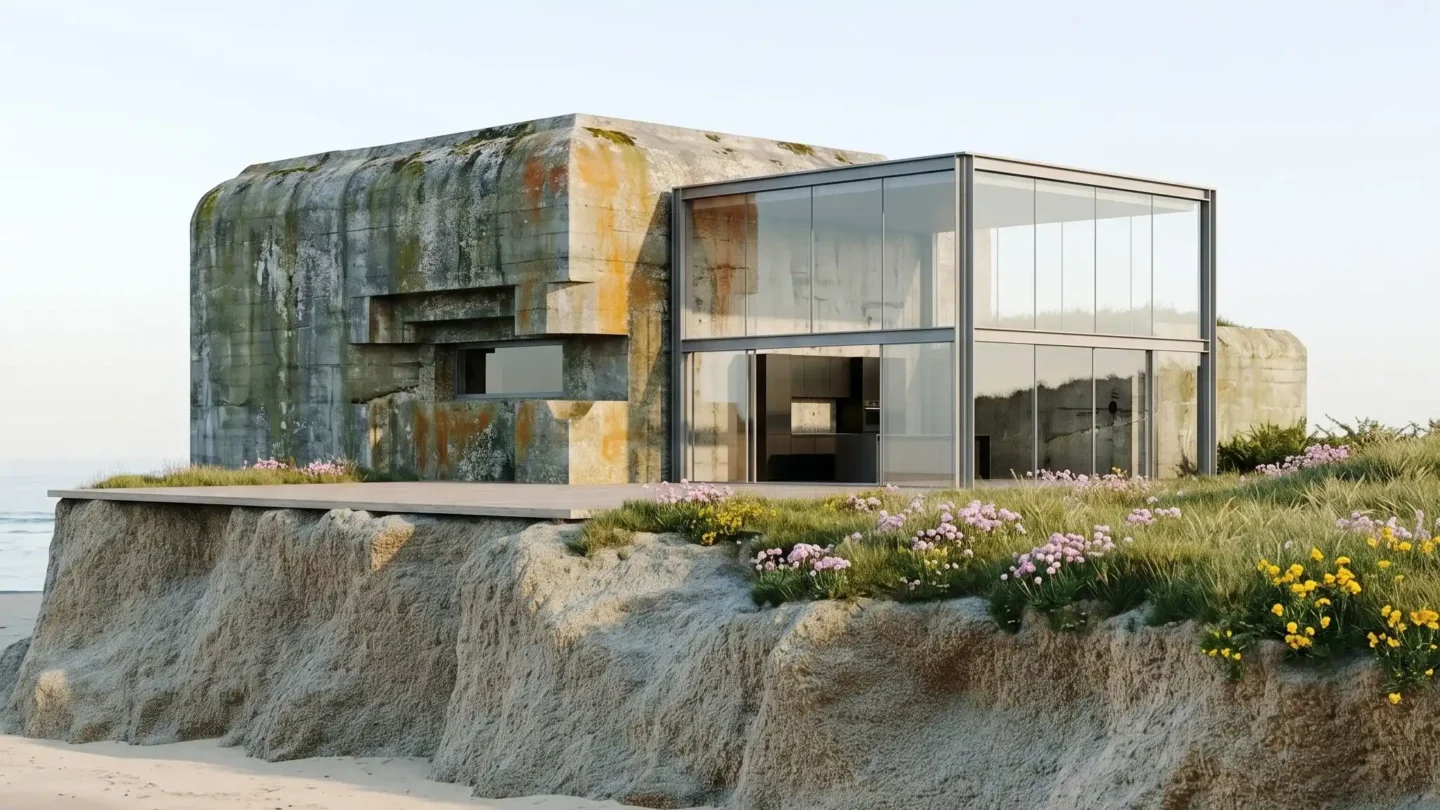
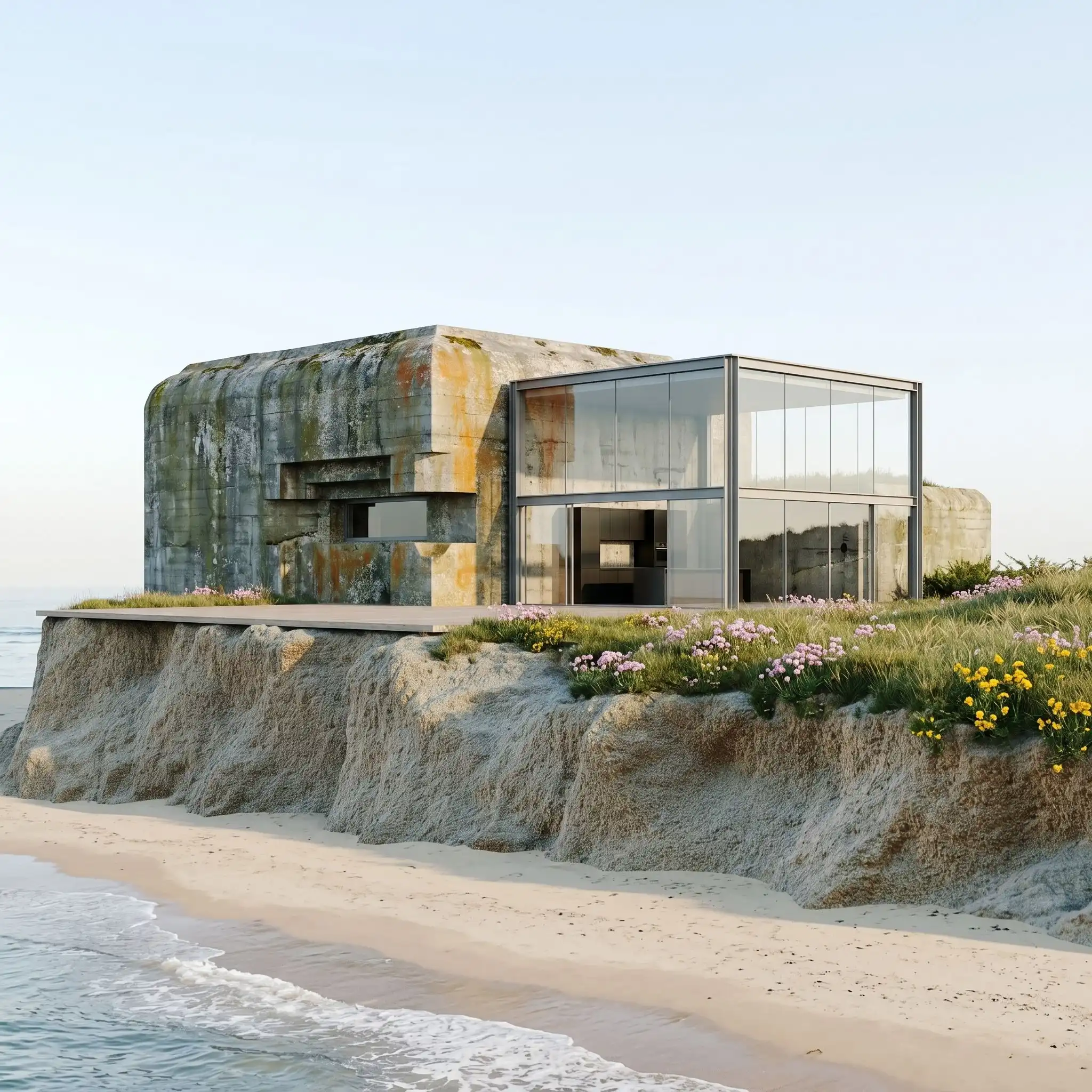
A photorealistic render of a private residence built within and around the concrete structure of a repurposed World War II coastal artillery bunker on the Atlantic coast of Normandy, France, the new house growing organically from the massive existing concrete structure. Existing bunker: The original Type 671 artillery bunker — a monolithic mass of 1943 German Atlantic Wall reinforced concrete (3m-thick walls, the concrete now weathered to a pale gray-green with orange iron staining from the exposed rebar at damaged corners, lichens and mosses colonizing the sheltered faces), the main chamber approximately 12m x 8m with a 3m-thick flat roof. The exterior walls show the history of the war — blast damage scars, shrapnel pitting, the texture of the original formwork boards (100mm wide, rough sawn) still legible in sheltered areas. New additions: Attached to the east face of the bunker, a new lightweight steel and glass living pavilion (8m x 6m, single story, 2.8m flat roof) is bolted directly to the bunker wall — the contrast between the 3m-thick wartime concrete and the 80mm steel sections of the new frame is deliberate and extreme. The pavilion is entirely glazed on three sides (frameless structural glass, floor-to-ceiling) with the bunker wall forming the fourth (west) face — the raw wartime concrete now an interior wall surface, its texture and history fully visible. Interior of pavilion: A minimal open-plan living space — polished concrete floor (seamless, warm gray), a simple kitchen along the bunker wall (black steel cabinetry, white Corian top, the raw concrete above used as a display surface for driftwood, sea glass, and a collection of WWII-era maps in simple clip frames). A daybed in natural linen facing the sea. Through the east glass wall: the Normandy coast — a wide sandy beach, gentle Atlantic swells, the pale horizon. Bunker chamber (main volume): The original chamber has been converted to a library and cinema room — the walls left entirely raw, the concrete surface sandblasted to remove loose material and treated with a colorless consolidant, preserving every crack, patch, and historical mark. A polished concrete floor, a built-in cinema screen on the west wall (retractable into a ceiling slot when not in use), deep leather armchairs in dark cognac, and floor-level lighting (LED strip in the floor perimeter joint, warm amber 2200K) that washes up the raw concrete walls. Landscape: The bunker sits directly on a coastal cliff edge (approximately 10m above the beach), the Atlantic Ocean visible from all sides of the new pavilion and from the bunker's original firing apertures (now glazed with clear fixed glass). Sea grass and wild coastal flowers (sea thrift in pink, yellow bird's-foot trefoil) colonize the thin soil around the structure. Camera angle: Exterior from the beach below looking up at the cliff edge, the massive bunker concrete mass on the left and the lightweight glass pavilion attached to it on the right — the contrast between old and new in full relief. The sea in the foreground. Focal length equivalent 35mm. Aspect ratio 16:9. Time of day: 7:00 AM, June, soft early morning Atlantic light.

Before & After

Before - original sketch
Before
After - AI render
After

Ideal for military heritage adaptive reuse and coastal residential projects. Upload bunker survey drawings or site photographs.
Getting Started with This Prompt

1

Grab the Prompt

Tap the copy button above and the entire prompt will be saved to your clipboard, ready to use.

2

Launch Your Renderer

Head over to Archfine AI or any compatible visualization tool you prefer working with.

3

Add Your Design

Drop in your floor plan, elevation sketch, or any reference image - then paste the prompt.

4

Render & Refine

Run the generation and review the output. Swap out a few keywords to explore completely different aesthetics.

Want a faster workflow? Archfine AI lets you skip prompt editing entirely - just upload and render.

How to Get Stronger Renders

1

Describe the Scene

Mention specific materials, time of day, weather, and camera perspective. The more context the AI has, the more realistic the output becomes.

2

Run Multiple Passes

Each generation is unique. Changing even a single adjective can shift the entire mood - so experiment freely and compare outcomes.

3

Blend Prompts Together

Borrow phrases from other entries in our collection and merge them. Hybrid prompts often deliver the most original visuals.

4

Start with a Clean Drawing

Crisp linework and high-contrast sketches give the AI a clear foundation. Blurry or cluttered inputs lead to softer, less defined renders.

Common Questions About This Prompt

Am I allowed to edit or customize this prompt?

Of course. Think of it as a foundation you can build on. Adjust the style, swap materials, change the lighting setup, or rewrite entire sections to fit your specific project needs.

Which rendering platform does this prompt work with?

It has been fine-tuned for Archfine AI, but the descriptive structure translates well to other popular AI visualization engines. You may need minor adjustments depending on the tool.

Does using this prompt cost anything?

Every prompt in our library is completely free. You can copy, adapt, and use them across personal portfolios, client presentations, or commercial marketing materials without restrictions.

What kind of input image gives the best output?

Clean line drawings with strong contrast tend to perform best. The AI reads edges, proportions, and spatial relationships from your input - so a well-drawn elevation or section will consistently outperform a rough napkin sketch.

Can I use the rendered image commercially?

Yes. Renders generated through Archfine AI on any paid plan come with full commercial usage rights. Use them in proposals, publications, social media, or anywhere else your work needs to shine.

Try this prompt yourself

Upload your own sketch and use this prompt to generate a stunning render.

Try on Archfine