Ideal for primary school and civic courtyard building projects. Upload site plans, floor plans, or massing models.
Brick Masonry School Courtyard
Prompt Used
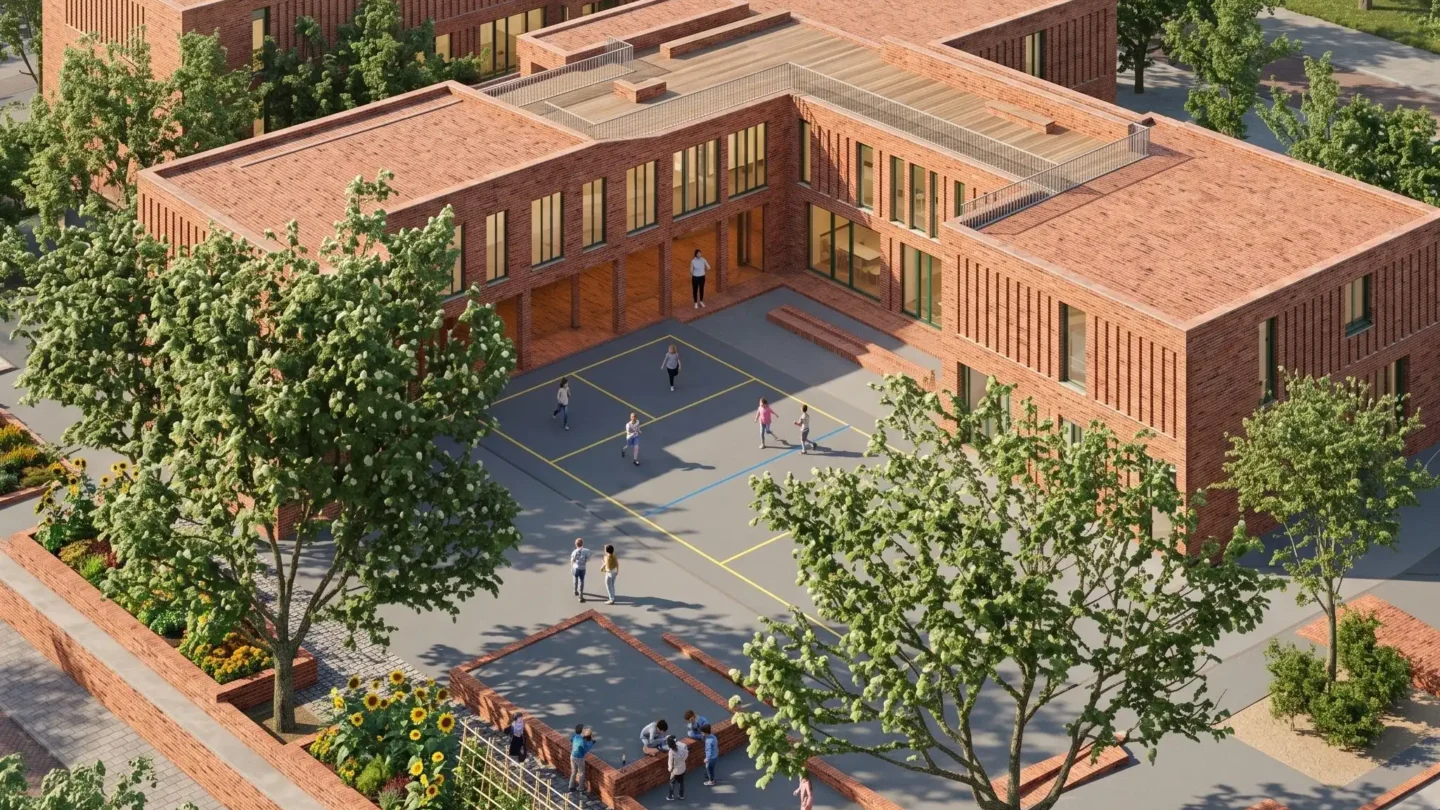
A photorealistic render of the main courtyard of a new primary school in a mid-density residential district of Amsterdam, a courtyard-plan building of approximately 3,200 square meters organized around a central shared outdoor space. The building is three stories on the north and east sides, two stories on the south and west, creating a partially covered outdoor room with varying light conditions throughout the day. Architecture: The entire building is in handmade Dutch brick (Wasserstrich format, 210mm x 52mm x 100mm, warm red-orange with strong kiln variations and occasional darker vitrified faces) laid in a traditional Dutch cross bond with slightly raked mortar joints in pale gray. The three-story north facade facing the courtyard has a series of deep arched loggia openings at ground level (each arch 1800mm span x 3200mm tall, in two-ring brick arch) giving a covered arcade that connects to all ground-floor classrooms. The classroom windows above are large (1600mm x 1800mm, pivot opening, slim painted steel frames in forest green) with deep brick reveals (250mm) that create sun shading and a rich shadow pattern across the facade. Courtyard: The courtyard is approximately 28m x 22m, surfaced in a combination of materials that create informal zones — a central area in poured rubber safety surface (mid-gray with yellow line markings for simple games), a planted zone along the south wall (raised beds in the same brick as the building, containing sunflowers, bean plants on bamboo canes, and marigolds planted by the children), and a hard-paved zone in reclaimed Amsterdam street cobbles (gray granite sett, 100mm x 100mm x 100mm) under a large existing mature horse chestnut tree (approximately 15m spread) retained from the previous site and integrated into the new courtyard as the central natural landmark. Children: Approximately 25 children aged 6-10 visible at play — running, playing with a ball, gathered in small groups, some sitting under the chestnut tree. A teacher supervising from the arcade. The presence of children is essential for scale and life but rendered with appropriate privacy (faces not identifiable). Materials: A single large ceramic tile mural (approximately 6m x 3m, Delft-inspired blue and white, depicting Amsterdam canal scenes and local flora in a contemporary graphic interpretation) is set into the south courtyard wall at child eye height. Sky: A clear Dutch spring afternoon, direct sun from the southwest creating warm light across the courtyard and casting the pattern of the chestnut tree's branching shadow onto the rubber play surface below. Camera angle: From the first-floor corridor window on the south side looking down and across the courtyard toward the north arcade and facade, the children at play in the middle ground, the chestnut tree to the right. Slightly elevated perspective (approximately 4m height). Focal length equivalent 35mm. Aspect ratio 16:9. Time of day: 1:30 PM, early May, bright spring afternoon.
Getting Started with This Prompt
Grab the Prompt
Tap the copy button above and the entire prompt will be saved to your clipboard, ready to use.
Launch Your Renderer
Head over to Archfine AI or any compatible visualization tool you prefer working with.
Add Your Design
Drop in your floor plan, elevation sketch, or any reference image - then paste the prompt.
Render & Refine
Run the generation and review the output. Swap out a few keywords to explore completely different aesthetics.
How to Get Stronger Renders
Describe the Scene
Mention specific materials, time of day, weather, and camera perspective. The more context the AI has, the more realistic the output becomes.
Run Multiple Passes
Each generation is unique. Changing even a single adjective can shift the entire mood - so experiment freely and compare outcomes.
Blend Prompts Together
Borrow phrases from other entries in our collection and merge them. Hybrid prompts often deliver the most original visuals.
Start with a Clean Drawing
Crisp linework and high-contrast sketches give the AI a clear foundation. Blurry or cluttered inputs lead to softer, less defined renders.
Common Questions About This Prompt
Am I allowed to edit or customize this prompt?
Of course. Think of it as a foundation you can build on. Adjust the style, swap materials, change the lighting setup, or rewrite entire sections to fit your specific project needs.
Which rendering platform does this prompt work with?
It has been fine-tuned for Archfine AI, but the descriptive structure translates well to other popular AI visualization engines. You may need minor adjustments depending on the tool.
Does using this prompt cost anything?
Every prompt in our library is completely free. You can copy, adapt, and use them across personal portfolios, client presentations, or commercial marketing materials without restrictions.
What kind of input image gives the best output?
Clean line drawings with strong contrast tend to perform best. The AI reads edges, proportions, and spatial relationships from your input - so a well-drawn elevation or section will consistently outperform a rough napkin sketch.
Can I use the rendered image commercially?
Yes. Renders generated through Archfine AI on any paid plan come with full commercial usage rights. Use them in proposals, publications, social media, or anywhere else your work needs to shine.
Try this prompt yourself
Upload your own sketch and use this prompt to generate a stunning render.
Try on Archfine