
Rooftop Urban Farm
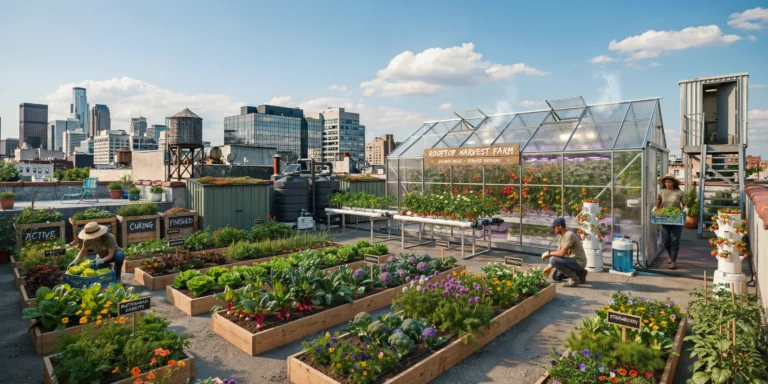
A productive rooftop urban farm occupying the entire roof of a 6-story former industrial building in a dense city center, approximately 1,200 square meters of growing space. The farm is a working commercial operation producing vegetables, herbs, and edible flowers for local restaurants, visible against a backdrop of surrounding urban rooftops, water towers, and downtown skyscrapers. Growing systems: The roof is organized into three primary growing zones. Zone 1 (approximately 500 sqm): Intensive raised bed cultivation — 48 raised timber beds (each 3600mm x 1200mm x 400mm deep, constructed from untreated Douglas fir boards, 50mm thick) arranged in parallel rows with 600mm gravel pathways between them. The beds contain a proprietary lightweight growing medium (compost, perlite, vermiculite, and coir mix) and are planted with a diverse rotation: leafy greens (lettuces in red and green varieties, arugula, spinach, kale — dark lacinato and curly types), root vegetables (rainbow carrots with orange, purple, and white tops visible, radishes, beets with deep red stems), brassicas (compact broccoli heads, purple cauliflower), herbs (basil in large green bushes, cilantro, dill with feathery tops, flat-leaf parsley in dense clumps, flowering chives with purple pompom blossoms), and edible flowers (nasturtiums in orange and yellow cascading over bed edges, marigolds, violas in purple and yellow). The beds are at various stages of growth — some freshly planted with seedlings, others in full production, some recently harvested with bare soil being amended. Zone 2 (approximately 400 sqm): Hydroponic growing system — four NFT (Nutrient Film Technique) channels, each 12m long, constructed from white food-grade PVC channels (100mm x 100mm profile) mounted on galvanized steel A-frame stands at waist height (900mm). The channels hold net pots with growing basil, lettuce, and strawberry plants (runners trailing with white flowers and ripe red fruit). Adjacent to the NFT channels, two vertical growing towers (each approximately 2.5m tall, 400mm diameter, made from stacked white plastic growing pots in a cylindrical arrangement) containing strawberries and herbs, with a nutrient solution reservoir and small circulation pump (visible blue plastic tank, approximately 200 liters) at the base. Zone 3 (approximately 300 sqm): A greenhouse structure (single-span, approximately 12m x 8m x 3.5m to ridge, galvanized steel frame with 6mm twin-wall polycarbonate glazing panels, two roof vents with automatic wax openers) housing warm-season crops — tomato plants (approximately 2m tall, trained on vertical string supports, heavy with ripening fruit in red, yellow, and heirloom varieties), pepper plants (sweet bell and chili varieties), cucumber vines climbing a trellis, and a section of microgreens (24 growing trays on multi-tier stainless steel shelving with LED grow lights, 6500K full-spectrum, in purple-pink hue). Infrastructure: A compact tool and storage shed (approximately 3m x 2.5m, corrugated steel walls, flat roof with a living sedum roof) near the rooftop access stair. A large rainwater collection tank (5000-liter black polyethylene, connected to roof drain downpipes from the greenhouse) with a solar-powered drip irrigation controller (small solar panel, approximately 300mm x 500mm, on the tank frame) managing timed watering to all beds via black poly drip lines (visible running along each bed). A composting station (three-bin system, constructed from recycled pallet wood, bins labeled Active, Curing, and Finished in hand-painted white lettering) near the shed. Workers: Three to four farm workers in action — one kneeling at a raised bed harvesting lettuce into a plastic crate, one checking the hydroponic channels and adjusting flow rates, one carrying a full harvest crate toward the rooftop access stairway (a simple industrial steel-and-concrete stair tower with a metal door, propped open), and one in the greenhouse tying tomato plants to their support strings. Workers wear casual farm clothing — work gloves, sun hats, rubber boots, and branded t-shirts with the farm's logo. Urban context: The surrounding rooftops are visible at various heights — typical urban roofs with AC units, elevator machine rooms, water tanks (old wooden barrel type on steel frames), and satellite dishes. In the middle distance, taller commercial buildings (10-15 stories) with glass curtain walls, and on the horizon, the city's downtown skyline with recognizable but generic skyscrapers. A neighboring building's rooftop has a small unauthorized garden (a few pots, a lawn chair) visible as a poignant contrast to the productive farm operation. Signage: A hand-painted wooden sign (approximately 1200mm x 400mm, white text on forest green background, simple serif font) mounted on the greenhouse reads the farm's name and tagline. Smaller chalkboard labels (200mm x 100mm, on wooden stakes) identify crops in each raised bed. Sky and light: Late afternoon summer sun (approximately 5 PM in July) casting long warm shadows across the growing beds from west to east. The light is intense and golden, with strong contrast between sunlit and shaded areas. The leafy greens glow translucently in the backlight. A few fair-weather cumulus clouds punctuate a deep blue summer sky. A slight heat shimmer is visible above the greenhouse polycarbonate roof. Camera angle: Elevated perspective from the top of the stair tower (approximately 2m above main roof level), looking east across the full extent of the farm. The raised beds fill the foreground and middle ground in receding perspective lines, the hydroponic towers and greenhouse occupy the middle-right, the city skyline forms the backdrop. The golden late-afternoon light rakes across the scene from the left. Focal length equivalent 24mm wide-angle. Full depth of field from nearest raised bed to distant skyline. Aspect ratio 16:9.